Kristi Noem Ousted as Homeland Security Chief.
Discover the latest on Kristi Noem’s unexpected departure as Homeland Security Chief and the implications for South Dakota’s leadership.

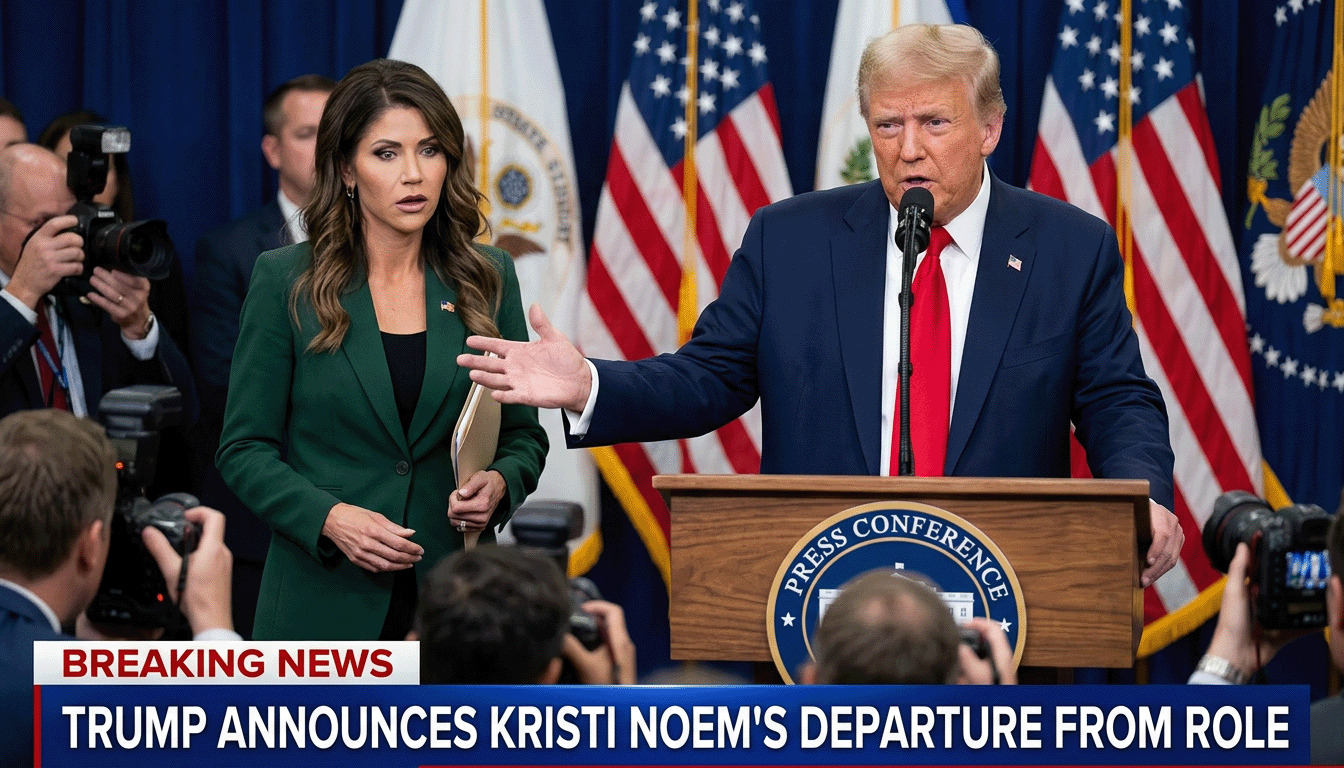
President Donald Trump fired Kristi Noem on Thursday. This move ended her tumultuous time at the Department of Homeland Security. The decision came after intense questioning on Capitol Hill.
In a social media post, Trump announced Oklahoma Sen. Markwayne Mullin as his new pick for DHS. This change is significant for those who closely follow politics. It shows a push for more stable management in areas like immigration and disaster response.
Noem’s departure marks a big change for a conservative leader once key to the administration’s deportation plans. Critics pointed to DHS spending and her actions after the Minneapolis shootings. These issues were highlighted in recent reporting on the shake-up.
This is also a significant moment in the Trump White House. Kristi Noem is the first Cabinet secretary to leave during Trump’s second term. Now, the Senate will review Mullin’s nomination, testing party unity and the administration’s stance on border security.
Kristi Noem Fired Key Takeaways
- Kristi Noem was fired as DHS secretary after mounting criticism of her leadership.
- Trump said he will nominate the Republican party Sen. Markwayne Mullin to replace her.
- The decision followed intense questioning from lawmakers in both parties.
- Immigration enforcement and disaster response were central to the dispute.
- Spending scrutiny and the Minneapolis shootings added political pressure.
- Noem is the first Cabinet-level departure in Trump’s second term.
Why President Trump Fired Homeland Security Secretary Kristi Noem
Kristi Noem’s job was on the line in a whirlwind of Washington politics. She went from defending her record to losing her job in just days. This move hit the Republican Party hard, as it was already divided over enforcement policies.
For many conservatives, this episode tested whether tough talk could lead to real results. It was a big test for the party.
Trump’s announcement and timing in Washington
President Donald Trump announced the change on social media. He said he would nominate Sen. Markwayne Mullin of Oklahoma for the job. This came after two tense days of Capitol Hill testimony.
The timing was key, showing how fast a public hearing can change a decision.
The news spread fast across national outlets. Lawmakers were trying to guess what the White House would do next. Reports on Noem’s ouster, including the nomination plan, were everywhere.
One account of the move and its immediate backdrop appeared in reports on Noem’s ouster. The story quickly moved from rumor to official action.
Key controversies: immigration crackdown, disaster response, and spending scrutiny
A major dispute centered on a $220 million DHS ad campaign. It featured Governor Noem urging people in the U.S. illegally to leave. She said Trump knew about it in advance.
Trump later said he didn’t know, adding to the argument over who approved it.
Spending questions were also a big deal. Lawmakers wanted to know how DHS used funds Congress had already given. FEMA delays after major disasters also caused frustration. Conservatives were more concerned about service reliability than slogans.
Minneapolis shootings and the political fallout
The Minneapolis incident was a major flashpoint. Immigration officers shot and killed two protesters, Renee Good and Alex Pretti. Noem initially said both were aggressors, but videos showed a different story.
She didn’t apologize or change her story during testimony. This backlash changed the politics around enforcement tactics, hitting the Upper Midwest hard.
It also split the Republican Party. Some members wanted aggressive action, while others worried about public trust and the next election.
Shutdown pressure and behind-the-scenes signals in Congress
The DHS funding fight intensified during a 20-day shutdown. Many employees were working without pay. Negotiators were trying to reopen the agency while debating immigration tactics.
The stalemate made leadership a key target. Senate Republicans told Democrats that Kristi Noem was likely to be fired, according to insiders. Democrats said this was no real concession, as she was already a liability.
Separate reporting on the conflict, including impeachment talk, circulated alongside the staffing drama in coverage of the impeachment push.
The White House was pushing DHS to speed up deportations. They wanted clearer benchmarks and higher arrest targets. This framed the leadership debate as one of output, not just words. The operational strain, including detention space limits, was outlined in reporting on deportation targets, as Noem’s tenure faced more scrutiny.
Kristi Noem: From South Dakota Governor to DHS Leader Under Fire
In Washington, Kristi Noem quickly moved from state politics to a national spotlight. Her years as South Dakota governor showed her blunt messaging and strong party ties. At DHS, her leadership style faced sharp scrutiny because the stakes were high and cameras were always rolling.
Background and political profile
Noem’s rise was tied to President Trump’s orbit. Her public profile grew as her responsibilities expanded. Supporters saw her accomplishments as aligning with the administration’s priorities, like enforcement and border policy. Critics, though, said her approach blurred the line between governing and campaigning.
Her time at DHS also brought attention to spending and oversight. Reporting on her removal showed a mix of policy fights and optics battles. This included disputes over major DHS outlays and public-facing promotions, as detailed in this account of the fallout.
Leadership style and made-for-social-media enforcement operations
As DHS chief, Kristi Noem was linked to high-profile immigration actions that played well online. Several operations were staged with strong visuals and quick video turnarounds. She sometimes joined officers in the field, turning routine enforcement into moments built for sharing.
Border Patrol official Gregory Bovino, elevated under her watch, became a key figure in city crackdowns. These actions often led to street clashes and viral footage, which then fed new rounds of pressure on department leadership. The combination of arrest scenes, protest response, and political messaging kept her tenure in constant churn.
Supporters vs. critics react to her ouster
Reaction to her removal split along familiar lines. Minneapolis Mayor Jacob Frey posted “good riddance,” and Senate Democratic Leader Chuck Schumer echoed that tone. Vanessa Cárdenas of America’s Voice argued the change was not real accountability, calling it a reshuffling tied to Trump’s agenda.
On the other side, Gregory Bovino praised her as a standout leader and “the ultimate patriot.” The split response underscored that her biography now carries two competing storylines: accomplishments claimed by allies and lasting anger among opponents who saw her DHS tenure as harsh and provocative.
Trump’s parting message and Noem’s next role
Even as he replaced her, Trump praised Kristi Noem in public and credited her work on the border. He said she would move into a new post as special envoy for the Shield of the Americas, a Western Hemisphere security initiative. Details about the staffing change and the pick to replace her were outlined in coverage of the transition.
Noem later thanked Trump online and pointed to what she called historic accomplishments at DHS. The handoff to Markwayne Mullin, set to begin March 31, lands as DHS faces tight funding fights and heightened attention on enforcement outcomes. Her next chapter keeps her close to the administration’s security agenda, while her leadership record remains a flashpoint back home and in Washington.
Kristi Noem Fired Conclusion
Kristi Noem’s firing shows how quickly things can change in today’s politics. Big decisions on immigration and tight budgets can shift the story in a week. For the republican party, it’s a lesson that a conservative message must face tough questions about results.
The White House is moving fast, aiming to replace Noem with Sen. Markwayne Mullin. Press secretary Karoline Leavitt says the administration wants the Senate to confirm him quickly. Mullin’s early choices will show what kind of leadership is next.
Noem’s departure leaves many disputes behind. Lawmakers criticized her over a $220 million ad campaign and slow FEMA funding, as reported in coverage of FEMA and staffing cuts. The political fallout grew after the Minneapolis shooting deaths of Renee Good and Alex Pretti, putting more pressure on the department.
DHS also faced a 20-day shutdown and new debates over enforcement tactics. Noem’s push for security, including an ICE arrest tied to a threat letter, sparked a big debate. Her comments on executive power and due process, analyzed in the analysis of her DHS remarks, raised more questions. The next phase for a conservative administration will depend on balancing enforcement, disaster response, and the Constitution without new controversy.