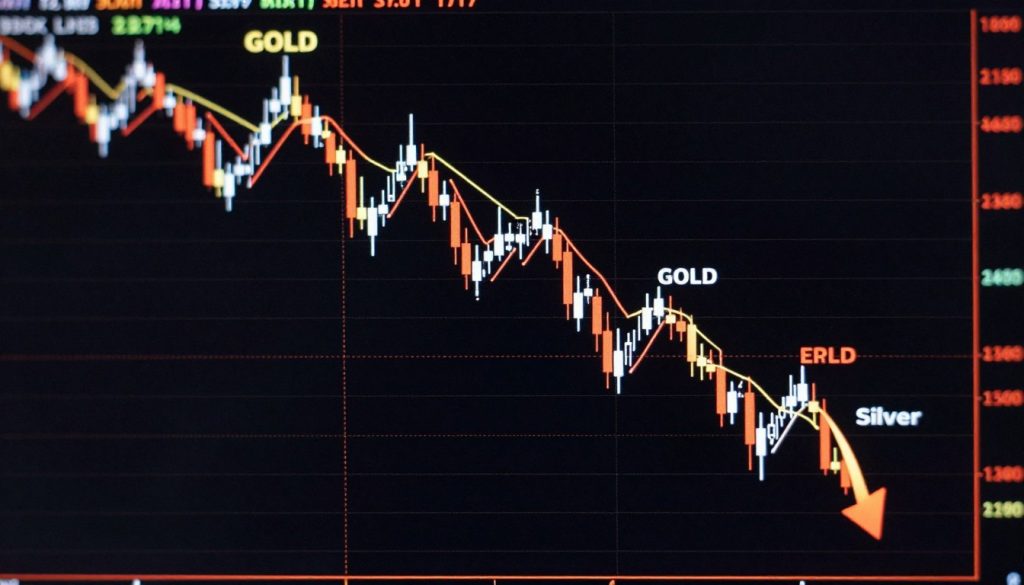
Discover why Gold and Silver prices are dipping as the U.S. dollar shows renewed strength. Stay updated on the latest precious metals market trends.
Gold and Silver prices quickly dropped after hitting record highs. This illustrates how quickly precious metals can fluctuate. The price fall affected markets and shook short-term trader confidence.
Gold fell by over 12% and went below $5,000 per ounce. This was the biggest drop in decades. Silver fell even more, dropping by as much as 36% in a single day.
The U.S. dollar’s sharp rise also contributed. A stronger dollar makes gold and silver more expensive for buyers outside the U.S. For more on the day’s wild trading, see this the $7 trillion wipeout was seen as a liquidity event more than a fundamental shock.
Despite the shock, there’s a story of resilience too. Many updates showed strong monthly gains. This highlights the unusual volatility in Gold and Silver. Investors are now wondering whether prices can stabilize near key psychological levels, such as $5,000 for gold and $100 for silver.
In the short term, traders might look beyond a simple bounce. They might focus on calmer trading conditions, which often signal better liquidity. Silver’s drop was steeper because it trades more thinly and with greater leverage. This means it can gap when risk limits kick in. For anyone tracking precious metals, the lesson is clear: the gold and silver prices can look stable until a wave of selling hits all at once.
Gold and Silver FAQ
What caused gold and silver to drop so sharply after hitting record highs?
Gold and silver saw a sudden drop after a strong rally. The U.S. dollar’s rise was a key factor. News about a new Federal Reserve chair nominee also played a role, affecting rate expectations and the dollar’s strength.
How big was the move in the gold and silver prices during the selloff?
Gold plummeted by more than 12% and fell below $5,000 per ounce. This was its biggest drop in decades. Silver saw an even larger decline, dropping by up to 36%.
Why does a stronger U.S. dollar hurt gold and silver?
When the dollar rises, gold and silver become more expensive for buyers. This weakens demand from overseas. It can also weigh on their prices, even if they’re good investments in the long run.
What role did Kevin Warsh’s Fed chair nomination play in the reversal?
Traders saw Warsh as tough on inflation. This made them expect a stronger dollar. State Street’s Aakash Doshi said this was good for the dollar but bad for precious metals. Month-end rebalancing also added to the selloff.
Did profit-taking accelerate the selloff in precious metals?
Yes. Investors took profits after silver’s 42% monthly gain. This, along with speculative positions, fueled the selloff.
How did options trading and a gamma squeeze intensify the drop?
Call option buying pushed prices up. But when prices fell, hedging flows turned against them. This added to the decline, as dealers rebalanced.
Which option levels were traders watching in gold markets?
Traders watched SPDR Gold Shares (GLD) at $465 and $455. On Comex, big options were around $5,300, $5,200, and $5,100. These levels affect gold and silver prices.
Why can gold and silver markets move so violently during periods like this?
High prices and volatility strain risk models and balance sheets. This can lead to sudden selling and extreme price moves.
If prices fell so hard, were gold and silver up for the month?
Yes. Despite the sharp drop, both metals showed strong monthly gains. Gold was up about 13%, and silver was up about 19%.
What happened to other metals like copper, platinum, and palladium?
The selloff hit the whole metals complex. Copper fell 3.4% in London. Platinum and palladium also saw big drops.
Did mining stocks fall along with gold and silver bullion?
Yes. Shares of major producers like Newmont Corp., Barrick Mining Corp., and Agnico Eagle Mines Ltd. fell over 10% in New York trading.
What technical signals warned that gold and silver could correct?
Overbought conditions were a warning sign. Bloomberg noted that gold’s RSI reached 90, a level not seen in decades.
Why are $5,000 for gold and $100 for silver seen as key levels?
These levels are key for short-term trading. Heraeus Precious Metals’ Dominik Sperzel said volatility was extreme and that these levels had been broken, leading to a volatile market.
What support level is the market watching for silver right now?
Spot silver around $99.77 is a key level. If the dollar strengthens, silver might test or break this area.
How do ETFs affect the gold and silver markets during sharp swings?
ETFs can intensify flows in sharp moves. Bloomberg noted GLD’s large options positions can fuel buying or selling.
What does the silver/gold ratio signal during periods of high volatility?
The ratio shows whether silver is outperforming or underperforming gold. Bloomberg’s Simon White said the ratio’s sharp move could mark a turning point.
Is now a “buy gold and silver” moment for investors?
It depends on your goals and risk tolerance. Some buy during pullbacks, while others wait for clearer signals.
What are common ways investors get exposure to gold and silver?
Investors can buy physical items like gold and silver coins and gold and silver bullion. They can also use exchange-traded products and futures. Some prefer tangible items, such as gold and silver jewelry.
What should investors keep in mind when investing in gold and silver after a move like this?
Risk controls are key when prices swing around key levels. Focus on position sizing, liquidity, and patience. Consolidation often follows extreme rallies and reversals.
Mr Cooper is a financial expert and Stock Trader, he has a masters in finance and business and is a Contributor and Author for Network World News and other news outlets.
To provide the best experiences, we use technologies like cookies to store and/or access device information. Consenting to these technologies will allow us to process data such as browsing behavior or unique IDs on this site. Not consenting or withdrawing consent, may adversely affect certain features and functions.
Functional
Always active
The technical storage or access is strictly necessary for the legitimate purpose of enabling the use of a specific service explicitly requested by the subscriber or user, or for the sole purpose of carrying out the transmission of a communication over an electronic communications network.
Preferences
The technical storage or access is necessary for the legitimate purpose of storing preferences that are not requested by the subscriber or user.
Statistics
The technical storage or access that is used exclusively for statistical purposes.The technical storage or access that is used exclusively for anonymous statistical purposes. Without a subpoena, voluntary compliance on the part of your Internet Service Provider, or additional records from a third party, information stored or retrieved for this purpose alone cannot usually be used to identify you.
Marketing
The technical storage or access is required to create user profiles to send advertising, or to track the user on a website or across several websites for similar marketing purposes.