Minimum Wage Increase Effective January 1st, 2026: What you need to know
Discover the key details on the Minimum Wage Increase set for January 1st, 2026, and understand its potential impacts on workers and businesses.

Minimum Wage Increase
A pay raise is coming for millions of workers. Starting January 1, 2026, 19 states and 49 cities and counties will see a Minimum Wage Increase. This comes as grocery, rent, and electricity bills keep rising.
Yannet Lathrop of the National Employment Law Project says many paychecks don’t cover basic needs. For more on where and when wages will increase, check out this national overview.
By the end of 2026, 22 states and 66 cities and counties will have raised their minimum wage. Some places will even reach $17 an hour. Denver will have a citywide rate of $19.29, higher than Colorado’s $15.16.
New York City will hit $17, Arizona will go to $15.15, Nebraska to $15, Missouri to $15, and New Jersey will lift long-term care workers to $18.92. Florida will also adjust its wage to $15 on September 30, 2026.
Local rules play a significant role. For example, in Novato, California, wages vary by employer size. Everett and Renton, Washington, also tie wages to business size. Tip credits and service charges can affect how much workers take home, adding to the debate.
About 26 million workers earn less than $17 an hour, says the Economic Policy Institute. Yet, 20 states are stuck at $7.25, the federal minimum, unchanged for 17 years. These gaps drive the push for higher wages and raise questions about fairness and enforcement.
As the year goes on, we’ll see how these changes affect the country. This includes other national shifts in budgets and public services. It helps understand the benefits of higher minimum wages in the bigger picture, as seen in this recent report.
Minimum Wage Increase Key Takeaways
- Wages rise on January 1, 2026, in 19 states and 49 cities and counties, with more increases later in the year.
- Many jurisdictions surpass $15 per hour, and several cross $17, including Denver and New York City.
- States like Arizona, Nebraska, Missouri, and New Jersey post notable gains for hourly and care workers.
- Local rules vary: employer size and tipped status can change the applicable pay floor.
- About 26 million workers earn under $17, while 20 states are set at $7.25, the federal minimum wage.
- Midyear and September adjustments—such as Florida’s $15 on September 30, 2026—extend the timeline.
- The minimum wage debate centers on the cost of living, equity, and the benefits of increasing the minimum wage for families.
What changes on January 1, 2026, across states, cities, and counties
The new year brings a significant minimum wage increase across the country. Many places have their own rules to raise wages because living costs are higher. This shows how minimum wage legislation is being used at different levels and how it affects budgets and jobs.
Who is getting a raise: scope of workers affected
Millions of hourly workers will get a pay increase on January 1. The most significant changes will be in states and cities that tie wages to inflation or set higher floors. Workers in retail, food service, home care, and logistics will be most affected, as these sectors rely on hourly workers.
Experts say these changes aim to close the gap between what people earn and what they need to live. According to policy trackers and state labor departments, this change is nationwide, even though the rules are local. For more information, see this overview of 2026 wage changes.
Where wages are rising: 19 states and 49 cities and counties to start the year
Nineteen states and 49 cities and counties will start the year with higher minimum wages. Washington will have a salary of $17.13, New York $17.00 in metro areas, and California $16.90. Connecticut will be at $16.94.
- Colorado will be at $15.16; Maine at $15.10; Rhode Island at $16.00.
- New Jersey will have a general floor of $15.92, with sector rules that can set a higher floor.
- States like Virginia ($12.77) and Ohio ($11.00) also adjust, with local add-ons in several metros.
These changes show the ongoing minimum-wage legislation and the real impacts of raising the minimum wage as cities deal with local costs.
Examples of local wage floors exceeding state minimums
Local rules often go beyond state minimums. Denver’s city rate of $19.29 is higher than Colorado’s $15.16. New York City’s $17 is more than upstate’s $16. In Arizona, the statewide step to $15.15 coexists with higher city targets in places that use cost-of-living formulas.
Employer-size tiers also matter. Novato, California, sets $17.73 for 100+ workers, $17.46 for 26–99 workers, and $16.90 for 25 or fewer workers. Everett and Renton, Washington, apply business-size standards that shape timing and amount. For a comprehensive state list and city snapshots, see this concise guide to state minimum wage rates.
These local policies aim to raise the minimum wage above a single statewide level. They aim to match housing, transit, and food costs while considering the employer-side impacts of raising minimum wage.
Scheduled increases later in 2026, including mid‑year and September adjustments
Some places will update wages mid-year on July 1. Florida will raise its wage to $15.00 on September 30, 2026. Several places plan to make two adjustments within the year for certain worker groups, and many maintain separate rules for tipped employees.
This staggered calendar shows how minimum wage legislation varies across places and over time. It also highlights how a steady, gradual minimum wage increase can phase in costs for employers while increasing workers’ take-home pay. This demonstrates the real-world impacts of raising minimum wage across sectors that rely on hourly labor.
Minimum Wage Increase: legislation, local variations, and economic impacts
Across the country, cities and states are raising the minimum wage faster than the federal government. They do this because of higher living costs and tight labor markets. Policymakers see this as a way to be fair and send a strong economic signal.
What does this mean for employers and workers? Raising the minimum wage affects how much employers pay and how much workers take home. It also changes how pay is calculated in some places.
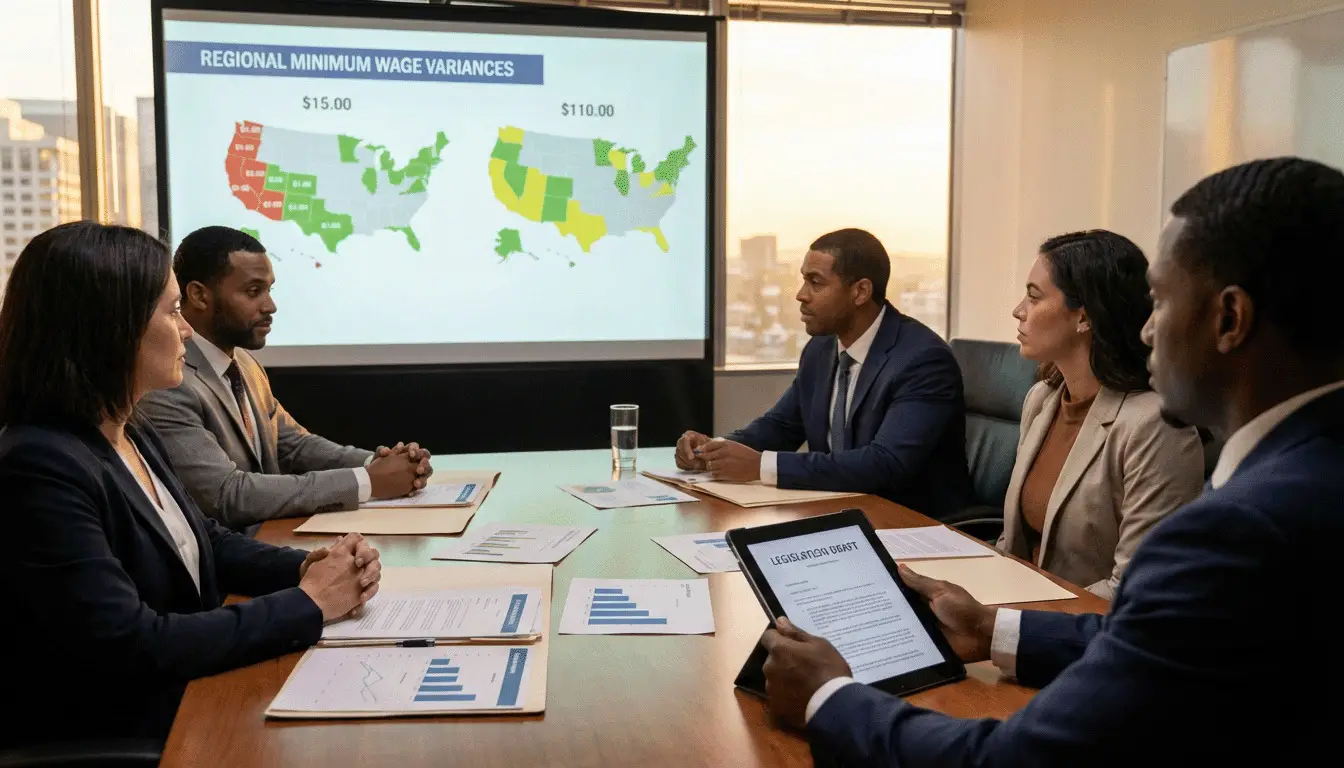
Minimum wage legislation trends and the push to raise minimum wage
States and cities have raised the minimum wage because the federal rate hasn’t changed in 13 years. They use inflation to increase wages over time. Advocates say this boosts consumer spending and reduces turnover.
Employers plan their staffing and automation in response to these changes. Some places update wages annually, while others do it every year.
For a clear look at pay rules, check out this overview of minimum wage standards. It shows how indexing and special categories work.
City spotlights: Denver’s $19.29, New York City’s $17, Arizona’s $15.15, and Missouri’s $15
Local wages are rising. Denver will have a minimum wage of $19.29, higher than the state rate. New York City’s wage will be $17, reflecting its high costs. Arizona and Missouri will both have a minimum wage of $15.
These changes benefit millions of workers across industries. They can lead to higher earnings, changes in work schedules, or changes in benefits.
Employer-size tiers in places like Novato, CA; business-size rules in Everett and Renton, WA
Local rules add complexity. Novato, California, has different wages for small and large businesses; Everett and Renton, Washington, base wages on business size.
This means managers must track different rules. Workers may see other benefits based on their workplace size, even in the same city.
Timing differences: July 1 and Sept. 30 increases (including Florida’s $15 on Sept. 30, 2026)
Not all wage increases happen on January 1. Some places update wages on July 1. Florida will reach $15.00 on September 30, 2026, affecting many sectors.
Employers plan price changes and staffing ahead of these dates. Workers consider these changes when budgeting for living expenses. Communities feel the overall impact on spending and on small businesses.
Minimum Wage Increase Conclusion
The Minimum Wage Increase on January 1, 2026, is a significant change. Nineteen states, 49 cities, and 49 counties will see higher wages at the start of the year. Then, more places will raise their minimum wage in mid-year, and Florida will do it on September 30.
By December, 22 states, 66 cities, and 66 counties will have higher wages. Many will be at or above $15, with some reaching $17. Denver will have the highest wage at $19.29, and New York City will be at $17. Arizona, Missouri, Nebraska, and New Jersey will also have higher salaries.
These changes will affect millions who have seen their costs go up but not their pay. The federal minimum wage has been $7.25 for 17 years.
Local rules are essential too. Some places, like Novato, California, use employer size to set wages. Others, like Everett and Renton, Washington, use business size. Many cities also keep different rules for tips.
These rules affect how employers pay and how workers see their paychecks. Studies show that wages may be compressed and that pay structures may change. For more on this, see this analysis on minimum wage impacts.
For employers, this is a chance to update their pay practices. They can use clear communication, market benchmarking, and total rewards to keep their staff. For workers, these raises are a big help, as 26 million earn under $17 an hour.
The debate over the minimum wage will continue. Businesses will have to balance costs, prices, and fair pay with good service. It’s a big challenge.
It’s essential to stay updated. Rules and standards will keep changing. Keeping track of these changes will help businesses plan and workers know their rights. These efforts to raise the minimum wage will have a significant impact on the economy for years to come.