Yale Scholar Critiques Trump in Revealing New Book
Explore the critical insights of a Yale scholar on Trump’s presidency in this thought-provoking new book, dissecting political and historical impacts.
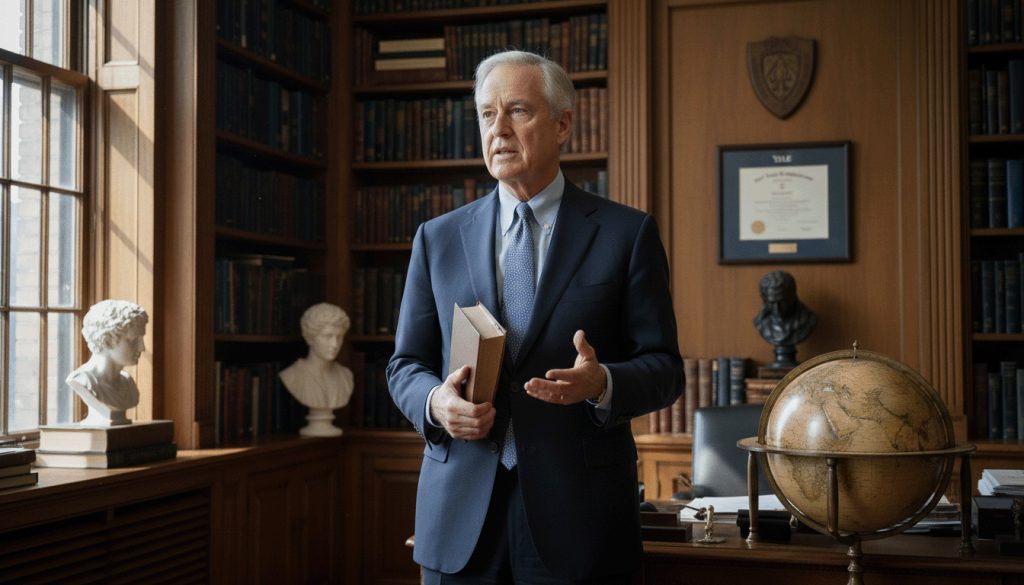
A Yale scholar, Jeffrey Sonnenfeld, is looking at President Donald Trump in a new light. He says Trump’s seeming chaos is not just random. Instead, it’s a strategy, according to Sonnenfeld’s new book.
Sonnenfeld shared his ideas on the Raging Moderates podcast with Scott Galloway and Jessica Tarlov. He believes Trump’s public turmoil is not a sign of weakness. Instead, it’s a way to get ahead by being fast, loud, and in control.
Sonnenfeld calls Trump “dumb as a fox” but also very street-smart. He warns business leaders not to underestimate Trump. Sonnenfeld’s views are unique because they come from both his academic work and personal experiences.
The book’s early chapters explore how attention, loyalty, and conflict can be used to gain power. For more background on Trump, check out his biography. Then, dive into Sonnenfeld’s book for a fresh perspective on Trump’s tactics.
Key Takeaways
- A Yale scholar says Trump’s chaos is often a calculated strategy.
- Jeffrey Sonnenfeld previewed his book’s thesis on the Raging Moderates podcast.
- He argues that Trump is underestimated, even by business leaders.
- Sonnenfeld calls Trump “dumb as a fox” with strong street savvy.
- The book combines leadership research with political commentary, tied to current events.
- The section establishes a book review focused on how power is maintained, not merely won.
What Jeffrey Sonnenfeld’s New Book Says About Trump’s Grip on Power
Jeffrey Sonnenfeld views power as a pattern, not just a feeling. He regards Donald Trump’s public battles as indicators to track and analyze. This approach puts his book at the center of a critique of the Trump administration, while also drawing on presidential history.
In the same political climate, court battles also shape the story. A recent example is Chief Justice John Roberts pushing back against impeachment talk targeting Judge James E. Boasberg. This demonstrates the importance of institutional rules. The episode, discussed in coverage of judicial independence, echoes Sonnenfeld’s interest in how conflict can be used to pressure other branches.
From the Raging Moderates podcast to the page: the core thesis of Trump’s Ten Commandments
Sonnenfeld first tested parts of his framework in the Raging Moderates podcast with Scott Galloway and Jessica Tarlov. The book expands that talk into a tighter playbook, written for readers who want a scholarly perspective without the jargon. It’s less about gossip and more about repeat behaviors that show up across cycles of presidential history.
- How attention gets captured and held, even during bad headlines
- How opponents get pulled into fights on Trump’s terms
- How loyalty cues are broadcast to allies and rivals at once
Why Sonnenfeld argues Trump’s chaos is a calculated strategy, not incompetence
One of Sonnenfeld’s main claims is that volatility can be a tool. He argues that the mess often functions like a system: it moves the news agenda, forces rushed responses, and blurs accountability. For readers used to a standard trump administration critique, this lens asks a tougher question: what if the “disorder” is partly designed?
That view also connects to ongoing narratives about power and suspicion in politics. A parallel thread appears in deep-state conspiracy reporting, where competing storylines vie for control of the same facts. Sonnenfeld’s method focuses on how those storylines spread, rather than on whether they are polite or impolite.
“Dumb as a fox”: the scholarly perspective on Trump’s street savvy and leadership tactics
Sonnenfeld rejects the easy “incompetence” label with a blunt line. He writes that appearances can be misleading because performance and skill are not the same.
“Just because Trump often appears convincingly ignorant doesn’t mean he’s stupid,” Sonnenfeld writes. “He’s dumb as a fox. He has incredible street savvy.”
From a scholarly perspective, that quote serves as a warning against underreading the tactics. The book invites academic analysis of persuasion, incentives, and media feedback loops, instead of treating every outburst as random noise.
Why Sonnenfeld says business leaders underestimate Trump “at their peril.”
Sonnenfeld argues that many CEOs misjudge Trump because they judge him by boardroom habits. He warns they do so “at their peril,” as Trump’s tactics can succeed even when they look messy. The point is not admiration; it’s risk literacy, grounded in presidential history and the reality that institutions respond to pressure.
He also adds a caution he has raised with Fortune: even “foxes can get outfoxed.” Myths and scientific studies across centuries and cultures show that clever actors can be trapped by overconfidence. In Sonnenfeld’s academic analysis, that’s the opening for rivals, regulators, and voters who prepare instead of assuming the chaos will burn out on its own.
Yale scholar Critiques Trump in new Book
The phrase “Yale scholar trashes Trump in new book” fits the tone Jeffrey Sonnenfeld sets: sharp, specific, and designed to persuade. This book review approach is important because the author is not merely reacting to headlines. He is mapping behavior, and he wants readers to see how power gets held and expanded.
Who Sonnenfeld is: longtime Yale leadership scholar, Fortune contributor, and CEO convener
Sonnenfeld is a longtime leadership scholar with long stints at Harvard and Yale, and he is also a regular contributor to Fortune. Through the Yale Chief Executive Leadership Institute, he has convened leading CEOs for discussions on civic engagement. That mix of campus research and boardroom access shapes the way he frames political commentary.
How his personal history with Trump shapes the academic analysis and political commentary
He says he has known Donald Trump for years, predicted early that Trump would run, and spoke with him in dozens of in-person conversations and calls. Sonnenfeld also claims Trump “often checked in” during the first campaign, even while knowing Sonnenfeld supported Hillary Clinton. In Sonnenfeld’s telling, that closeness gives his political commentary a firsthand perspective rather than a distant reading.
Readers can see that lens in reporting that tracks his arguments about strategy and attention management, including this wall-of-sound breakdown. It’s presented less like gossip and more like a field guide to influence.
What makes this book different from typical Trump administration critiques and presidential history titles
Sonnenfeld challenges the crowded Trump-book market. He argues many titles either whisper the gossip of disenchanted insiders or recycle a familiar presidential-history lament. That stance also fuels debate about whether he is a controversial author, as he attacks not only Trump but the way elite observers explain him.
In that sense, the book review question is not “How shocking is it?” but “How useful is it?” He wants the reader to treat the material like a set of working tools, not a recap of old fights.
“Actionable insight” claim: decoding patterns to anticipate Trump’s next moves
His key pitch is “actionable insight”: decoding what appears to be madness to reveal repeatable patterns, based on a quarter-century of studying Trump’s leadership strategies. He also argues that business leaders can blunt Trump’s momentum if they act together, calling collective pressure “how you take down a bully.” He cites the corporate exodus after the 2017 Charlottesville protests as evidence that unified resistance can have an effect.
That claim lands differently for readers who follow election coverage and corporate news side by side, amid debates such as online chatter about Trump being the new president. It’s a reminder that this is not just a biography; it is a playbook framed as political commentary, written by a controversial author who wants CEOs, voters, and institutions to plan ahead.
Inside the “Wall of Sound” Strategy and Other Commandments
Jeffrey Sonnenfeld views Trump’s media tactics as a system rather than a series of random events. He believes the goal is to create constant noise. This makes it hard for the public to focus on what’s important.

Defining the “wall of sound”: overwhelming the public with constant, competing controversies
Sonnenfeld compares Trump’s strategy to Phil Spector’s “Wall of Sound.” Spector layered instruments to create a massive sound. Trump raises numerous controversies simultaneously, making it difficult to focus.
This tactic makes it difficult to keep track of a single scandal. Spector’s story is a reminder that famous techniques can have dark sides. He died in prison in 2021 after a murder conviction.
Distraction examples cited: annexation threats, foreign-policy attacks, and shifting attention from domestic risks
Sonnenfeld points out major distractions such as the annexation of Greenland and attacks on Venezuela. He sees these as ways to change the subject.
He believes these distractions hide important domestic issues. For example, millions lost health care insurance. Trump’s involvement in the Jeffrey Epstein scandal is another example. Foreign-policy debates also distract from accountability issues, such as strategic errors that receive considerable attention.
When provocations escalate: Sonnenfeld’s warning about “screaming racial venom” and why he says it’s used
Sonnenfeld says Trump’s tactics have become darker. He shared a racist AI video about the Obamas. He calls it “screaming racial venom,” not just a “dog whistle.” Political Polls and Trump’s Ratings.
He believes the goal is to quickly change the subject. Sonnenfeld is blunt:
“Using race is always a last resort of scoundrels, and he’s not above that.”
He also links this to Commerce Secretary Howard Lutnick. Lutnick faced new questions after revelations about his relationship with Epstein.
“Trump doesn’t ever apologize”: how Sonnenfeld contrasts Trump with past political norms
Sonnenfeld notes that Trump never apologizes. He contrasts this with older leaders who sometimes resigned in shame.
He says CEOs see Lutnick’s reputation slipping. Trump’s rule is to move away from losers. Sonnenfeld views this as a liability issue, not an ethical issue.
In his analysis, Sonnenfeld argues that many business leaders remain silent out of fear of retaliation. Trump’s attacks on CEOs and brands are a warning. He believes you can’t act alone.
He also wonders where the clergy is. He notes how trade unions and professional associations are quieter than in the civil rights era. This is part of his ongoing analysis of current events.
Sonnenfeld warns against betting on Trump’s downfall. He argues that CEOs have a duty to manage resources rather than rely on patriotism or ethics. He ties this to Alexis de Tocqueville’s ideas on community trust and leaders who verify the truth.
Conclusion
Jeffrey Sonnenfeld, a Yale leadership scholar, views Trump as a pattern, not a mystery. He believes that what appears to be chaos is, in fact, a strategy. This strategy keeps Trump’s opponents repeating the same mistakes, thereby giving him more power.
Instead of relying on rumors, Sonnenfeld offers clear rules to follow. He suggests watching Trump’s moves, understanding his tactics, and then acting quickly and clearly. This approach helps readers not just understand Trump, but also predict his next steps.
A recent Yahoo/YouGov poll shows many Americans think Trump is making the country worse. Sonnenfeld points out that even with bad numbers, Trump’s loud tactics can win headlines.
He emphasizes the importance of collective action, urging business leaders to oppose Trump. But fear and division hold many back. Sonnenfeld also expects transparency and honesty in public work, following Yale’s guidelines. He sees this moment as an opportunity to shape history, not merely to comment on it.