Thousands of Flights Cancelled, Hundreds of Thousands Stranded
Travel chaos ensues as thousands of flights cancelled amidst a surge in disruptions, leaving countless passengers seeking alternatives.
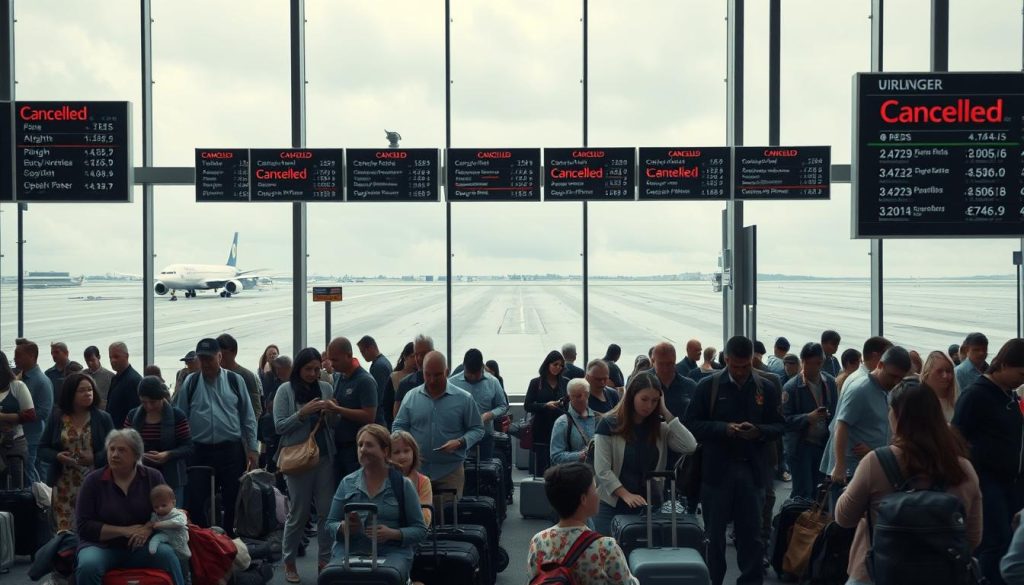
Thousands of Flights Cancelled, Hundreds of Thousands Stranded: Travel chaos is hitting U.S. flyers hard. Thousands of flights are cancelled, leaving hundreds of thousands stranded. This is due to the US-Israel war on Iran, causing airlines to avoid Middle East airspace.
Airports and airlines are updating flight cancellations hourly. Reports show widespread shutdowns and injuries at key hubs. For more, see reports on stranded travelers.
Markets are also affected. Airline and travel shares fell sharply. Donald Trump’s comments on U.S. military action added to the uncertainty.
Costs are rising, too. Brent crude jumped 13% to about $80 a barrel. Analysts warn oil could hit $100, affecting carriers.
U.S. readers wonder what’s next. Which airspaces will stay closed? How are Gulf hubs operating? Which airlines are pausing routes? We’ll cover airline responses and what stranded passengers are getting.
Travel rules can change quickly during disruptions. This global travel restrictions update helps understand how restrictions evolve.
Flights cancelled. Key Takeaways
- Thousands of flights cancelled as the US-Israel war on Iranian forces forces airlines to reroute and cut schedules.
- Cancelled flights are leaving hundreds of thousands of passengers stranded across connecting hubs.
- Airline and travel stocks slid as investors priced in a longer period of flight cancellation risk.
- Brent crude jumped sharply, raising fuel-cost pressure for carriers managing canceled flights.
- Concerns about shipping through the Strait of Hormuz add to the wider economic and travel strain.
- Readers can expect a clear breakdown of airspace closures, hub shutdowns, and passenger refund and rebooking options.
Global air travel turmoil as US-Israel war on Iran triggers widespread airline cancellations
Airlines and airports faced a crisis as the conflict widened and safety rules tightened. This led to a sharp increase in airline cancellations. Many travelers found themselves stuck, waiting for rebookings and facing long delays.
Thousands more flights were cancelled on Monday, leaving hundreds of thousands of passengers stranded
By Monday, thousands more flights were cancelled, leaving hundreds of thousands stranded. Travelers struggled to confirm their plans as airlines updated their schedules. Flight disruptions led to last-minute schedule changes and standby lists on some routes.
Crews and aircraft were scattered worldwide, making it hard to restart service. Even when conditions improved, delays piled up, making simple fixes difficult.
Middle East airspace remains largely empty over Iran, Iraq, Kuwait, Israel, Bahrain, the UAE, and Qatar
Flightradar24 data showed skies over Iran, Iraq, Kuwait, Israel, Bahrain, the UAE, and Qatar were nearly empty. Carriers avoided these areas due to closures and risk assessments. This reflected how quickly security alerts can change flight paths.
Reroutes added distance and congestion on the remaining lanes. The Russia-Ukraine war had already changed long-haul patterns. When Iran and Iraq’s routes closed, disruptions spread far beyond the region.
Disruption spreads beyond the region, stranding travelers from Bali to Frankfurt
Travel snarls were not limited to the Middle East. Passengers were stranded from Bali to Frankfurt as networks tightened. Each change increased the risk of flight delays on onward legs.
Air India cancelled Sunday departures from Delhi, Mumbai, and Amritsar to major European and North American cities. These cancellations affected return flights and crew rotations. This led to airline cancellations in one area, causing gaps across the wider map.
Conflict expansion to Lebanon adds pressure as closures and safety concerns persist
Pressure increased as fighting extended to Lebanon. Israel carried out airstrikes on Beirut’s southern suburbs after Hezbollah launched rockets. With safety concerns rising, airlines considered more diversions and cancellations.
Travelers faced uncertainty in shifting departure boards and long customer service holds. Even when planes departed, longer routes increased the risk of delays. In the background, flight disruptions continued as carriers tried to align crews, aircraft, and open airspace.
Flights cancelled: Gulf airports suspend normal operations as Dubai and regional hubs shut down
Across the Gulf, the same message kept surfacing: check status first, then travel. With flights cancelled in waves, terminals shifted from routine transit to crowd control, rebooking queues, and constant alerts. The flight disruption also rippled into nearby routes, as carriers tried to route around closed airspace and limited airport slots.
Gulf airports and airlines suspend normal operations until at least 10:00 GMT Tuesday
Airports and airlines across the region suspended normal operations until at least 10:00 GMT Tuesday, citing safety limits and tight operating windows. In the UAE, carriers including Emirates, Etihad Airways, flydubai, and Air Arabia issued rolling updates as cancelled flights mounted, with only a small number of services cleared to run under special schedules. A detailed roundup of updates from UAE airlines and airports showed that passengers were repeatedly urged not to go to the airport without confirmed details.
For many travelers, the immediate challenge was simple: verify a booking that kept changing. Even when a route looked open on a map, the flight disruption meant last-minute gate changes, aircraft swaps, and uneven staffing at customer service desks.
Dubai closes for a third consecutive day, marking the most acute aviation shock in the Covid pandemic
Dubai, a central bridge between Europe, Asia, and Africa, closed for a third straight day. Analysts described it as the most acute aviation shock during the COVID pandemic, with the shutdown lasting more than 24 hours and hitting the region’s major transit hubs at the same time.
That kind of standstill creates a domino effect. When planes and crews are out of position, airlines can’t easily restart, even after the airspace begins to reopen. The result is more cancelled flights, packed rebooking systems, and longer wait times for bags and refunds.
Cirium data shows that at least 1,555 flights to the Middle East were cancelled by 10 a.m., with warnings of undercounting
By 10 a.m., analysts at Cirium counted at least 1,555 flights to the Middle East that had been cancelled. They warned the tally could be artificially low because of limited visibility from Iran and the UAE, where hundreds more flights were scheduled. Cirium also estimated up to 25,000 passengers might have flown on 74 flights into the region that day.
Other sectors were jolted as well, adding pressure to airline planning. Market historians have pointed to how quickly travel demand can swing during broad shocks, including the aviation slide during the historic stock market crash, when airlines saw steep declines and confidence dropped within days.
FlightAware reports nearly 2,800 cancelled flights on Saturday and 3,156 cancelled flights on Sunday
FlightAware reported almost 2,800 cancellations on Saturday and 3,156 on Sunday, showing how quickly the weekend unraveled. The numbers underscored how flight disruption can grow hour by hour as new restrictions stack on top of earlier delays.
- In the eastern Mediterranean, flights to Cyprus were affected after a drone hit the RAF base in Akrotiri; easyJet cancelled three return services between Paphos and Larnaca and the UK, and British Airways cancelled Monday’s Larnaca service.
- Some flights to Bahrain, Saudi Arabia, and Jordan were cancelled, while flights to Egypt were reported as unaffected at that point.
For U.S. travelers connecting through Gulf hubs, the practical impact was fewer options and longer detours, even on trips that never planned to enter the region. With flights cancelled and schedules thinning out, airlines leaned on tighter corridors and limited departures to keep parts of the network moving.
Flight disruption ripple effects: flight delay, flight rescheduling, and cancelled flight policy changes
Airspace issues lead to quick updates on airport boards and mobile alerts. Travelers face longer connections, missed slots, and fast flight rescheduling. This is due to networks that usually run smoothly.
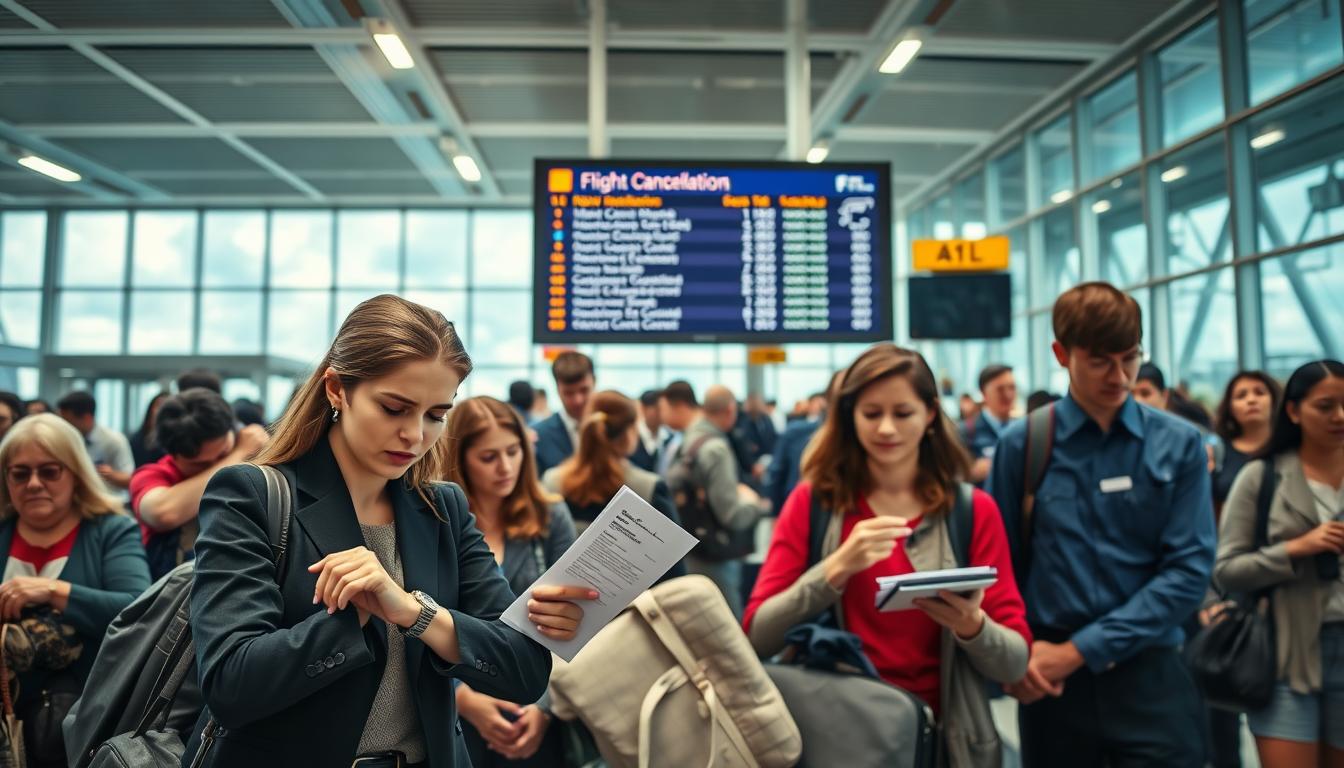
Airlines update their cancelled flight policy in real time. This can change what passengers can do without fees. Options depend on seat availability, route, and disruption duration.
Emirates and Etihad pause flights to and from Dubai and Abu Dhabi until late Tuesday morning
Emirates and Etihad Airways have stopped flights to and from Dubai and Abu Dhabi until late Tuesday morning. Emirates says passengers who can travel will be notified. Other departures are on hold.
This pause leads to more travelers needing to reschedule flights. This often means fewer open time windows. It also raises questions about compensation for cancelled flights, when delays lead to overnight stays and rebooked connections.
Qatar Airways suspends operations as long as Qatari airspace remains closed
Qatar Airways has suspended operations until Qatari airspace opens again. The message is clear: even with ready aircraft and crews, the route can be impossible.
For passengers, the cancelled flight policy is key in the hours after an alert. Rebooking rules, refund timing, and compensation can vary by ticket type and where it was bought.
Limited “special flights” planned from the UAE to help stranded passengers depart on Monday evening
The UAE aviation authority plans to allow “special flights” to help stranded passengers leave. Emirates and Etihad will resume some flights on Monday evening, but seats will be limited.
Travelers need to act fast to secure rescheduling on these limited departures. Many are also checking whether compensation applies to flights from different airports or to later dates.
International carriers cancel and reroute flights as airlines squeeze into narrower corridors around closed airspace
International carriers flying around restricted areas add time, fuel stops, and crew changes. Flightradar24 warns of increased congestion and delays in these narrow corridors.
Some carriers are being more flexible. Air Canada has updated its ticketing rules for affected routes. This change is reported in updated booking guidance, allowing changes without penalty in certain cases.
Disruptions can spread far from the conflict zone when safety agencies intervene. In Florida, an FAA investigation tied to a SpaceX incident briefly stopped or slowed traffic, according to the FAA disruption report. This shows how quickly a flight delay can ripple across a region.
The strain is showing in investor reactions, cargo planning, and passenger travel as well. With oil prices in focus, airlines are balancing network stability with a cancelled flight policy. They aim to keep rebooking clear, flight rescheduling realistic, and compensation easy to understand.
Thousands of Flights Cancelled Conclusion
The U.S.-Israel war on Iran has caused big problems for air travel. Many flights have been cancelled, leaving travelers stuck. This has also caused delays and crowded airports in major cities.
In the Gulf, flights are not running as usual. Airports and airlines are working in an emergency mode until Tuesday. Only a few special flights are moving passengers in the UAE, while many routes are paused.
Even in North America, flight cancellations are affecting travel. For more information, check recent data on flight disruptions. This includes cancellations and delays from major airlines.
Airspace restrictions and aircraft out of position add to the problem. This makes it harder for airports to get back to normal. Higher fuel prices and longer routes also increase costs and complexity, leading to more cancellations.
For travelers in the U.S., the key is to stay alert to airline updates. Be ready for changes in your flight schedule. If your flight is cancelled, act fast to get a refund or change your flight.