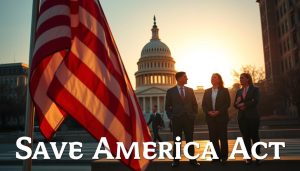
Save America Act: Trumps New Bill
Discover how Trump prioritizes the Save America Act for economic revival, emphasizing job creation and infrastructure investment.

President Donald Trump said Sunday he won’t sign new laws until Congress passes the Save America Act. He also turned down any Save America Act deal that he thinks weakens its main rules.
The bill aims to make voting stricter by requiring proof of citizenship to register everywhere. The House sent it to the Senate last month. But the path there is tough, as recent reports on Trump’s stance show.
This fight comes at a tense time, with government funding deadlines pressing Capitol Hill. This pressure can slow other important initiatives, such as economic stimulus and job-creation packages. Lawmakers are deciding what to prioritize and what to put on hold.
There are worries about shutdowns and how federal workers will be treated if agencies close. Trump has also said the military should be protected during any government funding pause. This point is mentioned in coverage of his shutdown promise.
Save America Act Key Takeaways
- Trump said the Save America Act must pass before he signs other bills.
- He insists a Save America Act deal should not be “watered down.”
- The bill would require proof of citizenship for voter registration nationwide.
- The House already sent the legislation to the Senate, where it faces tough odds.
- Government funding deadlines raise the risk of wider gridlock in Congress.
- Economic stimulus and job creation efforts could be sidelined by the standoff.
Trump’s Demand Sparks Legislative Standoff and Possible Government Shutdown
Washington is facing a tight spot as President Donald Trump makes a big ask. He wants lawmakers to focus on one thing first. This is while they’re already dealing with many other important issues.
Trump’s pledge to withhold signatures until the act advances
Trump has said he won’t sign other bills unless the SAVE America Act is passed first. This makes other important issues, like tax relief and investment incentives, harder to pass.
Even bills aimed at helping the economy can get stuck. This can cause problems for agencies and state budgets.
Truth Social message: “must go to the front of the line” and no “watered down version.”
On Truth Social, Trump urged lawmakers to prioritize the bill. He also wanted strict voting rules, including limits on mail ballots and more ID checks. This was reported in connection with Trump’s threat to block legislation.
Trump’s clear message makes it hard for lawmakers to find common ground. This can make negotiations even tougher.
Shutdown pressure point: Department of Homeland Security funding and partial shutdown risk
The Department of Homeland Security is facing a big deadline. If it’s missed, there could be a partial shutdown. This could affect pay and planning, even if some services continue, as the Los Angeles Times reported on a possible DHS-linked shutdown.
Government funding issues can affect more than just DHS. Contractors and local partners might delay projects. Households could also face financial challenges.
What happens if a president doesn’t sign: the 10-day rule for bills becoming law
Procedure also plays a role in the standoff. If Congress passes a bill and the president doesn’t sign it within 10 days, it can become law. This is if Congress is in session.
But a shutdown can cause problems. Agencies might have to furlough staff. This can disrupt services and timelines, as reported on this shutdown vote update. This uncertainty can harm investment incentives and tax relief plans.
Save America Act
The Save America Act has moved quickly in the House. But the debate around it is complex. Supporters see it as a way to clean up federal election rules. Critics worry it will make it harder for eligible voters to participate.
The debate is happening in a busy Congress. They are also working on small business support, unemployment benefits, economic stimulus, and job creation.
What the House-passed bill does
The House-passed version changes federal election policy. It requires proof of U.S. citizenship to register to vote in federal elections nationwide. It also tightens voter-roll oversight, creating clearer standards across states.
A closer look at the White House framing and the push for more federal involvement is outlined in the greater federal oversight of voter rolls.
Context on noncitizen voting
Noncitizen voting in federal elections is already illegal and rare. The debate centers on whether a broad new mandate is needed. Some question how changes would be implemented at the DMV, in rural areas, and for those without easy access to records.
Senate outlook: uphill battle and the 60-vote hurdle
In the Senate, the main challenge is the math. Controversial bills require 60 votes to move forward. The Save America Act faces a tough climb, even before amendments are considered.
This uncertainty affects other important issues. Lawmakers are also focused on small business support, unemployment benefits, economic stimulus, and job creation.
Trump’s additional demands are not included in the House bill
Donald Trump supports the bill but wants more. He has called for language like “NO MEN IN WOMEN’S SPORTS” and “NO TRANSGENDER MUTILATION FOR CHILDREN.” These demands are not in the House-approved bill.
In an NBC News interview, he said he is “not happy it’s not moving”. He has made this point repeatedly. This adds to the Senate’s already complex fight.
Senate Fight Lines: Thune, Filibuster Tactics, and Democratic Pushback
The Senate is in a heated battle over the SAVE Act. This fight is testing the Senate’s endurance and control. It’s happening on a busy agenda that includes important issues like infrastructure and tax relief.

Key players: Senate Majority Leader John Thune and sponsor Sen. Mike Lee
Senate Majority Leader John Thune controls the Senate floor. Sen. Mike Lee wants a quicker path for the bill. House Republicans are pushing Thune to use stronger tactics, saying delays harm financial recovery and investment incentives.
Donald Trump’s public callout of Thune has raised the stakes. The message is clear: pass the bill, or face public criticism while other issues vie for attention.
“Talking filibuster” strategy and why it’s being discussed
The “talking filibuster” idea is gaining traction. It would force senators to speak on the floor rather than rely on a quick vote. Supporters believe it exposes obstruction and could lead to a simple-majority vote if opponents tire out.
A detailed explanation of the tactic is found in a “talking filibuster” explainer. Republicans see it as a way to highlight their tax relief and investment incentives while pushing election policy.
Thune’s warning: reopening government could be harder during a prolonged filibuster
Thune wants to move the bill but warns of complications if the fight drags on. A prolonged debate could make it harder to reopen the government. Routine votes tied to funding could become a challenge.
Delayed payments and halted services can slow financial recovery. The costs and impacts on federal programs are detailed in coverage of the shutdown timeline. This shows how quickly economic damage can accumulate.
Schumer’s response: claims of disenfranchisement and prediction of Senate gridlock
Senate Minority Leader Chuck Schumer sees the bill as a threat to voting rights. He claims it would disenfranchise millions and predicts total gridlock under Trump’s hardline stance. Schumer believes this would leave little room for negotiations on other important issues.
- Democrats argue the measure shifts burdens onto eligible voters and invites confusion at registration.
- Republicans argue the fight is worth it, even if it burns time that could be spent on debates over government funding and financial recovery.
- Leadership faces a choice between a prolonged procedural battle and a faster route that may not overcome the 60-vote barrier.
Save America Act Conclusion
Trump is making a strong stand: he wants the Save America Act passed before signing other bills. He won’t accept any watered-down deals. This has turned into a test of power, with each vote being closely watched.
The situation is urgent because funding for the Department of Homeland Security is also at risk. If Congress and the White House can’t agree, basic government work could slow down. In past shutdowns, even essential programs have been affected, as seen with SNAP benefit updates.
The Save America Act is at the heart of the debate. It would require proof of citizenship for voter registration and more documentation. Critics say it could block some eligible voters, like older adults without a current photo ID.
More information on these challenges is in this SAVE America Act guide. Even though noncitizen voting is illegal and rare, the act’s impact is significant.
In the Senate, the Save America Act faces tough odds. It needs 60 votes to pass, and procedural fights are growing. John Thune is trying to meet Republican demands while warning of the challenges ahead. Chuck Schumer is showing strong Democratic opposition, leaving Washington in a stalemate.