Trump Threatens 100% Tariffs in US-Canada Trade War Continues
Discover the latest on the US-Canada Trade War as Trump announces potential 100% tariffs, escalating economic tensions.
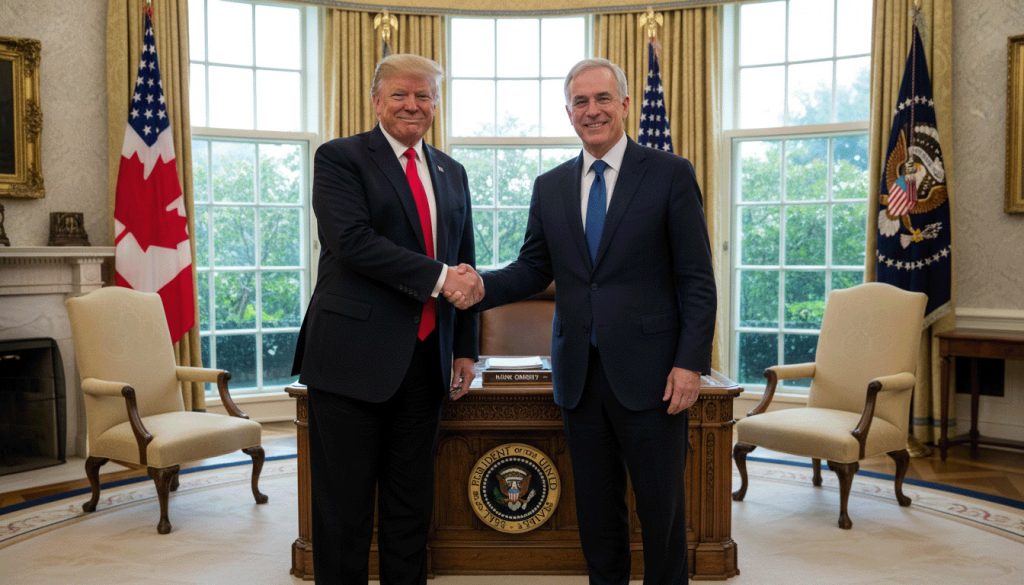
President Donald Trump escalated the US-Canada Trade War on Saturday. He warned that Canada could face a 100% tariff on goods entering the United States. This move comes as part of a broader trade war, marked by new tariffs and disputes. Trade talks with the U.S. and Canada Sour, as trade debate over Tariffs continues.
Trump’s threat was aimed directly at Prime Minister Mark Carney. It raised the stakes for both countries’ economies. Canadian officials say they are not seeking a free trade pact with China. They see the talks as a way to solve specific tariff issues.
Details on the 100% tariff warning were shared by the international trade disputes coverage. The timing and enforcement of this tariff are unclear. For U.S. businesses, even a threat can impact contracts, pricing, and shipping plans.
Trade War Key Takeaways
- Trump threatened a 100% tariff on Canadian imports tied to a possible China deal.
- The warning escalates a Trade War that has already widened into broader tariffs.
- Canada has signaled it is not pursuing a free trade deal with Beijing.
- The dispute adds pressure to supply chains and raises the risk of higher prices.
- International trade disputes can move markets even before new rules take effect.
- The US-Canada trade war now centers on both policy and political messaging.
Trump’s 100% Tariff Threat on Canadian Imports and the China Deal Trigger
Trade talks heated up again, focusing on what they mean for markets. Trump linked his warning to Canada’s talks with China. He saw it as a test of U.S. trade policies and border enforcement.
What Trump said and where he said it
In a Truth Social post, Trump threatened a 100% tariff on Canadian imports. He said this if Canada made a deal with China. He claimed it was to stop China from using Canada to get into the U.S.
His words quickly spread, prompting investors and exporters to seek answers. Live updates followed the post and the reactions. The message also sparked debate on the quick changes in trade policies and their impact on supply chains.
Why Canada’s China trade deal sparked the warning
Canada’s deal with China on electric vehicles and farm products was the trigger. Trump saw it as a challenge to U.S. trade negotiations. He believed it could change border traffic.
He had previously called the Canada-China deal a good thing. This contrast added to the pressure on businesses to plan amid rapidly changing trade policies.
Unclear timing and lack of added White House details
Trump said the tariff would start “immediately” if Canada made a deal with China. But the deal was made about a week before. The White House didn’t give details on timing, scope, or enforcement.
- Whether the 100% rate would apply across all Canadian goods or only select categories
- How U.S. Customs would define and trace China-linked products moving through Canada
- What the move would mean for existing trade agreements and routine border procedures
The threat was more like a pressure point in trade talks than a formal notice. This uncertainty can be costly, as buyers and sellers must make commitments before policies are clear.
Trade War
A trade war starts with a threat and can quickly turn into a cycle of retaliation. Leaders raise barriers, markets react, and trust drops fast. In North America, this pattern has fueled global trade tensions, with business groups watching closely for the next move.

How the dispute escalated between Trump and Prime Minister Mark Carney
The latest clash between Donald Trump and Prime Minister Mark Carney sharpened. Trump warned about tariffs after Canada made a deal with China, which he saw as a direct challenge.
Carney pushed back, saying Canada values its independence and democratic choices. He made it clear that Canada doesn’t just rely on the United States. Analysts noted a shift in tone after Carney’s Davos speech, moving from policy to personal messages.
Tariff threats can act like economic sanctions, aiming to force quick concessions. This raises the stakes for exporters, retailers, and cross-border supply chains.
Political flashpoints: Davos remarks, “Governor Carney,” and the “Board of Peace” reversal
At Davos, Carney said middle powers must act together, warning that they risk being left out. His words drew heavy attention, widening global trade tensions by framing trade pressure as coercion.
Trump escalated, calling Carney “Governor Carney,” echoing a nickname for Justin Trudeau. He also canceled plans to include Carney in a “Board of Peace,” adding to the dispute’s intensity.
For those interested in how these spirals work, understanding a trade war shows why retaliation often gets the headlines, even if the first move is small.
How Trump’s Greenland push and sovereignty jabs added to global trade tensions
The fight has also involved Trump’s push to buy Greenland, straining alliances and raising questions about power and territory. His sovereignty jabs, including calling Canada a 51st state, have added a geopolitical edge to global trade tensions.
Trump shared an altered map showing Canada and other places as part of the U.S. territory. Such provocations can harden positions, making economic sanctions and tariff threats seem like tests of resolve.
Legal fights in the U.S. have added another pressure point, as tariff authority can become a matter for the courts. A recent Supreme Court debate over the tariff power under emergency law shows how quickly global trade tensions can run up against domestic limits on executive action: tariffs without Congress.
Tariffs, Trade Agreements, and Trade Barriers Shaping US-Canada Trade
Tariff threats can change quickly, but the rules take time to implement. In the U.S.-Canada relationship, trade barriers often take the form of tariffs on key goods. Yet, broader ties keep the relationship strong.
This mix means small policy changes can lead to big international trade disputes.
How CUSMA shields Canada from some tariffs and why its review matters this year
Canada has not secured a deal to ease pressure on major sectors. Yet, CUSMA has helped limit harsh outcomes. Its review this year is key because it can change tariffs, sourcing rules, and enforcement.
When these rules change, import/export restrictions can hit real supply chains hard.
Even when leaders speak tough, CUSMA provides formal steps to slow sudden moves. These steps don’t end international trade disputes. But they can shape where the fight goes: courts, panels, or new duties on specific products.
Canada-China tariff back-and-forth: EVs, steel/aluminum, and China’s import taxes on Canadian exports
The Canada-China tariff cycle has been a major issue. Canada set a 100% tariff on Chinese electric vehicles and a 25% tariff on steel and aluminum. China responded with 100% import taxes on Canadian canola oil and meal, as well as 25% on pork and seafood.
Prime Minister Mark Carney’s recent outreach to Beijing widened the gap with Washington at a tense moment. Trump’s newer warning, tied to Canada’s China engagement, added fresh trade barriers to an already crowded map of import/export restrictions, as described in the tariff threat report.
Cross-border stakes for the U.S.: daily trade flows, energy imports, and critical minerals
The stakes for the United States are real. Canada is the top export destination for 36 states. About 3.6 billion Canadian dollars in goods and services cross the border each day. When tariffs rise, the added cost can affect factories, trucking routes, and grocery aisles.
Energy ties make things even more intense. About 60% of U.S. crude oil imports come from Canada. Roughly 85% of U.S. electricity imports come from Canada. Canada also leads as a foreign supplier of steel, aluminum, and uranium.
Canada holds 34 critical minerals and metals tied to Pentagon investments. Tighter controls here can act like import/export restrictions without looking like classic tariffs.
As export controls and licensing expand around strategic inputs, the policy toolbox starts to look broader than tariffs alone. This shift, including rare-earth pressure points, is part of the landscape outlined in coverage of rare-earth export moves, and it feeds ongoing international trade disputes.
Past pressure tactics and trade negotiations: Ontario’s anti-tariff ad and threatened extra duties
Recent brinkmanship has not stayed inside meeting rooms. Ontario ran an anti-tariff ad in the U.S. using Ronald Reagan’s words. Trump responded by ending trade talks with Canada. He also floated an additional 10% duty on Canadian imports, then did not implement it.
These episodes show how fast messaging can harden into trade barriers. They also show why negotiators watch timing, tone, and leverage. Each move can trigger new international trade disputes and sharper import/export restrictions across the same border.
Trade War Conclusion
Trump’s threat of a 100% tariff has escalated the trade war. It shows how U.S. actions are linked to Canada’s stance on China. Businesses are in the dark, unsure of what’s coming next.
Every day, nearly $3.6 billion in goods and services move across the border. Supply chains involve steel, aluminum, autos, and minerals. Tariffs can lead to higher prices for consumers and fewer choices, as explained in this trade war explainer.
Canadian small businesses are facing higher costs and weaker profits. They’re looking for new suppliers to avoid U.S. tariffs. A recent CFIB survey shows how quickly plans can fall apart with sudden policy changes.
The future depends on whether trade talks can ease tensions before the CUSMA review. The standoff between Trump and Prime Minister Mark Carney has economic implications. Recent signs suggest talks could stall at any moment, as reported in this update on trade negotiations with Canada. Clear plans and focused solutions might be key to avoiding more tariffs.