What the White House Act to Nationalize Voting Means for You
Explore the implications of the White House act to nationalize voting and how it impacts your voting rights and the democratic process.
Nationalize Voting: President Donald Trump wants Republicans to take control of voting. He claims election fraud helps Democrats. This idea is now a real fight over who sets election rules. More political news stories.
This debate is real. It affects how we vote, including identity verification and the timing of ballot counting. Reporting on these national elections is a big deal with far-reaching effects.
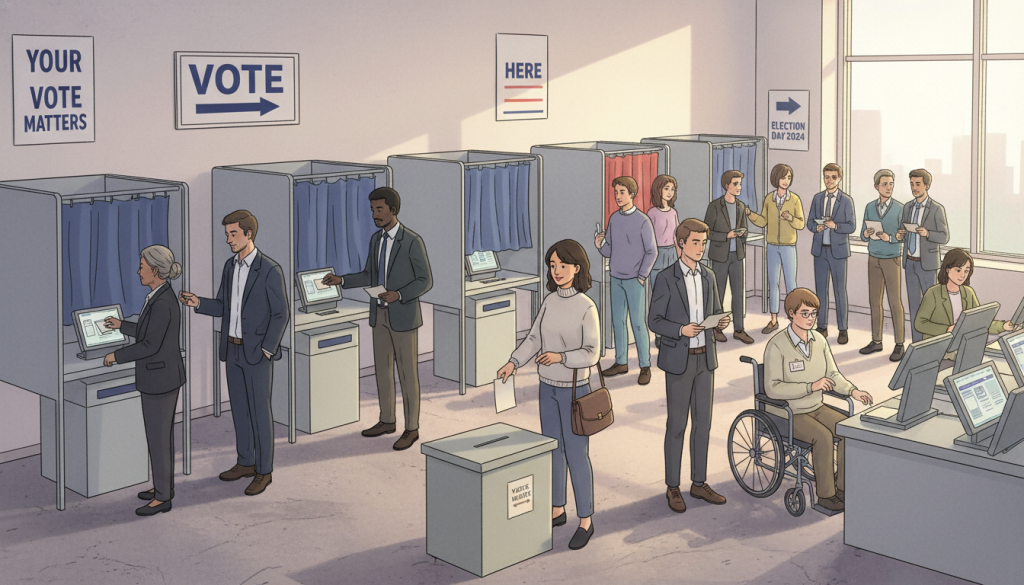
Voters lining up to cast ballots is common. There is now a push for a national plan. This raises a big question: what if Washington takes over local voting systems?
For many, the practical impact matters most. A federal push could change how we register and vote. Even big plans face legal limits. Critics say the Constitution keeps elections local, as explained in this analysis of the power grab.
Nationalize Voting Key Takeaways
- Nationalize Voting is more than a slogan; it’s a real push to change election control.
- The debate impacts the democratic process, affecting how we register, verify, and cast ballots.
- Proposed electoral reforms could introduce new steps that change how eligible voters participate.
- Universal suffrage is key: rule changes can expand or limit access to voting.
- States run elections, so any federal takeover would face significant legal hurdles.
- The outcome could change how federal elections work in every community, from cities to rural areas.
What Trump Means by “Nationalize” Elections and Why It’s in the News
The term “nationalize voting” has become a hot topic because it suggests a big change in how elections are run. In the U.S., most election work happens at the state and local level. This is because local rules, budgets, and staffing shape these processes. The House votes on Trump’s new Health Care bill.
This call for a single nationwide approach raises big questions. It brings up voting laws, electoral reform, and the democratic process.
Trump’s Bongino podcast remarks and the push to “take over the voting” in “15 places.”
Donald Trump made some comments during a call with Dan Bongino. Bongino recently returned to podcasting after leaving a federal role. Trump suggested Republicans should “take over the voting” in “at least many, 15 places,” then said they “ought to nationalize the voting.”
He didn’t explain what “take over” would mean. This has sparked debate, as people try to understand the implications for voting laws and electoral reform.
More details on the exchange and reactions are in this report.
Unsubstantiated fraud claims, including noncitizen voting allegations
Trump linked the push to nationalize voting to claims of election rigging. He said he actually won in 2020 against Joe Biden. He also claimed some states were “so crooked” while counting votes.
He again made claims about noncitizen voting affecting outcomes. This claim is a significant concern because it could lead to stricter voting laws. Even when local officials say checks are already in place.
How the White House framed the idea: pointing to the SAVE Act and tighter federal oversight of voter rolls
When asked to clarify, White House spokesperson Abigail Jackson mentioned the SAVE Act. This focuses on documentary proof of U.S. citizenship for federal voter registration and more federal oversight of voter rolls.
Supporters view this as an electoral reform that clarifies the rules. Critics worry it could affect access unevenly, depending on state laws.
- Photo ID standards are a nationwide expectation
- Limits on no-excuse mail voting and ballot collection practices
- Stricter voter-roll controls tied to eligibility checks
Related recent efforts: executive actions on citizenship proof and mail-in ballot deadlines, and the lawsuits that
The rhetoric was also tied to earlier moves on state election procedures. A Trump Executive Order sought to make major changes, including requiring proof of citizenship and halting the processing of certain mail-in ballots after Election Day.
These steps led to lawsuits from Democrats and voting rights groups. Federal courts blocked parts of the order, citing limits on presidential power. This shows how quickly a push to nationalize voting can clash with existing laws, even as both parties debate what protects democracy.
Nationalize Voting: What the Constitution Allows and What It Doesn’t
Calling for Nationalized Voting might seem simple, but it’s not. In the U.S., election power is divided, with many checks in the democratic process.
This setup leads to today’s fights over voting laws. People often see federal power as a quick fix for state issues.
Why U.S. elections are decentralized: Article I, Section 4 and state control of the “Times, Places and Manner.”
The Constitution starts with the states. Article I, Section 4, Clause 1 grants state legislatures authority over the times, places, and manner of elections.
It also lets Congress change these rules, but only in a few cases. This balance keeps elections local, even when national stakes are high.
Where Congress can step in—and why the President is largely left out
Congress can pass laws, such as establishing a national Election Day. They can also require list maintenance rules or ban discrimination. The Voting Rights Act is a clear example of Congress protecting access to the ballot.
But a President seeking to change voting laws alone faces a significant challenge. The Constitution doesn’t give the President that power. Courts have said so, as seen in coverage of federal election control claims.
What critics say would happen in court: claims a federal takeover would be unconstitutional
Legal critics say a federal takeover would prompt lawsuits immediately. Former U.S. District Judge John E. Jones III told CNN it would be “flatly unconstitutional.” He said the President should read the Constitution.
These views are part of ongoing debates over the Voting Rights Act. The Supreme Court has weakened Section 5 and faced calls to narrow Section 2. These rulings affect how challenges to new voting laws are handled.
How elections are actually run: thousands of local jurisdictions and safeguards that make large-scale manipulation difficult
In reality, elections are run by thousands of local offices, not a national center. Ballots are printed, stored, checked, and counted in different ways across states and localities.
- Separated duties across clerks, bipartisan boards, and poll workers
- Paper trails and audits in many places, with public record requirements
- Chain-of-custody rules for ballots, machines, and tabulation records
The American Bar Association says these safeguards make large-scale breaches almost impossible. This reality shows why big claims about controlling the entire democratic process clash with how voting laws are enforced.
How a Federal Push Could Change Voting Rights, Voting Accessibility, and Voting Laws
Washington is pushing for new election rules. These rules could affect every county office. Supporters say they protect elections. Critics worry they could limit voting rights and make it harder to vote.
Proposals gaining traction: SAVE Act-style citizenship documentation requirements for federal registration
The White House is looking at the SAVE Act. It requires proof of U.S. citizenship to vote in federal elections. This move is intended to keep voter rolls accurate.
These ideas are part of a proposal to nationalize elections. The key question is how these national rules will work with local officials with different resources.
GOP election agenda in Congress: the MEGA Act and its policy package
Rep. Bryan Steil of Wisconsin introduced the MEGA Act. It aims to prevent fraud. Supporters say it makes voting more secure.
- Photo ID requirements for voting
- State citizenship verification for voter registration
- A ban on ranked-choice voting
- A ban on universal vote-by-mail
Why opponents call it voter suppression: concerns that eligible voters may lack easy access to required documents
Opponents say these rules could suppress votes. They note that not everyone has the required documents. This includes people without passports or those facing long waits and fees.
Democracy Docket calls this proposal a disaster for democracy. Rep. Joe Morelle of New York says it’s a voter suppression bill. He believes it lets politicians control who can vote.
Political and ideological pushback: resistance from some Republicans and conservative groups opposed to the federal takeover
Not just Democrats are opposing these changes. Rep. Don Bacon of Nebraska has also spoken out. He believes in state control over elections.
The Heritage Foundation also opposes federal control over elections. This opposition matters because it affects what changes are made. It determines if voting becomes easier or harder.
Nationalize Voting Conclusion
Trump’s push to Nationalize Voting came from his fraud claims, including unproven noncitizen voting allegations. The White House linked this to stricter voting rules, like the SAVE Act. This has sparked a new debate over voting laws in the U.S.
The Constitution sets the basic rules for democracy. States handle most election details, while Congress can set specific rules. Federal courts have held that a president cannot unilaterally change election rules, a decision that is key to voting rights.
Supporters say these plans could make voting more secure and trustworthy. Critics fear they could make it harder for eligible voters, disproportionately affecting some communities. This debate centers on voting laws and rights, with lawmakers considering the SAVE Act and other proposals.
Yet, a full federal takeover is a tough goal. Legal challenges, political opposition, and conservative resistance make the outcome uncertain. For the latest on Nationalize Voting, see this report on nationalizing elections and how Congress and the courts are responding.