Exploring Black Holes: Cosmic Mysteries Unveiled
Dive into the enigmatic world of black holes. Explore their formation, characteristics, and impact on the universe. Uncover the latest discoveries in astrophysics.

NASA M87 Black Hole
Black holes are mysterious cosmic objects that fascinate scientists and space fans. They are areas where gravity is so strong that it warps our understanding of space. At their heart is a point of infinite density, known as a gravitational singularity, which goes beyond what we know about physics.
The event horizon is a boundary where anything that gets too close can’t escape. It’s a key part of understanding black holes and how they affect space and time.
New technology has changed how we study black holes. The Event Horizon Telescope captured the first-ever image of a black hole in the galaxy M87. This achievement is a big step forward in understanding the universe. The Cosmic Abyss of Black Holes.
Black holes vary in size, from small stellar-mass to huge supermassive ones. Supermassive black holes, found at the centers of most galaxies, can be millions to billions of times more massive than our Sun. These giants help shape galaxies and their structures.
Studying black holes is pushing science to new limits. The discovery of gravitational waves in 2015 confirmed Einstein’s predictions, giving us new insights into how black holes affect space and time. Upcoming missions, like the Laser Interferometer Space Antenna (LISA), will help us learn more about these cosmic mysteries.
Key Takeaways
- Black holes are regions of extreme gravity in spacetime
- The event horizon marks the boundary of no return
- A gravitational singularity lies at the core of black holes
- Different types of black holes exist, varying in size and mass
- Recent technological advances have improved black hole observations
- Gravitational waves provide new insights into black hole behavior
- Future missions aim to expand our understanding of these cosmic entities
The Nature of Black Holes
Black holes are cosmic mysteries that fascinate scientists and space fans. They warp spacetime with their strong gravity, as general relativity explains. Let’s explore the world of black holes and their main features.
Definition and Basic Concepts
A black hole is a space area where gravity is so strong that nothing, not even light, can escape. They form when massive stars collapse or galaxies collide. In 2015, LIGO detected gravitational waves from colliding black holes, and has made nearly 100 observations since then. The Event Horizon Telescope captured the first-ever image of a black hole in 2019, proving its existence.
Types of Black Holes
Black holes vary in size and origin. Here’s a look at the main types:
| Type | Mass Range | Formation |
|---|---|---|
| Stellar | 3-100 solar masses | Collapsed massive stars |
| Intermediate | 100-100,000 solar masses | Mergers or direct collapse |
| Supermassive | Millions to billions of solar masses | Galaxy centers, mergers |
Supermassive black holes are at the centers of galaxies, weighing millions to billions of solar masses. At the center of the Milky Way lies Sagittarius A*, a supermassive black hole with about 4.3 million solar masses.
Key Components: Singularity and Event Horizon
At a black hole’s core is the singularity, a point of infinite density where physics fails. The event horizon surrounds it, marking the point of no return. The event horizon also emits Hawking radiation, with temperature inversely related to the black hole’s mass5.
The accretion disk is another key part: a swirling cloud of gas and dust around the black hole. It’s crucial for understanding black hole dynamics and their effects on space. Scientists like Andrea Ghez and Reinhard Genzel won the Nobel Prize for tracking stars around our galaxy’s black hole.
As we learn more about black holes, we grow to appreciate their complexity and impact on the universe. From general relativity to the latest observations of supermassive black holes, these cosmic wonders continue to expand our understanding.
Formation of Stellar Black Holes
Stellar black holes come from the death of massive stars. These stars are much more massive than our Sun, with masses over 8 times that of the Sun. They go through many changes until they become black holes.
When these stars run out of fuel, they start to collapse. This leads to a huge explosion called a supernova. If the core is too massive, it collapses and becomes a black hole.

The Milky Way has billions of stars and many black holes. These black holes are the most common type in the universe.
Not every massive star turns into a black hole. Some become neutron stars, which are very dense. The star’s mass and its final moments decide its fate. This process shapes our universe and amazes us.
“The death of a star is the birth of a cosmic mystery.”
Seeing these black holes is hard, but new tech is helping us learn more. Since 2015, we’ve found many black holes by listening to gravitational waves. As we learn more, we appreciate these mysterious objects even more.
Supermassive Black Holes at Galactic Centers
At the heart of galaxies are supermassive black holes. These massive entities have masses over 100,000 suns. Some can weigh billions of solar masses8. Their size warps spacetime, guiding galaxy growth and powering quasars.
Formation Theories
Scientists have several theories on how these giants form. One theory is that they come from the collapse of massive gas clouds. Another suggests they grow by merging smaller black holes. These theories help us understand their role in the universe.

The Milky Way’s Sagittarius A*
The Milky Way has its own supermassive black hole, Sagittarius A*. It’s four million times heavier than our Sun and 27,000 light-years away. More than 300 researchers at 80 institutes worldwide study it, underscoring its importance in cosmic studies.
Impact on Galaxy Evolution
Supermassive black holes greatly influence their galaxies. They control star formation and gas flow, shaping the galaxy’s structure. Their gravity can either initiate or halt star formation, guiding the galaxy’s evolution for billions of years.
| Black Hole | Mass (Solar Masses) | Distance from Earth | Gas Orbit Time |
|---|---|---|---|
| Sagittarius A* | 4 million | 27,000 light-years | Minutes |
| M87* | Over 4 billion | 55 million light-years | Days to weeks |
The comparison between Sagittarius A* and M87* is fascinating. M87* is much larger and more massive. Yet, gas around Sgr A* orbits in minutes, while M87*’s gas takes days or weeks. This comparison helps scientists better understand black holes and their role in the universe.
Einstein’s Theory of General Relativity and Black Holes
Einstein’s theory of general relativity helps us understand black holes. It shows how massive objects warp spacetime, creating strong gravitational effects. This warping causes the intense pull of black holes and affects nearby objects and light paths.
The theory also predicts the existence of black holes and their properties. The Event Horizon Telescope Collaboration tested Einstein’s theory using data from the first image of a black hole. They confirmed their predictions.
Spacetime near black holes is very curved. A person 3 feet from an Earth-mass black hole would feel a force over 40 trillion times Earth’s gravity. This extreme curvature leads to phenomena like gravitational time dilation and spaghettification of matter.
The center of a black hole has a gravitational singularity. This point has infinite spacetime curvature. It challenges our understanding of physics and reality.
| Black Hole | Mass | Event Horizon Size |
|---|---|---|
| Earth-sized | 1 Earth mass | The size of a marble |
| Stellar | 10 Sun masses | 37 miles across |
| Sagittarius A* | 4 million Sun masses | 15 million miles across |
The size of a black hole’s event horizon grows with its mass. This is what general relativity predicts. Observations of black holes, like Sagittarius A* at the Milky Way’s center, confirm this.
“The concept of black holes and their formation challenges traditional scientific understanding of space-time, gravity, and matter.”
General relativity’s predictions about black holes are still being tested and verified. For example, the star S2 orbiting Sagittarius A* moves at 1-2% the speed of light at its closest point. This offers a chance to test relativistic effects10.
The Event Horizon: Point of No Return
The event horizon is the edge of a black hole, where nothing can escape. It’s a fascinating topic for scientists and space fans. It shows us the extreme physics of our universe.
Properties of the Event Horizon
The event horizon’s size depends on the black hole’s mass. For a black hole as massive as our sun, it’s about 3 km11. At this point, the speed needed to escape is the speed of light. This makes it impossible for anything to leave once it crosses the event horizon.
Gravitational Time Dilation
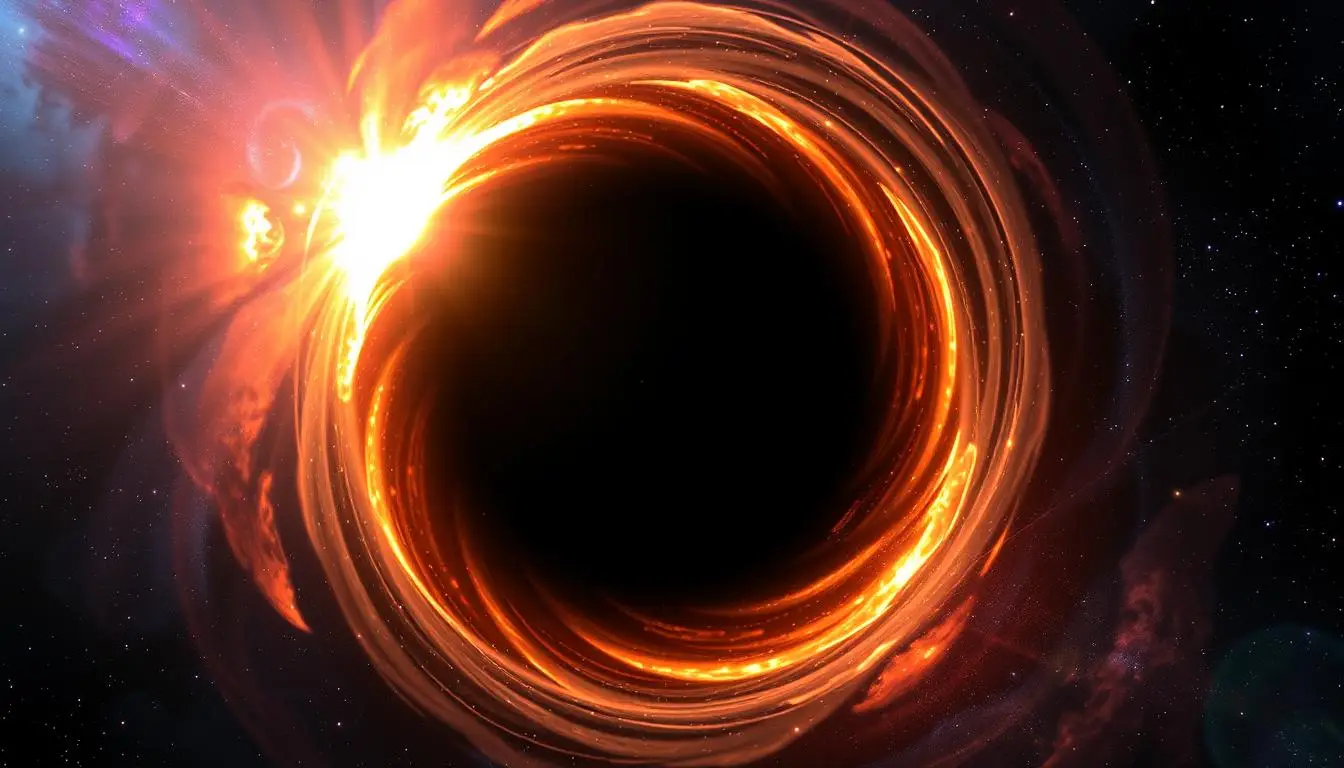
Time moves very slowly near the event horizon. This is because of the extreme warping of space-time. From outside, it might seem like time stops at this point12. The gravity is so strong that it distorts space-time, making time pass more slowly near the black hole.
Spaghettification of Matter
Objects get stretched and compressed as they get closer to a black hole. This is called spaghettification. In simulations, stars appear to stretch near a virtual black hole with a mass 1 million times that of the Sun. More From NASA.GOV.
| Black Hole Type | Mass Range (Solar Masses) |
|---|---|
| Stellar-mass | 5-20 |
| Intermediate-mass | 100-100,000 |
| Supermassive | Millions to Billions |
The Event Horizon Telescope (EHT) captured the first-ever image of a black hole in April 2019. It used a network of radio telescopes. This achievement has greatly helped us understand these mysterious objects and their effects on space, including gravitational lensing.
Hawking Radiation and Black Hole Evaporation
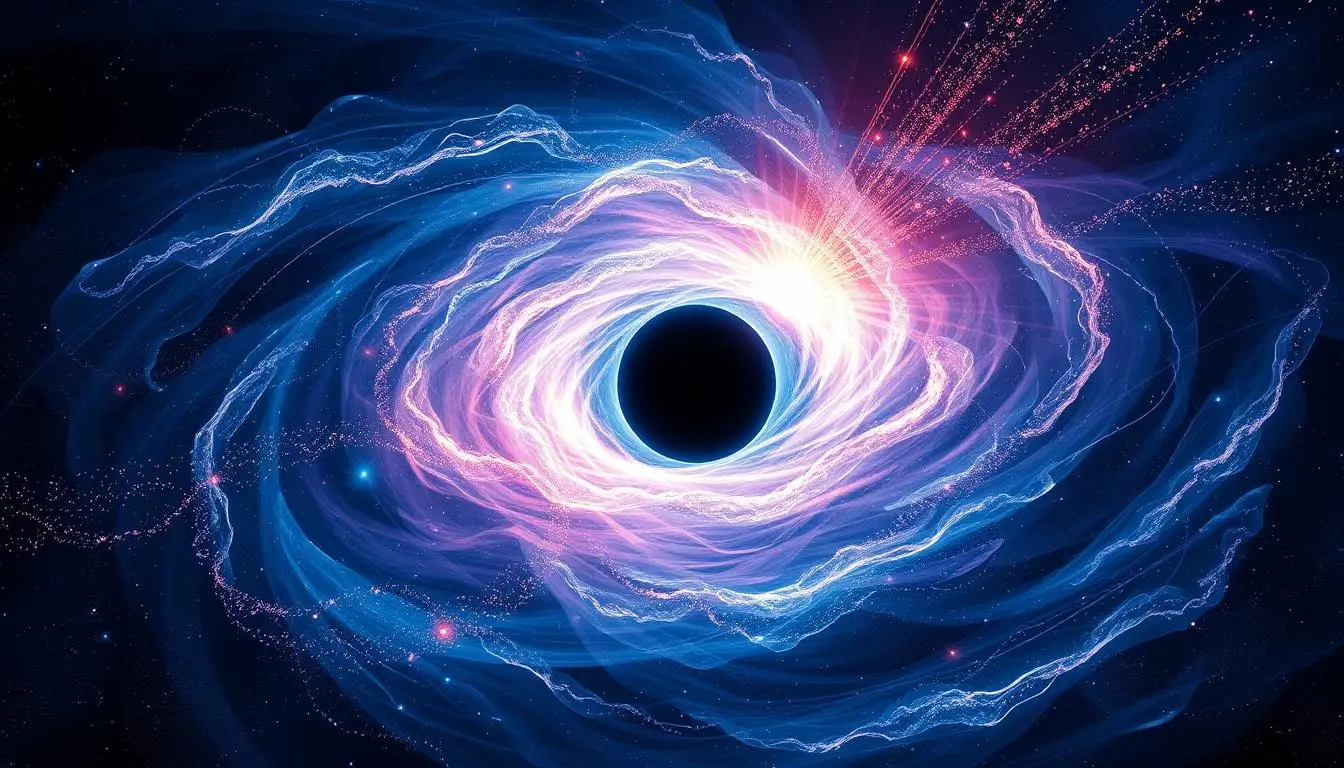
Stephen Hawking changed how we see black holes in the 1970s. He found that black holes emit faint radiation, now known as Hawking radiation. This idea makes us question how information is lost in these cosmic objects.
Hawking radiation is a kind of thermal radiation that comes from outside a black hole’s event horizon. It makes black holes lose mass and spin over time. This process links to quantum mechanics and black hole thermodynamics.
The temperature of Hawking radiation, or Hawking temperature, decreases as a black hole gets larger. For example, a black hole as big as our sun has a temperature of just 60 nanokelvins. This is colder than the cosmic microwave background radiation15. Finding Hawking radiation from big black holes is hard with today’s tech14.
“The presence of an event horizon, previously thought to be crucial for radiation, is shown to be not necessary for the creation of particles, indicating a new form of radiation.”
Recent studies have questioned old ideas about Hawking radiation. Researchers at Radboud University found that particle creation near a black hole is best at small distances. But the chance for these particles to escape increases at greater distances. This means that even objects without an event horizon, such as dead star remnants, could emit this radiation.
This research has big implications. It shows that over a very long time, this radiation could cause all large objects in the universe to evaporate, like black holes. But this would take trillions of years.
| Object | Radiation Temperature | Evaporation Rate |
|---|---|---|
| Solar Mass Black Hole | 60 nanokelvins | Extremely slow |
| Moon Mass Black Hole | 2.7 K | In equilibrium |
| Micro Black Hole | Much higher | Rapid |
Even though we can’t detect this evaporation yet, studying black hole thermodynamics is still important. It helps us understand quantum mechanics and the universe better14.
Black Holes and Spacetime
Black holes warp spacetime in amazing ways, creating cosmic phenomena that challenge our understanding of the universe. These gravitational giants bend light, twist time, and potentially open doors to interstellar travel.
Gravitational Lensing
Black holes bend light paths around them, causing gravitational lensing. This effect can magnify distant galaxies, allowing astronomers to peer deeper into space. Near a black hole, time slows dramatically, making objects appear frozen at the event horizon.
Warping of Spacetime Fabric
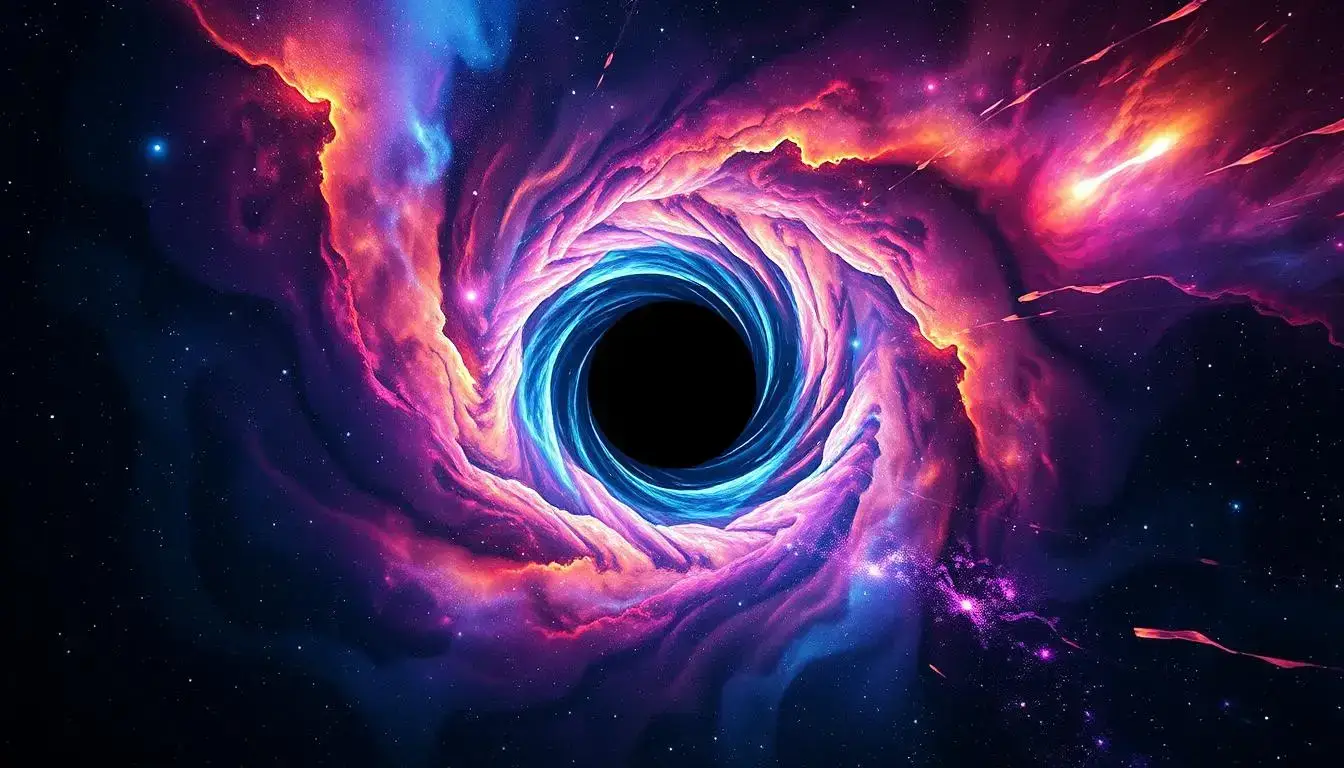
The Schwarzschild geometry describes how black holes warp spacetime. This warping becomes extreme near the Schwarzschild radius, where time dilation effects are profound. Objects falling into a black hole appear to freeze and redshift to outside observers.
Potential for Time Travel
Some scientists speculate that black holes might lead to other universes, but this remains unproven. The concept of wormholes, theoretical tunnels through spacetime, has sparked imaginations about possible interstellar travel. However, these ideas remain in the realm of science fiction.
“The nature of time inside a black hole is one of the greatest mysteries in physics.”
Understanding black holes is crucial for developing theories about the structure of the universe. While direct experiments inside black holes are impossible, studying their effects on spacetime from the outside provides valuable insights17.
| Phenomenon | Effect |
|---|---|
| Gravitational Lensing | Bends light paths |
| Time Dilation | Slows time near the event horizon |
| Schwarzschild Radius | Critical point of extreme warping |
Observing Black Holes: Techniques and Discoveries
Scientists have made big steps in observing black holes. They use advanced tech to reveal these cosmic mysteries. The Event Horizon Telescope captured the first-ever image of a black hole, a major breakthrough in astrophysics.
This achievement has opened new avenues for studying black holes. It also tests the theories of general relativity. Gravitational waves are another key tool for finding black hole mergers. These waves, predicted by Einstein, give us vital info about the mass and spin of colliding black holes.
Astronomers have found strong gravitational pull and energy at the centers of galaxies. This shows that supermassive black holes exist in almost all large galaxies, including our Milky Way.
The Hubble Space Telescope has been crucial in black hole research since the 1990s. It showed that huge black holes, millions or billions times more massive than our Sun, exist. Hubble found a link between a black hole’s mass and a galaxy’s stellar bulge, hinting at a feedback loop between galaxy growth and black hole size.
These findings have greatly improved our understanding of the universe. The James Webb Space Telescope will soon offer even more insights into black holes and galaxy evolution19. By studying early black holes, scientists aim to learn more about these cosmic giants and their role in the universe.
These ongoing research efforts promise to reveal more secrets about black holes. They will help us understand their deep impact on the cosmos.
Black Holes FAQ
What are black holes?
Black holes are areas in space where gravity is so strong that nothing, not even light, can get out. They happen when massive stars collapse after using up all their fuel.
What are the different types of black holes?
There are several types of black holes. Stellar black holes form when stars collapse. Supermassive black holes are found at the centers of galaxies.
What are the key components of a black hole?
A black hole has a few main parts. The singularity is a point of infinite density. The event horizon is where nothing can escape. The accretion disk is a swirling cloud of gas and dust.
How do stellar black holes form?
Stellar black holes form when stars bigger than our sun run out of fuel. Their core collapses, causing a huge explosion. If the core is big enough, it turns into a black hole.
How do supermassive black holes form?
Supermassive black holes might form from massive gas clouds or by merging smaller black holes. They could also come from the early universe.
What is the role of Einstein’s theory of general relativity in understanding black holes?
Einstein’s theory helps us understand black holes. It shows how massive objects warp space and predicts the existence and properties of black holes.
What is the event horizon of a black hole?
The event horizon is the point of no return around a black hole. It warps space in unique ways, such as time dilation and the stretching of matter.
What is Hawking radiation?
Hawking radiation is the faint radiation emitted by black holes, discovered by Stephen Hawking. It shows that black holes can slowly disappear over time.
How do black holes affect spacetime?
Black holes warp space in extreme ways. This leads to effects like gravitational lensing and unique shapes in space.
How do scientists study black holes?
Scientists study black holes in many ways. They use the Event Horizon Telescope to detect gravitational waves and study nearby stars.
Source Links
- Top 10 Documentaries on Black Holes: Unveiling Cosmic Mysteries – https://www.factualamerica.com/documentary-lab/10-documentaries-that-explore-the-mysteries-of-black-holes
- Unveiling the Cosmic Abyss: Exploring the Enigmatic Black Holes; – https://medium.com/@zohaibalijanjua79/unveiling-the-cosmic-abyss-exploring-the-enigmatic-black-holes-6269d09f308b
- Black holes, explained – https://news.uchicago.edu/explainer/black-holes-explained
- How merging black holes could reveal the nature of dark matter – https://www.astronomy.com/science/how-merging-black-holes-could-reveal-the-nature-of-dark-matter/
- Black hole – https://en.wikipedia.org/wiki/Black_hole
- Are there different types of black holes? – https://wtamu.edu/~cbaird/sq/2022/08/02/are-there-different-types-of-black-holes/
- What are stellar-mass black holes? – https://www.astronomy.com/science/what-are-stellar-mass-black-holes/
- Supermassive black hole – https://en.wikipedia.org/wiki/Supermassive_black_hole
- Astronomers Reveal First Image of the Black Hole at the Heart of Our Galaxy – https://eventhorizontelescope.org/blog/astronomers-reveal-first-image-black-hole-heart-our-galaxy
- Black holes test the limits of Einstein’s relativity | Astronomy.com – https://www.astronomy.com/science/black-holes-test-the-limits-of-einsteins-relativity/
- Imagine the Universe! – https://imagine.gsfc.nasa.gov/science/objects/black_holes1.html
- Event Horizon in Black Holes: Where There Really is No Going Back! – https://stargazingireland.com/event-horizon/
- What Happens When Something Gets ‘Too Close’ to a Black Hole? – NASA Science – https://science.nasa.gov/universe/what-happens-when-something-gets-too-close-to-a-black-hole/
- Black Holes Evaporate–Now Physicists Think Everything Else Does, Too – https://www.scientificamerican.com/article/this-is-the-way-the-universe-ends-by-evaporating/
- Hawking radiation – https://en.wikipedia.org/wiki/Hawking_radiation
- Black hole evaporation: Theoretical study proves Stephen Hawking partially correct – https://phys.org/news/2023-06-black-hole-evaporation-theoretical-stephen.html
- –Universe Forum–Black Holes–What are they? – https://lweb.cfa.harvard.edu/seuforum/bh_whatare.htm
- 11.2: Spacetime Near Black Holes – https://phys.libretexts.org/Bookshelves/Astronomy__Cosmology/Big_Ideas_in_Cosmology_(Coble_et_al.)/11:_Black_Holes/11.02:_Spacetime_Near_Black_Holes
- How Do We Know There Are Black Holes? – https://webbtelescope.org/contents/articles/how-do-we-know-there-are-black-holes