Trump Seeks to Increase Tariffs Despite Supreme Court Ruling
Explore the latest on President Trump’s push to hike tariffs in light of a recent Supreme Court decision affecting global trade relations.

President Donald Trump looked upset Friday after the Supreme Court ruled against his tariffs. Yet, he made it clear that tariffs are key to his economic and security plans. He sees them as a way to control foreign goods and protect the nation. Trump imposes 10% global Tariffs, now he is pushing for 15% globaly.
In a quick news conference, Trump said the court’s decision doesn’t limit his options. He claimed he could use other laws and powers to impose tariffs.
Now, Trump is looking at new ways to use tariffs. He plans to impose a 10% tariff on all imports soon. This change could affect many businesses that depend on steady supplies.
This move is significant. Trump knows tariffs are now more complex to use. But his team sees them as a quick way to act and make money. They want to quickly increase the tariff rate to 15%, as PBS NewsHour’s coverage reports.
The battle over tariffs is far from over. The debate over emergency powers could expand or limit the president’s powers. This issue is drawing the courts and Congress back into the tariff debate, as Network World News explains.
Key Takeaways
- Trump criticized the Supreme Court after it struck down tariffs tied to an emergency law.
- He signaled that he will keep using tariffs and trade as core economic and security tools.
- He said other “methods, practices, statutes and authorities” remain available to him.
- Trump plans a temporary 10% global tariff under Section 122 “in the next few days.”
- The ruling makes the tariff strategy more complicated and may reduce fast revenue options.
- The fight over the definition of tariffs and who controls them is likely to move to new legal and political ground.
Supreme Court strikes down Trump’s emergency-law trade tariffs
The Supreme Court has made a big change in how a president can act on trade in emergencies. This affects import and export tariffs, as well as the tariffs businesses plan for each year.
The ruling was a big setback for Trump’s trade plans. For a simple explanation, the Supreme Court’s opinion strikes down tariffs broke down the legal points and what’s at stake.
What did the 6-3 ruling invalidate under the International Emergency Economic Powers Act of 1977
The Court voted 6-3 against Trump’s use of new import tariffs under the International Emergency Economic Powers Act of 1977 (IEEPA). Chief Justice John Roberts said IEEPA doesn’t mention tariffs or duties. He said Congress must clearly give the president such power.
The Court also used the “major questions” doctrine. This doctrine requires Congress to explicitly grant power to make major economic decisions. This could change how lawyers argue about tariffs in the future.
Trump’s reaction at the White House: calling the decision “terrible” and “a disgrace.”
Trump learned of the ruling during a meeting with governors. He was upset, calling it “a disgrace.” People there said he was angry and spoke in short, sharp sentences.
Later, he called the ruling “terrible” and said it was “an embarrassment to their families.” He hinted at other options, even though the decision took away the basis for the tariffs.
Justices in focus: Barrett and Gorsuch criticized, Kavanaugh/Thomas/Alito praised via the dissent
Trump was harsh toward two of his appointees, Justices Amy Coney Barrett and Neil Gorsuch. They joined Roberts and three Democratic justices to block the tariffs. Justices Sonia Sotomayor, Elena Kagan, and Ketanji Brown Jackson agreed with them on IEEPA.
He praised the dissenters—Justices Brett Kavanaugh, Clarence Thomas, and Samuel Alito. He used Kavanaugh’s dissent to argue that tariffs are a traditional tool. This split shows how the Court might view other trade laws in the future.
- Majority view: IEEPA is not a backdoor for tariffs without clear congressional language.
- Dissenting view: Tariffs can be a traditional tool for regulating imports, and other laws may support certain tariffs with greater procedural safeguards.
Claims of the court being “swayed by foreign interests” and the lack of evidence offered
Trump said the Court was influenced by foreign interests, but he didn’t provide evidence. This claim added to the tension, but it didn’t change the ruling’s impact. The emergency-law route for these tariffs is now closed.
Even as he criticized the decision, Trump suggested it could empower him to pursue other legal avenues. This keeps companies in the dark about future tariffs.
Tariffs
After the Supreme Court setback, Trump is focusing on import duties as a key tool. He sees them as a way to bring supply chains back to the U.S. and protect national security. He believes tariffs help domestic production and give the U.S. more power in trade talks.
https://www.youtube.com/watch?v=sGdZOl-TUUw
Policy goal remains central: Trump signals he will keep using import duties as an economic and national security tool
Even with the legal setback, Trump’s policy remains the same. He points to tariffs on autos, electronics, and other goods as benefits for voters. For a quick look at the impact, check the SCOTUS ruling update on importers and consumers.
Alternative authority: plan to impose a temporary 10% global tariff on all imports under Section 122
Trump is now looking at Section 122 for a 10% tariff on all imports. Supporters say this is easy to explain and quick to apply. Critics worry about higher prices for consumers.
150-day clock: the tariff expires unless Congress acts to extend it
Section 122 has a 150-day limit. If Congress doesn’t extend it, the tariff ends. This creates a deadline that affects retailers’ ordering and inventory.
Behind-the-scenes scramble: aides describe an “irate” mood and a shifting point-by-point plan
Trump’s team is racing to find a new way to keep tariffs and protect revenue. The mood is tense as they work out the details. The next deadline is August 1, raising questions about tariffs and their impact.
- They are figuring out how to discuss tariffs without making price commitments.
- They are watching for signs of trouble in shipping, autos, and household goods.
- They are looking at how tariffs might change where goods come from, not just in the U.S.
Political and economic implications of higher import tariffs and global tariffs
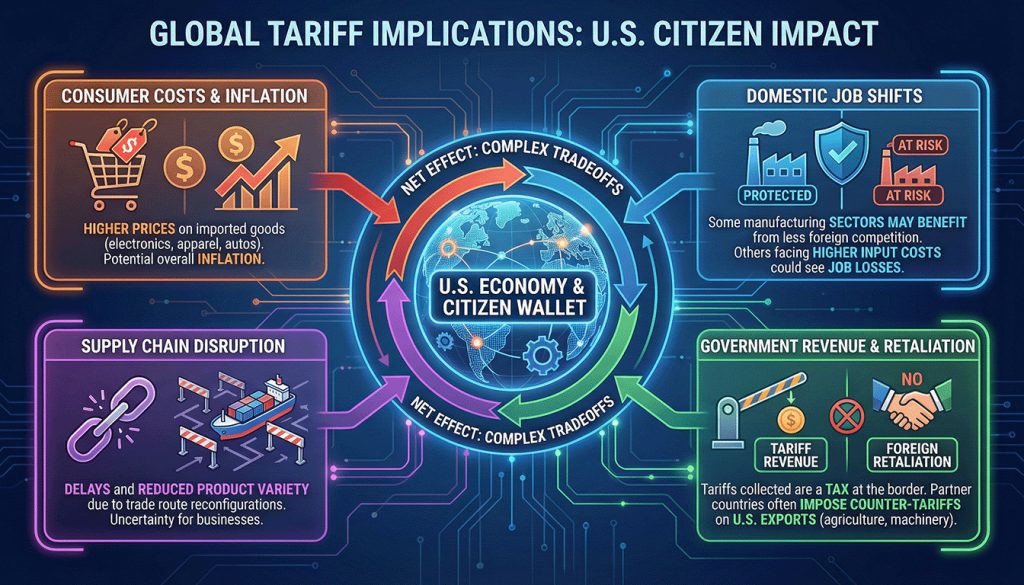
The political fight is now tied to everyday expenses. Candidates are weighing the tariff implications. They see how trade tariffs could affect prices, jobs, and business confidence.
Warnings from inside the GOP
Marc Short, a former Trump White House official, has warned fellow Republicans. He said broader trade tariffs can slow growth and increase consumer costs. Short believes the party’s midterm chances would improve if Trump accepted the court’s limits.
Short explained it as a policy tradeoff. Tax relief and deregulation can boost investment. But rising import tariffs can undermine that growth. He expects the White House to keep looking for narrower tools to pressure imports.
Democratic messaging in battlegrounds
In Pennsylvania, Democratic strategist J.J. Abbott has said the ruling won’t protect Republicans who backed trade tariffs. He says the message is clear: affordability is key, and import tariffs lead to higher prices and tighter margins.
Democrats also point to effects beyond retail, like farm demand and small-business costs. They often cite trade-war tariff data to show that tariffs affect more than just Washington.
Congressional responses
On Capitol Hill, opinions are divided. Sen. Bernie Moreno has urged Republicans to quickly codify tariffs, calling the court decision a betrayal. Moreno wants fast action through reconciliation.
Speaker Mike Johnson has signaled a slower pace. He says Congress and the administration will choose the best path in the coming weeks. This gap matters because trade tariffs are harder to sell when lawmakers must vote on them, line by line.
Strategy tension
Trump has claimed Congress would back him if he asked for new authority. But he also suggests he won’t ask. This mixed signal leaves allies guessing and keeps tariff implications uncertain for importers and exporters.
The math is tight in a narrowly divided House and Senate. Any push to expand tariff powers could turn into a whip-count problem. The broader U.S.-Canada fallout shows how trade tariffs can prompt retaliation and new sourcing plans, as outlined in Canada-U.S. trade coverage. Trump’s campaign pitch has leaned on tariffs as leverage and as a source of revenue, a message echoed in a recent speech-focused report, even as import tariffs remain a flashpoint for swing voters.
Conclusion
The Supreme Court ruled 6-3 against Donald Trump’s plan to use tariffs under the International Emergency Economic Powers Act of 1977. This decision doesn’t stop Trump’s efforts; it just changes his approach. Now, the White House must find new ways to push for trade policies while keeping tariffs a key part of Trump’s economic message.
Trump called the ruling “terrible” and “a disgrace.” He mentioned other options he could use. One idea is a 10% global tariff under Section 122, which would affect almost all imports. Tariffs are taxes on imports that can raise consumer prices.
The clock is ticking: Section 122’s temporary tariff expires in 150 days unless Congress extends it. This makes legislative action critical. Republicans are divided on tariffs, with some worried about inflation and others wanting to make tariffs law. Democrats in key states are focusing on affordability and the impact on small businesses and farmers.
The debate is not just about tariffs but also their types and scope. The cost of tariffs is already a point of contention. Studies by the New York Fed show most tariff costs fall on U.S. importers and buyers. Import prices have risen as tariffs increased in 2025, as explained in Who Is Paying for the 2025 U.S. Tariffs? The tariffs have also led to higher costs for retailers, with Walmart noting the impact on everyday items, as seen in Walmart raises prices.
In summary, despite the legal hurdles and internal challenges, Trump vows to continue pushing for tariffs. He aims to find lasting authority to support them.