New Chosen Iran Leader Mojtaba Khamenei, Son of former Supreme Leader Ali Khamenei
Unveiling Iran’s next potential leader: Mojtaba Khamenei, the influential son of ex-Supreme Leader Ali Khamenei, rises in political stature.

Iran’s top leader has changed to Mojtaba Khamenei. This marks a new, tense chapter for Iran’s ruling class. The move comes after his father, Ali Khamenei, passed away. It’s seen as a test of survival, not a chance for change.
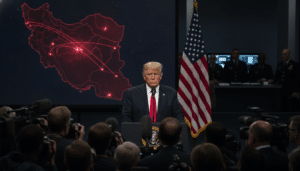
Mojtaba Khamenei’s rise is seen as more of the same rather than a big change. He is now the son of the supreme leader at a time when Iran is standing firm against U.S. pressure. Trump wants to end the War, but strategic targets remain. Oil prices will continue to rise as the war drags on.
Mojtaba Khamenei, the supreme leader, also instills fear among critics. They worry Iran is moving towards a dynastic rule. This goes against the belief that the 1979 revolution ended such transfers.
This move is also a message to the world. U.S. President Donald Trump had said Mojtaba Khamenei leading Iran was “unacceptable.” But Tehran’s choice shows they are ready to stand firm and resist.
Mojtaba Khamenei’s profile supports the idea that power is becoming more concentrated. Reports have shown his close ties to the IRGC and the security state. His background has also caught international attention, including in a profile of Mojtaba Khamenei.
Mojtaba Khamenei Key Takeaways
- Mojtaba Khamenei has become Iran’s new leader after the death of Ali Khamenei.
- The shift is widely seen as continuity for Iran’s clerical ruling class, not a reset.
- The ayatollah Khamenei’s son taking power raises renewed claims of dynastic rule.
- The selection signals Tehran’s intent to resist U.S. pressure and stay on a hard-line track.
- Mojtaba Khamenei is often associated with the IRGC, reinforcing the security state’s role.
- The new supreme leader’s son enters office under intense regional conflict and global scrutiny.
Mojtaba Khamenei was chosen as Iran’s new supreme leader after Ali Khamenei’s death
Iran’s succession story moved quickly, even amid a near-total communications blackout. Many outside observers focused on the supreme leader’s son. They wondered what his rise could mean for Iran’s political influence in the coming weeks.
What Iranian state media reported and why the succession is historic
State media pushed a biography that highlighted Mojtaba Khamenei’s discipline, family background, and religious studies. They showed a documentary about his early life, seminary years in Qom, and service in the Iran–Iraq War as a teenager.
This approach aimed to answer a sensitive question within the clerical class in Iran. It was whether Mojtaba Khamenei had the scholarly weight expected of a leader. With limited footage, some reports said broadcasters used AI to enhance his image.
Critics saw the optics as important as the process. The move from father to son could be seen as a departure from the revolution’s promise of opposition to inherited rule. It might turn Iran’s religious system into a dynasty around a key political figure.
How the Assembly of Experts made the decision
The 88-member Assembly of Experts voted on Sunday, giving the move formal backing under Iran’s constitution. This CBC explainer provides more details. It notes that Mojtaba Khamenei has not held a formal government post, despite his influence.
State messaging quickly emphasized unity. Reports described a rapid shift in public support from the president, parliament, and the IRGC. This was designed to show the system was intact and that Iran’s political influence would remain concentrated at the top.
- Fast, coordinated statements from major institutions
- Public displays of loyalty in key urban spaces
- Religious symbolism is tied to the timing of the announcement
Context of Ali Khamenei’s reported killing and the wider leadership shock
Iranian reports linked the leadership change to the shock of Ali Khamenei’s death in U.S.–Israeli air strikes. The timing was tight, allowing the clerical class to show continuity.
International coverage added pressure, focusing on whether the new leader would face threats or isolation. Details on the strikes and reactions were outlined by NBC News. Tehran’s narrative emphasized consolidation around the supreme leader’s son.
The public picture is built from fragments: controlled footage, official statements, and signals from security-linked institutions. Many Iranians and Americans wonder how far Iran’s political influence will shift—or if it will stay the same.
Behind-the-scenes power: the Iranian politician profile, political influence in Iran, and Revolutionary Guard connection
Mojtaba Khamenei is seen as a behind-the-scenes politician. He hasn’t held jobs that Americans expect from top leaders. Yet, his name is known in Tehran as a sign of real power.

His rise to power has brought attention to the Islamic Republic’s informal authority. People wonder how he built trust, access, and loyalty over the years.
A powerful political figure in Iran without elected office
Mojtaba Khamenei is a powerful figure in Iran, even without elected office. He worked in his father’s office, touching on security, politics, and appointments. This role is often compared to a chief of staff.
Succession talk grew louder in 2021. Social media posts in Tehran promoted him as the next leader. This hinted at his influence through networks rather than elections.
Revolutionary Guard connection and security establishment ties
Mojtaba’s ties to the Revolutionary Guard and the security establishment are key. He has close connections with the Islamic Revolutionary Guard Corps and the state’s economic networks. These ties help stabilize his rise to power, even under pressure.
In 2019, the U.S. Treasury accused him of working with senior security leaders. This record makes him seem like a gatekeeper rather than a public leader.
Role during the Green Revolution and allegations of crackdown coordination
His reputation grew during the 2005 election and the 2009 Green Movement protests. Many believe he supported Mahmoud Ahmadinejad and mobilized conservatives against Akbar Hashemi Rafsanjani. These claims are politically charged and shape discussions about power.
After Ahmadinejad’s disputed re-election in 2009, protests were crushed. Chants against Mojtaba showed his personal connection to the protests. This episode continues to influence debates about power in Iran.
Public visibility, clerical background, and what is known about his views
Mojtaba was born in 1969 and studied theology in Qom. He has clerical titles, but his scholarly rank is debated. He is married to Zahra, the daughter of former parliament speaker Gholam Haddad Adel, linking him to influential networks.
He has a low public profile, with few speeches and statements. This silence sparks speculation about his priorities. His supporters see him as a steady figure for continuity. For outsiders, his Revolutionary Guard connection is key to understanding governance.
Mojtaba Khamenei Conclusion
Iran’s clerical leaders have chosen Mojtaba Khamenei as the new top figure after Ali Khamenei’s death. This move has sparked debate, as it seems like a direct handover from father to son. This is significant in a country that rejected monarchy after the 1979 revolution.
The decision by the 88-member Assembly of Experts is likely to increase public frustration. Critics say it strengthens the clerical class in Iran and limits accountability. With Mojtaba Khamenei closely linked to the ruling machinery, the debate over legitimacy is expected to intensify.
Internationally, the move sends a clear message. Mojtaba Khamenei was once called “unacceptable” by Donald Trump. His elevation could be seen as a challenge to Washington. The process also highlights a stronger link to the Revolutionary Guard, which is pushing for unity and control.
Even if Iran changes its approach abroad, it faces significant challenges at home. Economic troubles, infrastructure needs, and high unemployment have eroded trust. A leadership change alone won’t solve these problems. As Iran International reports, Mojtaba Khamenei faces tough times with few easy solutions, while the clerical class focuses on survival.