Iran Now Controls the Strait of Hormuz: What You Should Know
Iran’s influence over the strait of Hormuz is critical for global oil transportation. Discover its geopolitical significance and impact on international shipping.

Nearly six months into the conflict with Iran, a big question for the U.S. is: will the Strait of Hormuz stay open? Or will Iran control it? This question is very important because the strait is key to the Middle East and global energy.
At first, the goals of the war were unclear and kept changing. People talked about regime change and weakening Iran’s nuclear and military power. Now, the main focus is on who controls the Strait of Hormuz and sets the rules for ships.
Brett McGurk, a CNN global affairs analyst, explained the stakes. If Iran controls the strait, it can control the world’s energy flow. This makes the strait like a global economy thermostat.
The risk for the U.S. and global markets is not just delayed ships. It’s the power to set prices and earn billions from transit fees. Recent reports have shown who controls the strait and if any tolls are valid, as detailed in an AP News report on the Strait of Hormuz.
The U.S., Gulf states, and the international community disagree with Iran’s rules for ships. They say the strait must stay open for all. Even small fights can affect shipping, insurance, and energy prices, making tensions worse, as explained in this analysis of how a Hormuz shock could hit the United States.
Key Notes
- The Strait of Hormuz has become the main flashpoint, with “control” now central to the conflict’s direction.
- The geopolitical significance of the strategic waterway is tied to energy flows that can sway prices worldwide.
- Brett McGurk frames the issue as leverage: the ability to meter energy like a thermostat for the global economy.
- U.S. officials and regional partners reject limits on navigation, arguing the route must stay open to all lawful shipping.
- Transit-fee talk raises major stakes, including possible revenue in the tens of billions and added strategic pressure on markets.
- Middle East tensions around the Strait of Hormuz can ripple into insurance costs, shipping delays, and broader supply stress.
How the conflict shifted into a fight over a maritime chokepoint in the Persian Gulf
What began as a campaign with changing goals has evolved into a battle for control of the Strait of Hormuz. This narrow passage in the Persian Gulf is now at the center of the conflict. Small actions here can have big impacts.
Iran’s stance on shipping has become more aggressive. It is now openly threatening or targeting commercial vessels in the Strait. This is happening when these ships refuse to comply with Iran’s demands.
The immediate goal is not to sink ships or block the waterway completely. Just a few credible attacks, drone sightings, or seizures can cause significant disruptions. This can scare off insurers, make shipowners hesitant, and make crews cautious. All this slows down the flow of goods that supports global trade.
This shift also challenges a long-held assumption. For years, many thought the Strait of Hormuz would always remain open, even during tense times. Now, this belief is no longer certain, and risk assessments are being updated in real time.
The situation is different from June 2025. During a 12-day war that included U.S. strikes against Iran’s nuclear sites, the Strait remained open. This makes today’s uncertainty feel like a new chapter, not just a repeat.
In the region, Gulf states near the strait have sided with Washington. They agree that free navigation is non-negotiable. This focus on navigation rules, not just military power, is key to keeping the international shipping route open. This route is vital for global trade.
What “control” of the strait of Hormuz looks like for oil transportation, global trade, and naval presence
In the strait of hormuz, “control” is not just a yes or no. It’s about slowing traffic, changing routes, or increasing insurance costs. This affects oil transport and global trade quickly. Even small changes in ship behavior can impact fuel prices and delivery times.
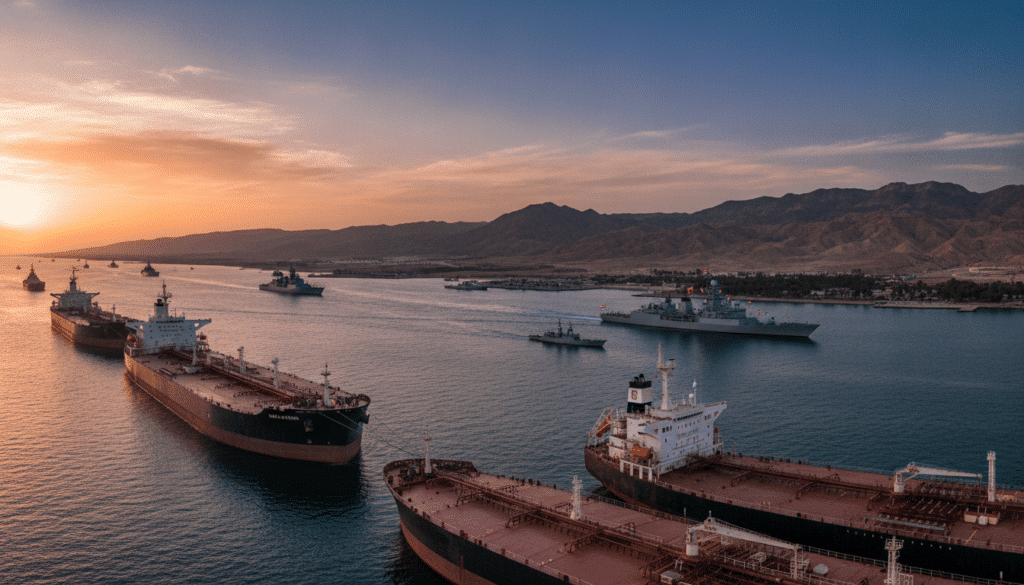
Shippers worry most about predictability. A steady naval presence keeps lanes open but can’t remove all threats. This uncertainty affects daily decisions on the water.
What’s moving through the waterway and why it’s an energy “thermostat”
Before the war, about 23 million barrels per day of energy products moved through the Strait of Hormuz. It was the main route for exports from Iraq, Kuwait, Qatar, and Bahrain. It also served as the main transit route for major flows from Saudi Arabia and the United Arab Emirates.
This corridor covers roughly 20% of global energy trade. When passage gets “metered,” global trade feels the impact. Prices and behavior change, but not drastically.
How Iran can disrupt an international shipping route without physically “closing” it
Disruption doesn’t need a declared blockade. Uncertainty and delay can thin the flow of oil. More inspections, tighter traffic separation, or sudden warnings can make captains hesitate.
Risk can also be pushed onto private actors. Insurers raising premiums or crews refusing certain transits can reduce ship numbers. This leads to higher costs and longer lead times in global trade.
Why restoring commercial confidence is difficult even with U.S. naval presence
A visible U.S. naval presence can deter attacks and speed up response times. Yet, commercial confidence is shaped by what shippers can measure. Incident reports, near-misses, and quick help in emergencies matter.
There’s also a coordination problem. Convoys, escorts, and rerouting can protect ships but create bottlenecks. The Strait of Hormuz may stay passable, but the business case remains shaky.
What changes next: bypass routes that could reduce reliance on Hormuz
To limit exposure, Gulf producers use bypass options. Saudi Arabia’s East-West pipeline and the UAE’s Abu Dhabi Crude Oil Pipeline are key. They offer alternatives when the Strait of Hormuz looks unstable.
These routes help but have limits in capacity and flexibility. As long as a large share of oil transport depends on the strait, global trade will price in the risk of disruption.
Strait of Hormuz Conclusion
The main point is simple: the focus of the conflict has shifted to controlling the Strait of Hormuz. Iran’s power now depends on its ability to decide who can pass through and under what conditions. This change makes the Strait of Hormuz more important than ever for global trade.
In the short term, oil transport might face challenges without a clear blockade. Drones and missiles targeting ships can increase insurance costs and slow down schedules. This makes the waterway seem unreliable, even if it’s technically open.
The U.S. has a tough job ahead to regain trust. Even with U.S. ships patrolling, threats can come from far away and blend in with regular traffic. This pattern is similar to recent issues at the Bab al-Mandeb, where shipping decisions were influenced by ongoing risks.
Over time, governments and energy companies are creating backup plans to reduce their dependence on Hormuz. They are building pipelines and routes to the Red Sea and the Mediterranean. This could limit the impact of any single waterway on global trade. For Americans, this means the U.S. needs to focus on supporting strong, resilient routes for oil transport and global trade.