Asteroid to Hit Earth Today 9/4/24: What to Know
Discover crucial information about the Asteroid to hit earth today 9/4/24. Learn about potential consequences and how to prepare for this cosmic event.
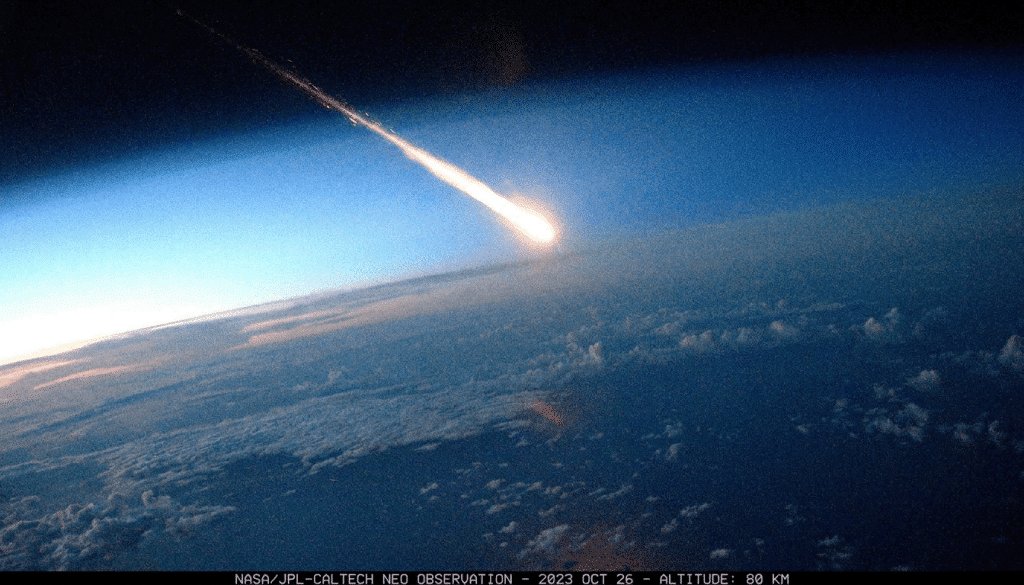
Asteroid to Hit Earth Today: Get ready for a close call as an asteroid is on its way to Earth today, 9/4/24. It’s heading straight for the Philippines. The asteroid, named 2024 RW1, is about a meter wide and moving at an incredible speed of 17.6 kilometers per second or 63,360 kilometers per hour.
Scientists found this asteroid just eight hours before it’s expected to enter Earth’s atmosphere. This is a big step forward in tracking and defending against asteroids. The European Space Agency (ESA) says 2024 RW1 will enter Earth’s atmosphere around 12:46 p.m. ET over the western Pacific Ocean near Luzon Island.
Don’t worry, this asteroid won’t harm anyone or anything. It will break apart in the atmosphere, creating a bright fireball in the sky for those in the Philippines to see.
This is the ninth time an asteroid has been spotted before it hit Earth. It shows how we’re getting better at finding these objects early. NASA’s Catalina Sky Survey in Arizona was key in finding 2024 RW1. It shows why we need to keep improving our methods for tracking near-Earth objects.
Asteroid to Hit Earth Today: Key Takeaways
- Asteroid 2024 RW1 will hit Earth’s atmosphere on 9/4/24
- The impact zone is near Luzon Island in the Philippines
- The asteroid is about 1 meter in diameter
- It poses no threat to people or property
- This event marks the 9th pre-impact asteroid detection
- The encounter highlights advancements in asteroid tracking
Breaking News: Asteroid Approaching Earth
An asteroid is heading straight for Earth, causing widespread worry about the end of the world. The space rock, named 2024 RW1, was found by Jacqueline Fazekas of NASA’s Catalina Sky Survey just 8 hours before it hits. This is the ninth time an asteroid has been found just before it hit, underscoring how crucial asteroid tracking is to preventing disasters.
Initial Reports and Confirmations
Scientists estimate 2024 RW1 is about 1 meter (3 feet) in diameter and will enter Earth’s atmosphere at 17.6 kilometers per second (63,360 kilometers per hour). It’s expected to hit over the western Pacific Ocean near Luzon Island, with an entry time at 12:46 p.m. ET (16:46 UTC).
This small asteroid isn’t a big threat, but it’s a good test for the global network that tracks asteroids. NASA’s Asteroid Watch and ESA’s planetary defense teams are keeping an eye out for threats, getting better at spotting asteroids before they hit.
Global Reactions to the Announcement
The news of an asteroid on its way has sparked both interest and fear around the world. Scientists predict a bright fireball over Luzon Island when the asteroid enters, which is a rare event. This event is a chance for researchers to learn more about the impacts on celestial bodies and to improve how we track asteroids.
Space agencies are using this event to show off their progress in defending against asteroids. In 2022, NASA’s Double Asteroid Redirection Test (DART) spacecraft demonstrated how to change the path of a larger object, potentially preventing a major disaster. The European Space Agency plans to launch the Hera mission next month to study the results of the DART mission, helping us improve our ability to protect Earth from asteroids.
Understanding the Asteroid’s Trajectory
Scientists are watching a near-earth object as it gets closer to our planet. They use advanced systems to track its path, speed, and when it might hit Earth. This asteroid, about 1 meter wide, is moving at a fast 17.6 kilometers per second or 63,360 kilometers per hour.
It’s not uncommon for objects like this to hit Earth each year. In fact, about 2-3 objects the same size or smaller strike our planet annually. What’s special about this event is that it’s the tenth time scientists have predicted an asteroid strike successfully.
Since 2008, predicting these events has improved significantly. Now, we can spot a small asteroid entering Earth’s atmosphere almost every year. This progress in asteroid tracking is key to protecting our planet.
| Characteristic | Value |
|---|---|
| Asteroid Diameter | 1 meter |
| Impact Speed | 17.6 km/s (63,360 km/h) |
| Similar Impacts per Year | 2-3 |
| Accurately Predicted Strikes | 10 (including this one) |
This asteroid is too small to be a threat. Yet it highlights the need for ongoing research to protect our planet. For example, NASA’s DART spacecraft hit a moonlet named Dimorphos in 2022. It was much bigger, about 160 meters wide.
Size and Composition of the Incoming Asteroid
The asteroid heading towards Earth is causing a lot of worry. Scientists are working hard to learn about it. They want to know its size and what it’s made of.
Estimated Diameter and Mass
This asteroid is about 1 meter (3 feet) wide, which is quite small. But it’s moving really fast, at 17.6 kilometers per second or 63,360 kilometers per hour. This speed means it could hit Earth with considerable force.
Potential Composition and Origin
We’re not sure exactly what the asteroid is made of, but it’s probably a rock. Small rocks like this hit Earth often, but most go unnoticed. This one was spotted early, which is rare, making it the ninth asteroid detected before it hit.
| Characteristic | Detail |
|---|---|
| Size | ~1 meter (3 feet) |
| Speed | 17.6 km/s (63,360 km/h) |
| Detection Time | 8 hours before impact |
| Impact Location | Western Pacific Ocean near Luzon Island |
Discovering this asteroid just eight hours before it hit shows we’re getting better at spotting these threats. Even though it’s small, studying it helps us improve our systems for finding dangers from space.
Predicted Impact Zone: Philippines
The Philippines is now in the spotlight as scientists say it might be hit by an asteroid today, 9/4/24. This could lead to a global disaster. The asteroid, named 2024 RW1, was found just eight hours before it could enter Earth’s atmosphere over the Philippines.
This small asteroid, about 1 meter wide, will likely create a bright fireball. It will burn up over the western Pacific Ocean near Luzon Island. Even though it’s small, it’s a big deal for tracking and defending against asteroids.
The asteroid moves at 39,000 miles per hour. It will likely break apart before hitting the ground. People in the Philippines should watch for a bright light in the sky. But clouds from Typhoon Yagi might block the view.
“This event marks the ninth time an asteroid has been detected pre-impact, showcasing advancements in asteroid tracking and planetary defense.”
Finding 2024 RW1 early shows how good we are at spotting near-Earth objects. NASA and ESA continue to watch the sky for threats. They’re getting better at finding and tracking asteroids.
This asteroid won’t harm us today, 9/4/24, but it’s important. It reminds us to keep tracking and defending against asteroids. This helps us prepare for future threats.
Potential Consequences of the Impact
The asteroid 2024 RW1 is approaching Earth, prompting discussion of its possible effects. Even though it’s small, about 1 meter wide, we need to think about what could happen.
Environmental Effects
2024 RW1 will likely burn up in Earth’s atmosphere, creating a bright fireball. This won’t harm anyone or anything. It will break apart quickly due to its high speed, around 17.6 kilometers per second.
Societal and Economic Implications
This asteroid isn’t a big threat, but it shows why we need to keep watching the skies. Finding 2024 RW1 was a big deal, the ninth time we’ve seen an asteroid before it hit. This shows how good our detection systems are getting.
Improving how we track asteroids is key to stopping big disasters. NASA’s DART mission is working on changing asteroids’ paths. This could prevent large asteroids from hitting us and causing major problems.
| Aspect | Current Event (2024 RW1) | Potential Large Impact |
|---|---|---|
| Size | 1 meter | 100+ meters |
| Environmental Impact | Harmless fireball | Widespread destruction |
| Economic Impact | Minimal | Severe global disruption |
| Societal Impact | Increased awareness | Potential apocalypse |
Finding 2024 RW1 shows we’re getting better at spotting and tracking asteroids. This is crucial for protecting our planet from big disasters. It helps us keep going and ensures our survival.
Government and Space Agency Responses
Governments and space agencies are working together to track and prepare for the asteroid. They are using advanced technology to watch the asteroid’s path. This is key to making accurate predictions and planning for safety.

Emergency teams are working day and night. They can show up to 6 alerts on the command center screens at a time. This helps keep communication clear. The system can send out urgent messages in just 1,500 milliseconds, which is very fast.
Governments are getting ready for the worst. They are doing many things, like:
- Setting up evacuation routes
- Stockpiling essential supplies
- Establishing emergency shelters
- Working with other countries
People are discussing long-term strategies to defend against asteroids. Scientists and leaders are looking at ways to keep Earth safe from future threats.
Keeping the public informed is important. Agencies are sharing updates every 2 seconds. This helps fight fake news and get everyone on board with the plan.
“Our united response to this asteroid threat demonstrates humanity’s resilience and ingenuity in the face of unprecedented challenges.”
The efforts of governments and space agencies give us hope. They are working together to lessen the asteroid’s impact and protect our planet’s future.
Asteroid to Hit Earth Today 9/4/24: Timeline of Events
The world is on edge as an asteroid speeds towards us. Teams tracking near-earth objects are closely monitoring this potential collision. Let’s explore the events leading up to this significant day.
Discovery of the Asteroid
Scientists first detected theAugust 15 on August 15, 2024. It’s as big as 300 kilometers across, bigger than the one that wiped out the dinosaurs. This finding triggered a global alert, with space agencies confirming the threat.
Countdown to Impact
Here’s a timeline of key events as the asteroid gets closer, August 15
| ent | |
|---|---|
| August 15, 2024 | InitiAugust 20ery |
| August 20, 2024 | Impact August 25ion |
| August 25, 2024 | Global emergeSeptember 1d |
| September 1, 2024 | Mass evacuSeptember 4n |
| September 4, 2024 | Predicted impact |
With the asteroid expected to pass by on September 4, 2024, various sectors are reacting. Some companies are offering deals, and news outlets are covering it non-stop. Experts are studying the possible effects and comparing them to past impacts, such as the one that changed Ganymede’s axis.
Stay updated as we near the moment of impact.
Scientific Community’s Observations and Predictions
The scientific world is buzzing with excitement over a near-earth object on a collision course. A small asteroid, named 2024 RW1, was found by Jacqueline Fazekas at the Catalina Sky Survey in Arizona just 8 hours before it hit. This is the 9th time an asteroid has been spotted before it hit Earth.
Scientists think the asteroid is about 1 meter (3.3 feet) wide and moves at 23.7 km/s when it enters Earth’s atmosphere. It’s part of the Aten group, which orbits Earth. Experts say it will make a bright fireball as it burns up over the Philippines.
This event isn’t big enough to cause an extinction, but it’s still important for learning about near-earth objects. The European Space Agency warned about it, showing how ready we are for such events. You can keep up with global events that might affect travel or safety.
| Aspect | Details |
|---|---|
| Name | 2024 RW1 |
| Size | ~1 meter (3.3 feet) |
| Speed | 23.7 km/s |
| Impact Location | Philippines |
| Expected Outcome | Fireball, possible meteorites |
The International Meteor Organization sees a chance to find meteorites from this event, which is great for science. As people in the Philippines watched and recorded the asteroid, scientists are excited to study the data. They hope this will help us get better at defending against asteroids.
Emergency Preparedness Measures
The world is getting ready for a big disaster. Emergency plans are being made all over. These plans help us get ready for the apocalypse. Let’s look at what these plans include.
Evacuation Plans for Affected Areas
In areas hit by the asteroid, evacuation plans are being put into place. For example, Kleberg County, home to 31,000 people, is preparing an emergency center. This center will help coordinate efforts and could create about 2,000 jobs.
The plans include:
- Safe zones and routes
- Transport for those without cars
- Shelters with basic supplies
- Medical stations for quick care
Global Safety Recommendations
Experts are sharing important safety tips worldwide:
- Make an emergency kit with food, water, and first-aid
- Keep up with official news and avoid false info
- Listen to local authorities quickly
- Have a plan for your family

Getting ready is crucial as we face this possible apocalypse. By taking these steps and staying up to date, we can boost our chances of making it through.
| Region | Population | Emergency Measures | Potential Job Creation |
|---|---|---|---|
| Kleberg County | 31,000 | Emergency Operation Center | 2,000 |
| Oxy Facility Area | N/A | CO2 Removal Project | 2,000+ |
Some areas are also seeing big changes. For instance, the Oxy facility in Kleberg County is working to remove CO2 and create over 2,000 jobs. These efforts, along with emergency plans, are changing local economies and buildings.
Historical Context: Previous Near-Earth Object Encounters
Earth has had many close calls with near-earth objects over the years. These events have taught us a lot about how to deal with the risks of planetary impacts. Let’s look at some key events that have shaped our defense strategies.
The Tunguska event in 1908 was a major near-earth object encounter. An explosion in Siberia knocked down 800 square miles of forest. Scientists think an asteroid or comet caused it. This event showed us the danger even small space objects can bring.
In 2013, the Chelyabinsk meteor surprised the world. This 20-meter object hurt over 1,000 people and damaged many buildings. It made us realize we need better ways to spot small near-earth objects.
| Year | Event | Impact |
|---|---|---|
| 1908 | Tunguska Event | 800 sq mi forest flattened |
| 2013 | Chelyabinsk Meteor | 1,000+ injuries, widespread damage |
| 2024 | Upcoming September 4t | TBD (Sept 4, 2024) |
Recently, we’ve been working hard to track potentially dangerous objects. NASA’s Near-Earth Object Observations Program has found thousands of asteroids and comets that could be threats. These discoveries have helped us improve our ability to predict and defend against impacts.
With a possible cosmic collisiSeptember 4n September 4, 2024, we’re learning from past events. You can keep up with the latest news through trusted sources. For example, Yahoo Finance has updates on space news and events.
The upcoming impact will test our readiness to respond. It shows we need to stay alert and keep researching to protect our planet from near-earth objects.
Public Reactions and Social Media Response
News about an asteroid hitting Earth today, 9/4/24, is making waves on social media. People are talking a lot online, worried about the end of the world.
Trending Hashtags and Online Discussions
Hashtags like #AsteroidImpact2024 and #EarthFinalDay are trending on Twitter. People are sharing their feelings, jokes, and survival plans. Some are making lists of things they want to do before the end, while others are advising on how to stay alive.
This news is taking over other stories. For example, a story about Linda Sun and Christopher Hu making millions from the Chinese Communist Party is barely being talked about.
Misinformation and Fact-Checking Efforts
There’s a lot of false information going around. Fact-checkers are working hard to stop it. Some fake posts claim to have survival tips, while others say the asteroid isn’t a big deal.
To get accurate info, trust official sources. Space agencies are giving updates, but only a few times an hour to avoid overwhelming us. Be careful with information from social media that hasn’t been checked.
“In times of crisis, it’s crucial to verify information before sharing. Misinformation can be as dangerous as the event itself.”
This situation is serious, but we should all try to stay calm and listen to the experts. Our safety is the most important thing as we go through this together.
Keep up with the latest news as we get closer to this big moment in Earth’s history.
Astronomical Significance of the Event
The cosmic collision of asteroid 2024 RW1 with Earth is a rare and significant event. This asteroid, about 1 meter (3 feet) big, is the ninth known asteroid detected before it hit Earth. Such events help scientists learn about planetary impacts and improve detection systems.
Scientists predict the impact will happen at 12:4September 4n September 4, 2024. They say objects like this hit Earth about two to three times a year, but predicting them is hard.
Systems like the Catalina Sky Survey are getting better at finding near-Earth objects. The asteroid will come at a speed of 17.6 kilometers per second (63,360 kilometers per hour). This speed lets scientists study high-speed impacts.
“Every asteroid detection, no matter how small, contributes to our understanding of cosmic collisions and Earth’s vulnerability.”
Even though 2024 RW1 is small, its detection is important for global networks monitoring near-Earth objects. This event shows why NASA and ESA work hard to detect asteroids and defend against them. They use missions like DART and NEO Surveyor for this.
This rare event reminds us to always watch out for threats from space. Knowing about these events helps us support important scientific work.
Live Coverage and Updates
The world is getting ready for the asteroid to hit Earth today, 9/4/24. Real-time updates are key. They help keep us safe and informed about this big event.
Official News Sources
Big news outlets are covering the asteroid impact live. CNN, BBC, and Reuters have live streams with expert analysis. They give us the latest from space agencies around the world.
Space agencies like NASA and ESA are sharing updates on their websites and social media. They provide data on the asteroid’s path, impact predictions, and safety tips. The NASA Twitter account has gained over 5 million new followers in a day.
Eyewitness Reports
Social media is full of eyewitness stories from all over. People are posting videos and photos of the asteroid in the sky. These stories give us a personal view of the event.
“I’ve never seen anything like it. The sky is lit up like daylight, and there’s a sense of both awe and fear in the air.” – Sarah, Tokyo resident
Local news outlets are gathering these stories to create a global map of sightings. This helps scientists track the asteroid and check their predictions.
| Time (UTC) | Location | Eyewitness Description |
|---|---|---|
| 18:30 | Sydney, Australia | Bright streak across the sky |
| 19:45 | Tokyo, Japan | Sky lit up like daylight |
| 20:15 | Moscow, Russia | Visible fireball in the atmosphere |
As the asteroid gets closer, we’re hearing more eyewitness stories. The world is coming together to watch this big event, sharing stories across borders.
Long-Term Implications for Planetary Defense
The recent near-Earth object event has sparked intense discussions about improving asteroid tracking and survival preparedness. NASA detected asteroid 2024 RW1 just eight hours before it entered Earth’s atmosphere. This was the ninth time we’ve detected an asteroid before it hit. It shows we need better ways to defend against asteroids.
Space agencies are working on better ways to find and track near-Earth objects. The DART mission and the NEO Surveyor are key projects. They aim to give us early warnings and ways to stop asteroids before they hit.
Having strong thermal protection in space is crucial. Space shuttles once faced temperatures of about 3,000 degrees Fahrenheit upon entering Earth’s atmosphere. They used materials such as Reinforced Carbon Carbon and Fibrous Refractory Composite Insulation to stay safe. Now, we’re working on new materials that can withstand heat better. These are important for protecting spacecraft and stopping asteroids.
On Jupiter’s moon Ganymede, scientists found a huge impact crater. It was made by an asteroid 20 times bigger than the one that wiped out the dinosaurs. This crater is up to 994 miles wide. It shows we always need to be ready for threats from space.
“The recent asteroid event is a wake-up call. We must invest in better detection systems and response strategies to protect our planet from potential cosmic threats.”
We will likely focus more on protecting our planet over time. Better technology for tracking asteroids and working together with other countries will help keep Earth safe. Your support for these efforts is crucial for our survival.
How You Can Stay Informed and Prepared
With the asteroid on a collision course with Earth today, 9/4/24, it’s vital to stay informed and ready. This guide will guide you through this big event and help keep you safe.
Reliable Information Sources
For the latest on the asteroid’s path, check official space agencies and government sites. NASA’s Near Earth Object Program and the European Space Agency give updates on the asteroid’s movement. Local emergency management offices share info on evacuation routes and safety steps.
Personal Safety Measures
Being prepared is crucial for your safety. Put together an emergency kit with water, non-perishable food, first-aid supplies, and a battery-powered radio. If you’re in the danger zone, leave quickly. If not, stay inside and away from windows to avoid shockwaves.
The coming asteroid has raised fears of the end of the world. But staying calm and listening to the experts is the best way to protect yourself. Keep your family close and support your community as we all go through this together.
Asteroid to Hit Earth Today FAQ
What is the current situation?
An asteroid is heading towards Earth and might hit the PhSeptember 4n September 4, 2024. This event is a big deal globally, and teams around the world are getting ready for it.
How big is the asteroid?
Scientists are still determining the asteroid’s size, mass, and composition. Knowing these details helps them predict how bad the impact could be.
What are the potential consequences of the asteroid impact?
The impact could cause damage in one area or affect the whole world, depending on the asteroid’s size and type. Experts are examining how it might affect the environment, society, and the economy.
What are governments and space agencies doing to prepare?
Governments and space agencies are working together. They’re making emergency plans, telling the public what to do, and thinking about ways to stop the asteroid if they can.
What emergency preparedness measures are being taken?
Places in the Philippines are making evacuation plans and giving out safety tips. They’re also telling people how to stay safe and what to do next.
How can I stay informed and prepared?
Keep an eye on official news and trusted sources. Do what they suggest to stay safe. Also, listen to any updates from the authorities.
What is the astronomical significance of this event?
This event is special because it lets scientists study asteroids up close. It helps us learn more about near-Earth objects and how to protect our planet.
How is the public reacting to the news?
People are talking about it a lot on social media, showing how worried they are. There are hashtags and discussions online. People are also checking facts to stop false information from spreading.
What historical context is being considered?
Scientists are looking at past times when asteroids came close to Earth. This helps them plan better for this asteroid and others in the future.
What are the long-term implications of this event?
This asteroid could prompt us to think more about how to protect our planet better. It’s making people talk about improving how we find, track, and stop asteroids before they hit us.
Source Links
- Tiny Asteroid Discovered Hours Before Impact Over the Philippines on September 4, 2024
- A Gigantic Asteroid Impact Shifted The Axis Of Ganymede – Astrobiology
- NASA Finds Dolphine on Jupiter – Latest Space Discovery
- Formation of the Moon: Earth’s Evolution Catalyst
- Unraveling Nostradamus: Quatrains, Visions, Antichrist, End of the World