Supreme Court Revises Texas Republican Voting Map
Explore the Supreme Court’s latest adjustments to the Texas Republican Voting Map, impacting GOP districts and future elections statewide.
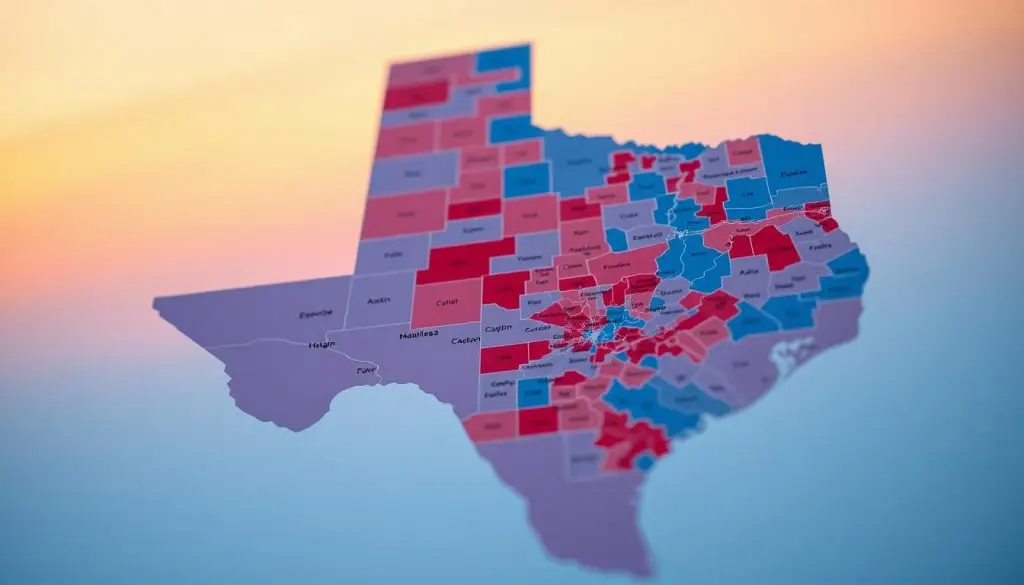
Texas Republican Voting Map
Texas Republican Voting Map: Thursday, when the Supreme Court made a big move. They allowed Texas to use a new voting map. This decision could change who wins up to five U.S. House seats in 2026.
Why is this important? It shows who gets a say when the outcome is close. The Texas Republican Voting Map is more than just lines on a map. It’s about who gets heard when the margins are thin.
Justice Samuel Alito had hinted at the Court’s decision earlier. The map was made by Republicans and signed by Governor Greg Abbott in August. It shows how quickly statehouses can change the future.
The map now moves from debate to action. I wonder: when lines change on paper, what changes in us?
Just before, a 2-1 panel in El Paso said the map was unfair. They ordered Texas to go back to the 2021 map. The NAACP pointed out that white voters have over 73% of congressional seats, even though Texas is about 40% white.
Judge Jeffrey Brown disagreed with the Justice Department’s concerns about race. His disagreement made the debate very sharp. U.S. Circuit Judge Jerry Smith’s dissent mentioned famous politicians, showing how heated redistricting can get.
This fight is happening all over the country. From California to Louisiana, the battle over voting maps is ongoing. The results of tomorrow’s elections will depend on today’s maps.
The stakes are high. If Democrats win in 2026, Donald Trump’s plans could be blocked. New investigations could start. This is not just a footnote—it’s the main story.
Texas Republican Voting Map Key Takeaways
- The Supreme Court cleared Texas to use a Trump-backed map that could add up to five GOP-leaning House seats in 2026.
- A lower court in El Paso had ordered a return to the 2021 map after finding likely racial gerrymandering.
- Justice Samuel Alito’s earlier pause foreshadowed the Court’s intervention in the election timeline.
- Governor Greg Abbott signed the map in August, after it passed the Republican-led legislature.
- The NAACP highlighted a gap between Texas’s demographics and its control of congressional seats, intensifying debate.
- National redistricting battles—from California to Louisiana—frame the broader stakes for Congress.
- Control of the House could hinge on how the Texas GOP voting map shapes voter power and turnout.
What the Supreme Court Decision Means for 2026 Midterms and Redistricting Battles
The moment the stay landed, I felt the ground shift. The map isn’t just lines; it’s a script for power. When I study the texas republican electoral map, I see choices, turnout, and the pulse of a state in motion.
Who benefits when timing becomes the tiebreaker? That question echoes as I weigh republican voting trends in Texas against a calendar that won’t slow down.
High Court lifts lower court block on Trump-backed map
The justices cleared the way for the new lines to guide filing and campaigns. I picture candidates redrawing their routes overnight. In this rush, Texas conservative districts take on fresh weight, shaping who shows up and who sits out.
Reports describe a swift intervention that restored the map for now. That’s a signal: process bends to the clock. I trace the court’s move and feel how deadlines turn legal theory into lived reality.
Potential flip of up to five Democratic-held U.S. House seats
Five seats—such a small number, yet so loud. On the texas republican electoral map, those flips look like tiny sparks; in the House, they can light a fire. I walk through districts in my mind and see swing suburbs, oil towns, and border hubs where a handful of votes can tip the day.
As Republican voting trends harden in some Texas suburbs and soften in others, the edges matter. Will a late surge in turnout override new contours? Or do these lines set the race before the first ad drops?
Impact on Republican control of Congress and Trump’s agenda
If these gains hold, committee gavels and floor debates tilt. That means more oxygen for priorities that animate Texas conservative districts, from energy policy to border oversight. If they don’t, the spotlight swings to investigations and procedural breaches.
I keep returning to a simple test: who gets to choose the questions? In Washington, that power decides which stories the nation hears first—and which never leave the folder.
Context: nationwide partisan map fights and gerrymandering precedent
Redistricting is now a coast‑to‑coast chess match. States trade moves, then race to court. One thread ties it together: the line between partisan intent and racial motive. The former often passes; the latter does not. But how do we read a mapmaker’s mind?
That puzzle defines the season, as filing clocks tick and appeals stack up. I scan new filings and note how the 2019 precedent frames today’s fights: draw hard for politics, but not for race. The tension hums beneath every district hearing and every precinct walk.
For voters, the practical question is more straightforward: where do I vote, and who now speaks for me? The answer lies in deadlines, in court calendars, and in the quiet corners of the Texas Republican electoral map. I follow those updates through the latest filings as they ripple across counties.
In the end, every map is a mirror. It reflects how we sort ourselves—and how power sorts us. As republican voting trends in texas evolve, I watch the margins, the middle, and the moves between them.
Texas Republican Voting Map: Legal Flashpoints, Political Stakes, and District-Level Impacts
I keep asking myself, what do lines on a map really choose? Looking at the texas republican district map, I see numbers and names. But I also hear the quiet voices that data can’t hold. Do we draw to reflect people, or to shape them?
The stakes feel personal. When I look at Texas GOP voter statistics and compare them with texas republican county voting data, I see patterns. These patterns hint at power, community, and trust. And I wonder—when the map shifts, whose daily life shifts with it?
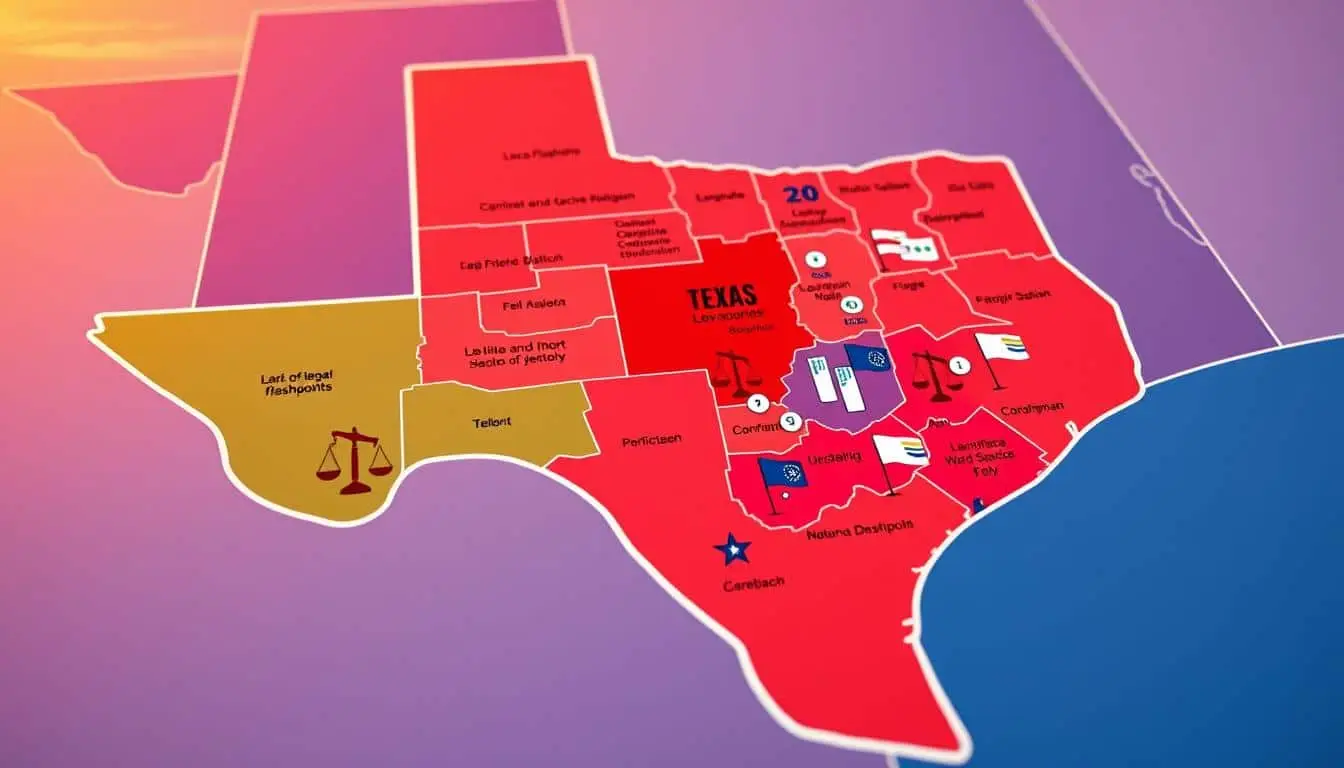
Lower court’s finding of likely racial discrimination vs. partisan intent claims
An El Paso-based panel split 2–1 and signaled that race likely drove parts of the redraw. One judge focused on how official guidance weighed racial composition when revising districts. Others read the record as partisan hardball. I paused at that divide. Is intent ever clean in a fight like this?
- Race as a trigger for legal scrutiny, even when partisanship is the stated aim.
- Partisan strategy is argued as the core driver, yet racial effects remain concrete.
- The texas republican district map sits in that tense space—contested, defended, lived.
14th and 15th Amendment considerations under equal protection and voting rights
The guardrails are clear on paper. Equal protection under the 14th Amendment and the 15th Amendment’s shield against racial discrimination anchor the courtroom logic. But after federal limits on partisan gerrymandering, the boundary between race and party feels blurred. Isn’t that where doubt and consequence thrive?
National debates on gerrymandering remind me that legal lines don’t always match lived lines. And yet, people vote, districts hold, and the result becomes real.
Texas legislature’s role and Governor Greg Abbott’s approval in August
Lawmakers in Austin drew the blueprint, and Governor Greg Abbott signed it in August. The process was brisk, public, and fiercely argued. In hearing rooms, the talk turned to growth, turnout, and coalition maps. I looked back at Texas GOP voter statistics and texas republican county voting data and saw the logic they leaned on—numbers marshaled like witnesses.
- Legislative control frames the timing and the contours.
- Executive approval seals the map into law.
- Public testimony echoes, but the ink moves quickly.
Republican majorities in Texas: 25 of 38 House seats and targeted gains
Republicans hold 25 of 38 seats and aim higher. The talk of five more seats is not just a forecast—it’s a plan to lock in advantage where margins are thin. The Texas Republican district map, read alongside Texas Republican county voting data, tracks precincts like fault lines. And the math behind Texas GOP voter statistics turns into a strategy. Who gets drawn in? Who gets drawn out?
When districts become instruments, we tune the future—sometimes to amplify, sometimes to quiet.
Even as courts weigh the line between race and party, campaign teams sharpen their paths. I keep asking: are we measuring voters, or are we measuring which voters matter most?
In a season of shifting rules and digital playbooks, even analytics guides—like a thorough audit—echo the same truth: what we track shapes what we build. Maps are no different. The lines tell a story, and the story tells us who we might become.
Texas Republican Voting Map Conclusion
The texas republican voting map is more than just lines on a page. It reflects the state’s political landscape and raises essential questions. The Supreme Court allowed it, despite concerns of racial bias. Governor Greg Abbott signed it in August, aiming to strengthen Republican control.
Republicans already hold most of Texas’s seats. The new map could flip up to five districts. Is this a fair representation of the people’s will, or just a power play?
The ruling is based on timing and disruption. It follows a pattern set by the Court in election cases. For more details, check out this SCOTUS analysis.
Across the nation, the debate over voting maps continues. California’s lines are under scrutiny, while Indiana is reconsidering its map. The Court has ruled on partisan gerrymandering, leaving Texas’s map in a complex situation.
Politics is rarely straightforward. The texas republican electoral map could benefit Donald Trump in 2026. Yet, it also raises questions about fairness and representation. The battle between fairness and strategy is intense.
Maps are promises we make to each other. Texas is evolving quickly, but its districts are not. The 2026 elections will test whether our democracy can adapt. If the lines hold, will trust be maintained?
The Texas Republican Voting Map, the Texas GOP Voting Map, and the Texas Republican Electoral Map pose a critical question. They ask if our rules can keep up with our democracy. The stakes are high, and the answer is far from clear.