Preparing for the Zombie Apocalypse: A Strategic Exercise by the U.S Government
Discover how the U.S. Government strategizes for a Zombie Apocalypse, enhancing emergency preparedness and survival insights.
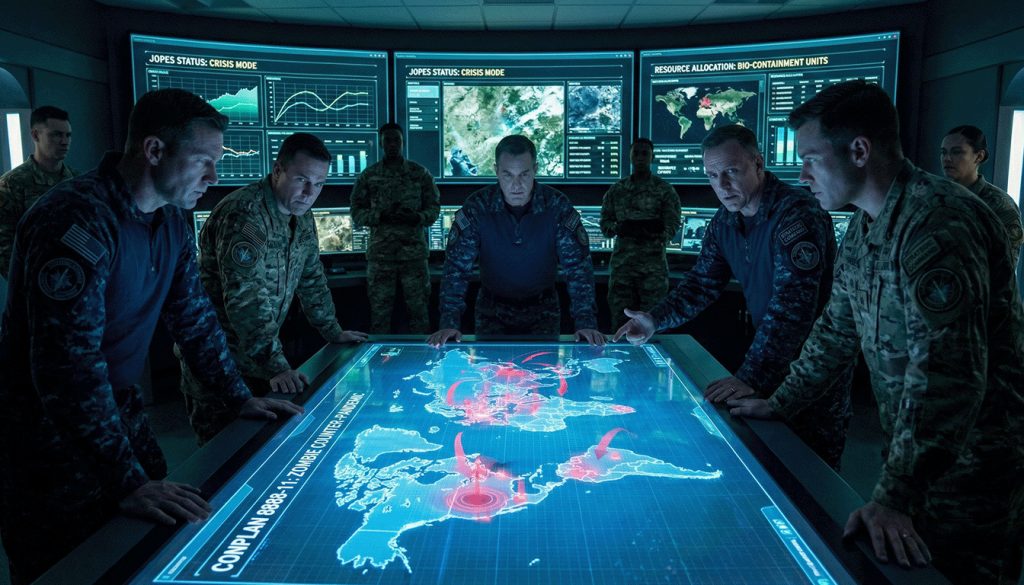
In the United States, a Zombie Apocalypse is more than just a movie thriller. It’s a real way to practice emergency preparedness and teamwork. Also see the CDC Zombie Survival Guide PDF.
Instead of worrying about zombies, the U.S. government uses this idea to test how well teams work together. They focus on how to share information and protect people. The goal is to identify and resolve problems before they become significant issues.
This article uses the CONPLAN 8888-11 document, known as “Counter-Zombie Dominance.” It demonstrates how this exercise is about keeping people safe and supporting them when challenges arise.
The Zombie Apocalypse idea helps focus on what’s really important in emergency planning. It’s about clear warnings, strong supply chains, and good quarantine plans. It’s also about being ready for medical emergencies and keeping the government running smoothly. This approach is serious, even if it begins with an unconventional idea.
U.S Military Zombie Apocalypse Key Takeaways
- This Zombie Apocalypse case study is about emergency preparedness, not a literal forecast.
- The U.S. government plans to use fiction to test real coordination across the United States.
- The approach helps surface gaps in communication, command, and decision speed.
- Logistics and supply chains are as important as the initial response in any major disruption.
- Quarantine planning and medical surge capacity are central stress points.
- Continuity of government and interoperability shape the pace of community recovery.
Why the U.S. Government Uses Zombie Scenarios for Emergency Preparedness
A zombie apocalypse is a safe way to practice for real emergencies. It allows planners to make difficult decisions without fear of real-world consequences. This approach maintains a focus on key skills, including clear roles, rapid decision-making, and consistent communication.
The CDC used a zombie theme to teach people about emergency preparedness. Their Preparedness 101: Zombie Apocalypse campaign used pop culture to explain basic emergency steps. It showed that if you can plan for zombies, you can plan for real emergencies.
Fiction as a low-risk way to test real crisis response plans
In training, zombies are a neutral means of testing crisis plans. Agencies can practice alerts, staging, and resource requests without fear of real enemies. This facilitates the review and improvement of plans.
It also helps practice coordination, shared language, and planning cycles. When the scenario involves many casualties, it’s like a drill for mass-casualty events. It covers triage, patient tracking, and medical surge decisions.
How “zombie apocalypse” framing improves attention, recall, and participation
Regular drills can lose people’s interest. But a zombie apocalypse grabs attention because it’s vivid and surprising. It helps individuals remember important steps under stress, such as escalating actions and managing rumors.
- Higher engagement means more people attend and remain for longer sessions.
- Clearer recall facilitates prompt action on important tasks.
- Better participation leads to more questions that uncover issues before they become problems.
Real-world parallels: pandemics, cyberattacks, bioterrorism, and natural disasters
An undead outbreak mirrors real-world threats, including pandemics and cyberattacks. It shows the importance of surveillance, public guidance, and medical capacity. It also highlights the need for reliable communications and supply lines.
These threats all require emergency preparedness and practical systems. The story may be fictional, but the focus on planning is real. It shows how small delays can lead to big failures in real emergencies.
CONPLAN 8888-11 “Counter-Zombie Dominance” and What It Really Is
CONPLAN 8888-11, also known as Counter-Zombie Dominance, sounds like a movie script. It’s a planning document from the U.S. Department of Defense, but it’s about zombies. The goal is to make a safe scenario that tests people’s thinking under pressure.
After CNN, Foreign Policy, CNBC, CNET, and The Washington Post explained it, many were curious. They learned it’s for training, not predicting the future. It’s compared to war planning to understand how scenarios are created.
Origin: U.S. Strategic Command training for the Joint Operational Planning and Execution System
It started in the U.S. Strategic Command as a tool for junior officers. It was meant to teach JOPES, a system for planning and executing actions. Zombies made the lesson urgent but kept it fictional.
The structure is like real planning. It prompts users to reflect on assumptions, missions, and command. The real learning is in these steps, not the zombies.
Timeline details: written April 30, 2011, and later declassified after a FOIA request
CONPLAN 8888-11 was written on April 30, 2011. It was first a secret document in the U.S. Intelligence Community. A subsequent FOIA request made it public, prompting discussion.
It’s clear now that Counter-Zombie Dominance was never meant to hunt monsters. It was intended to teach the Joint Operation Process and crisis planning in a safe manner.
Why planners avoided using real countries as adversaries in training scenarios
Using real countries as enemies could cause diplomatic issues. Zombies avoid these problems, allowing teams to practice without political worries.
This approach focuses on the process rather than personalities. It lets trainees work on timelines, logistics, and rules of engagement. CONPLAN 8888-11 and JOPES are like a worksheet and a lesson plan.
- Uses an invented threat to protect real-world relationships.
- Forces planners to handle uncertainty, changing conditions, and limited resources.
- Keeps training discussions technical, repeatable, and easy to grade.
“The scenario is fictional, but the planning discipline has to be real.”
Zombie Apocalypse
A zombie apocalypse is a stress test, not a prediction. It helps teams practice quick responses to chaos. The goal is to protect people and keep services running.
What a “zombie apocalypse” scenario tests in multi-agency coordination
Drills like a zombie apocalypse test how agencies work together. They check if information sharing and decision-making are smooth. It reveals delays, gaps in alerts, and confusion over leadership.
It also tests logistics in chaos. This includes managing roads, staff, and rumors. The aim is to have a clear, repeatable response.
Key survival tips that translate to real emergencies (water, power, meds, comms)
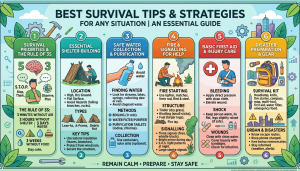
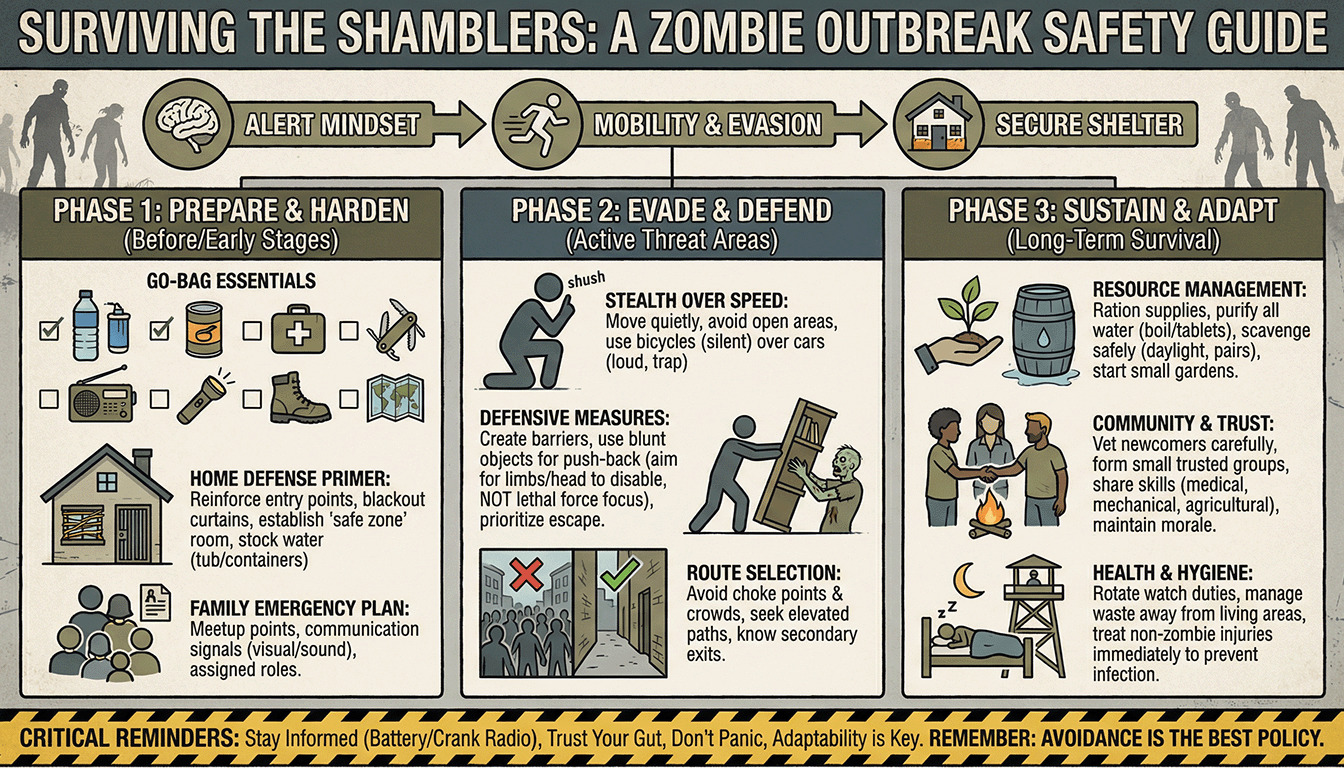
Survival tips are often simple because they’re based on routine. Water is first: plan for 1 gallon per person per day. Store it for days and swap it every six months.
They also focus on two kits: a Go-Kit for quick moves and a stay-at-home kit for longer disruptions. A basic checklist includes food, first aid, batteries, records, a flashlight, a radio, maps, cash, and spare keys.
Medications are key in any crisis. Maintain an up-to-date list, plan for refills, and store important documents in a waterproof bag. A good checklist helps ensure these essentials are remembered.
Communication is vital, not an afterthought. Select two meeting locations, establish an out-of-state contact, and practice drills twice a year. This includes two escape routes from every room.
How to survive a zombie attack as a preparedness mindset, not a prediction
Surviving a zombie attack is about being ready, not predicting. Expect mixed signals, move early, and keep plans simple. This mindset rewards adaptability in emergencies.
This mindset views the zombie apocalypse as a stand-in for any emergency. It focuses on practical survival tips. These include steady water, power backups, updated meds, and clear ways to reconnect.
Types of Zombies and Threat Variants Used in Planning Exercises
Planning drills are more effective when the threat changes. By switching threat variants, teams must rethink their plans, share more accurate information, and act with greater confidence. That’s why one zombie-virus story is insufficient for training.
In the declassified training material discussed in CONPLAN 8888, planners sort many types of zombies to widen the playbook. The list includes pathogens, radiation, and even stranger categories. The goal is to keep decisions structured, even when scenarios get weird.
Why multiple “zombie virus” variants help stress-test assumptions
When a zombie virus spreads in different ways, response steps change fast. One variant may push early testing and contact tracing. Another may demand faster isolation, more protective equipment, and strict rules governing the movement of supplies.
- Detection: what symptoms count as a case, and how soon alerts trigger
- Containment: when to shift from monitoring to quarantine
- Escalation: how quickly leaders request aid, beds, and transport
“Space zombies” and other extreme cases as boundary-testing scenarios
Space zombies sound like pure fiction, but that’s the point. Extreme setups pressure-test plans for unfamiliar exposure routes, confused public messaging, and equipment limits. They also require teams to discuss who has authority when the cause is unknown.
Atypical cases can mirror real risks, such as hazardous materials incidents or unexpected contamination. A scenario that breaks the usual pattern helps reveal weak links in screening, decon, and communication.
Using undead outbreak categories to model spread, containment, and escalation
In undead outbreak modeling, categories are more than labels. They shape how planners estimate spread speed, where clusters form, and which systems fail first. A fast-moving threat may overwhelm ambulances, while a slow one may strain staffing over weeks.
Modern reporting on ancient pathogens thawing from permafrost has even used the phrase “zombie virus” to explain the concept to the public, as described in this overview. Exercises borrow that clarity: they map scenario categories to triggers for alerts, quarantine sites, and staged resource deployment without treating the story as a prediction.
What These Drills Measure: Communications, Logistics, and Medical Surge Capacity
In a “zombie” exercise, the story is fun, but the evaluation is serious. These drills assess how quickly teams share information, allocate resources, and maintain order under stress. The focus is on performance, not blame.
Emergency communication systems and public alerting under pressure
They test emergency communication systems when lines get busy, and rumors spread. The goal is clear: simple public alerts that match what responders do.
They also check how well radio, cellular, and backup channels work across areas. A good drill looks at message timing, role clarity, and how quickly corrections reach the public.
Supply-chain resilience: food, fuel, medical supplies, and critical parts
Supply-chain resilience is about the basics: food, fuel, and medical supplies. Teams practice decision-making regarding staging sites, routing, and security when the normal distribution fails.
They also focus on hard-to-find items, like repair parts for generators and water systems. Small failures can halt major operations, so the exercise identifies bottlenecks.
Quarantine logistics, triage, and hospital capacity during mass-casualty spikes
Quarantine logistics are measured in simple steps: who screens, where people wait, and how records follow them. The drill watches staffing, signage, transport, and coordination with public health.
At the same time, medical surge capacity is tested through triage flow, bed expansion, and patient transfers during sudden spikes. In these drills, the goal is to assess how quickly hospitals and partners can transition to sustained response without compromising safety.
Continuity of Government and Critical Infrastructure in a Post-Apocalyptic World Model
In a post-apocalyptic world, planners focus on what fails first. They aim to keep the government running smoothly, even when everything else breaks down.
They test who has power, how orders are issued, and how records remain secure. They also assess whether leaders can continue to perform when personnel is reduced, travel is slow, and communication is difficult.
It all starts with critical infrastructure. When power goes out, water systems fail. When telecom falters, hospitals and alerts slow down.
Teams use models to see how failures spread. A fuel shortage can prevent backup generators from operating. This can shut down refrigeration and payment systems, thereby altering behavior.
Looking at scale, research on civilisational collapse resilience is helpful. It compares scenarios by death rate and damage. This helps planners determine whether services can continue or require reconstruction.
- Essential command and control that works even with staffing and connectivity gaps
- Priority services like water, power, and emergency care that keep people alive
- Continuity procedures for succession, secure data, and verified messages
The main goal is to protect people and support communities, even as things change. Keeping critical infrastructure stable is key. It enables response teams to move, communicate, and assist, even when conditions are uncertain.
Interoperability Across Federal, State, and Local Agencies During an Undead Outbreak
When planners model an undead outbreak, the real test is how fast agencies can connect their people, data, and tools. In the United States, this means interoperability across federal, state, and local systems, a situation that changes by the hour.
They use fiction because it lowers the stakes and skips politics, yet it puts pressure on command-and-control. It lets leaders practice decisions that feel real without naming a real-world enemy.
Public guidance also matters. Many communities align their messages with FEMA’s preparedness guidance so that residents can follow a single, clear set of steps.
Command structure and unified coordination for complex incidents
In a fast-moving crisis, unified coordination prevents responders from working at cross-purposes. It clarifies who sets priorities, who briefs the public, and who approves major decisions when multiple agencies arrive simultaneously.
To support interoperability, teams lean on shared radio plans, common map views, and consistent alert language. Small choices, such as consistently naming locations, can prevent major errors.
- Set one incident picture that everyone can reference
- Use agreed meeting points and backup channels if networks fail
- Keep public alerts consistent across sirens, radios, and phones
Resource sharing, mutual aid, and cross-jurisdiction decision-making
As needs spike, mutual aid becomes the difference between a smooth handoff and a stalled response. Exercises impose hard calls on scarce resources such as ambulances, shelter space, generators, and medical supplies.
Cross-jurisdictional response work becomes complex when rules are inconsistent. Drills surface the delays caused by different request forms, dispatch procedures, and credential checks.
- Request resources using plain terms, not agency slang
- Track what moved, where it went, and who approved it
- Coordinate shelter, hospital routes, and evacuation corridors across borders
Training outcomes: identifying friction points before a real disaster
These scenarios are built to reveal friction, not to look perfect. A tabletop or full-scale exercise can expose gaps in communication, logistics bottlenecks, or confusion about legal authority during an undead outbreak.
After-action reviews often focus on interoperability gaps that are easy to miss on paper. They compare timelines, check how quickly warnings reached the public, and note where unified coordination broke down under stress.
“Practice does not remove risk, but it can remove surprises.”
From Zombie Defense Strategies to Real-World Readiness
In the Pentagon, zombie defense is about planning, not monsters. CONPLAN 8888-11 uses a Joint Operation Planning Process. It helps teams practice under stress, making them ready for real crises.
Turning fictional after-action findings into actionable improvements
Exercises are only valuable if they lead to real changes. Teams note delays and errors to improve. They update procedures and checklists to improve collaboration.
They also set simple training goals and retest them. A guide such as “Preparedness: Stay Safe, Secure, and Ready” is helpful. It focuses on kits, alerts, and regular reviews.
- Revise call-down lists and notification rules so alerts are processed promptly.
- Standardize checklists to ensure that different agencies use the same terminology.
- Schedule brief refresher drills targeting known weaknesses.
Planning for cascading failures: power, water, transportation, and telecom
Cascading failures are the toughest problems. A power outage can stop water treatment plants. This can lead to boil notices and strain hospitals.
Transportation issues can slow down deliveries. Telecom outages block alerts and disrupt coordination. Planning ahead and practicing under pressure helps.
Why adaptability matters when the threat is uncertain or evolving
Good plans adapt to changing conditions. This is key for disaster adaptability. Teams that adapt to new threats remain stable.
This mindset turns drills into real-world readiness. It keeps planning behaviors sharp, not based on guesswork. After-action reports facilitate feedback throughout each cycle of failures.
Personal Emergency Preparedness Inspired by Government Playbooks
Government drills succeed by noticing, limiting chaos, and fixing failures. At home, this approach leads to calm, repeatable habits. In the U.S., drills are often called “zombie” drills, but they prepare for many emergencies.
Starting with a short log is key. It helps track what you have, what you need, and what might fail first. This record helps you act quickly and avoid mistakes when stress is high.
Survival tips for families: go-bags, medication lists, and reunification plans
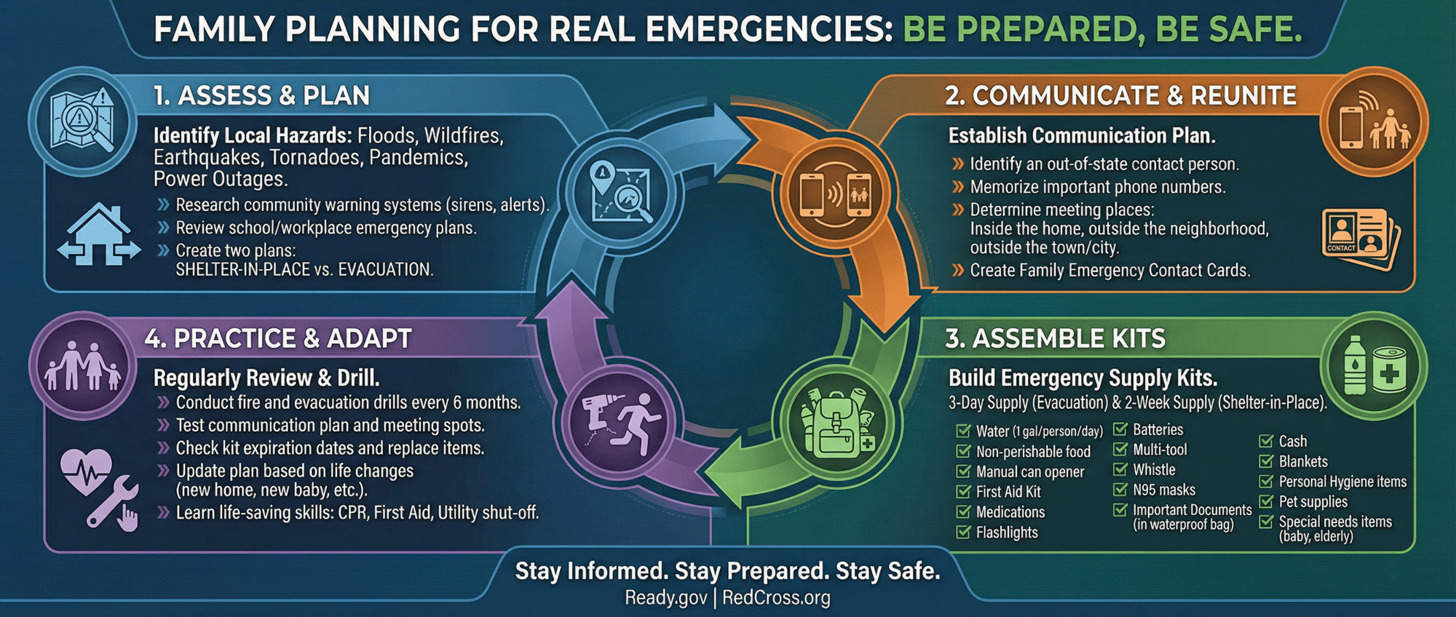
Building a family go-bag is easier with a checklist and regular tests. They pack for quick exits or short stays, then practice grabbing everything fast. If something’s missing, they add it and update their list.
Planning for medication is as important as food. Keep a list, note refill dates, and store copies in the bag and at home. A simple plan for meeting up helps when usual places are closed, and remember a backup way to contact each other.
- Contact card: two out-of-area numbers, one local meeting spot, one backup spot
- Health notes: allergies, prescriptions, and device needs like CPAP or insulin cooling
- Verification step: a quick drill to confirm everyone knows the plan
Home readiness: water storage, backup power, and sanitation basics
Improving home readiness involves tackling problems by category: water, power, and sanitation. Start small with water storage and keep it fresh by rotating it regularly. Note which tasks require clean water first, such as baby formula and cooking.
Focus on essential backup power, not the whole house. A phone, a flashlight, and a plan for medical devices are essential. Test each device, confirm it works, and document your success.
Sanitation is often overlooked but critical. Store heavy-duty trash bags and wipes, and plan for waste management in the event of plumbing failure. A simple checklist and quick review after outages prevent future problems.
Neighborhood coordination: check-ins, skills inventories, and shared supplies
Building community resilience starts with neighbor coordination. Establish regular check-ins, with a focus on vulnerable groups. Clear roles and short updates are key.
A skills inventory makes sharing easier during disruptions. One household might have first-aid training, another might have tools, and another might have language skills. Keep notes on who has what and validate them with a walk-through.
Best Weapons for Zombies as a Safe Stand-In for Practical Defense Planning
In many drills, the term best weapons for zombies is used. It’s a safe way to talk about defense without focusing on violence. The goal is to teach habits that help during emergencies.
Reframing “weapons” as layered protection: barriers, lighting, and deterrence
Real homes use simple upgrades for safety. Solid doors and reliable deadbolts are key. Window locks and dowels add extra protection.
Lighting is also important. It makes it harder for intruders to hide. Motion lights and headlamps help keep the area well-lit.
- Barriers: doors, locks, window security, garage reinforcement
- Lighting: motion lights, rechargeable lanterns, headlamps
- Deterrence: signs, cameras, tidy sightlines, routine check-ins
De-escalation, situational awareness, and lawful self-defense considerations
Being ready means staying calm and aware. Watch for signs of trouble and keep exits clear. De-escalation techniques can prevent violence.
In the U.S., self-defense means following the law. Locking doors, calling for help, and documenting incidents are key. This approach keeps everyone safe without promoting violence.
Non-weapon essentials that matter more: first aid, tools, and communication gear
Most emergencies need basic supplies, not weapons. A first-aid kit and tools such as wrenches can be very helpful. Communication gear is also vital when phones don’t work.
Having a NOAA Weather Radio and spare power banks is smart. A simple plan for maintaining contact can keep families together. This way, the best weapons for zombies idea leads to real safety through first aid, tools, and communication.
U.S Military Zombie Apocalypse Conclusion
The Zombie Apocalypse is a great way to teach, not predict the future. In U.S. government drills, zombies make things less scary and keep everyone interested. This helps teams test their emergency plans without worrying about real politics.
One important part is CONPLAN 8888-11, also known as “Counter-Zombie Dominance.” The U.S. Strategic Command created it on April 30, 2011. It was created for training and was later shared publicly in response to a FOIA request. It didn’t mention real countries to avoid political issues.
These exercises focus on key areas like emergency communications and supply chains. They also improve quarantine plans and medical readiness. Plus, they help teams work better together during tough times.
The main lesson for disaster readiness is simple. Plans need to be flexible and practiced. They should be prepared for major failures such as power outages and network disruptions. Having good habits helps people get through any challenge, no matter what it is.