The Big Bang Theory and How It Shaped Our Universe
Explore The Big Bang theory and how it shaped the formation and expansion of our universe, unveiling the origins of space, time, and matter.

The Big Bang Theory
The Big Bang Theory: Ever wonder where everything came from? Our universe, full of stars, planets, and galaxies, began from a single point about 13.8 billion years ago. This event gave rise to space, time, and everything we see Today.
Scientists call this event the Big Bang theory. It’s the top theory in cosmology for the start of our universe. Back then, everything was in an incredibly hot and dense state before expanding outward.
Astronomers and physicists worldwide agree on this theory. They do, because many lines of evidence support it. The data show that our universe began about 13.787 billion years ago, with a margin of 20 million years. It’s not just a guess.
This explanation helps us understand the patterns of space. It explains the light elements, the cosmic background radiation, and the distribution of galaxies. Each piece of evidence strengthens our understanding of our origins.
Key Notes
- The universe began approximately 13.8 billion years ago in an extremely hot, dense state.
- The Big Bang theory represents the expansion of space itself, not an explosion in existing space.
- Multiple scientific observations support this cosmology framework, including cosmic microwave background radiation.
- The theory of universe formation explains the abundance of light elements and the large-scale structures we observe Today.
- This theory is accepted by astronomers and physicists worldwide as the best explanation for our cosmic origins.
1. What the Big Bang Theory Tells Us About Our Universe
Our universe’s story starts with the Big Bang Theory. It’s a scientific theory that changed how we see existence. It’s not just one scientist’s idea but a strong explanation for the origin of the universe.
This theory tells us our universe has a birthday. Scientists say everything we see Today started about 13.8 billion years ago. They’ve figured this out with great accuracy using many different methods.
The Big Bang Theory is based on solid science. It’s not built on guesses. Instead, it uses physical laws that apply everywhere in the universe.
The theory relies on three main ideas. These ideas help scientists understand how our universe grew:
- Universal physical laws: The same physics rules everywhere in space and time
- Cosmological principle: The universe looks the same in all directions when viewed at large scales
- Perfect fluid model: Matter and energy acted in ways scientists can mathematically describe
These ideas might seem complex, but they’re very useful. They help scientists create cosmological models that match what we see in the sky.
The Big Bang Theory answers big questions. It explains where Matter and energy came from and when time started. It explains many cosmic mysteries that scientists have observed.
This theory also makes testable predictions. It says what kinds of elements should exist and what patterns we should see in the oldest light. When scientists test these predictions, they find they’re right.
There’s a lot of evidence supporting this theory. Scientists from different fields have all found the same results. This makes them very confident that they understand the origins of our universe correctly.
2. The Beginning: 13.8 Billion Years Ago in Extreme Conditions
The story of our universe starts with a cosmic event 13.8 billion years ago. It was a time of extreme conditions, unlike anything Today. Scientists study Today’s universe to understand those first moments.
The primordial universe was incredibly small and dense. It was smaller than an atom, challenging our understanding of reality. This tiny space held the seeds of billions of galaxies.
The Incredibly Hot and Dense Initial State
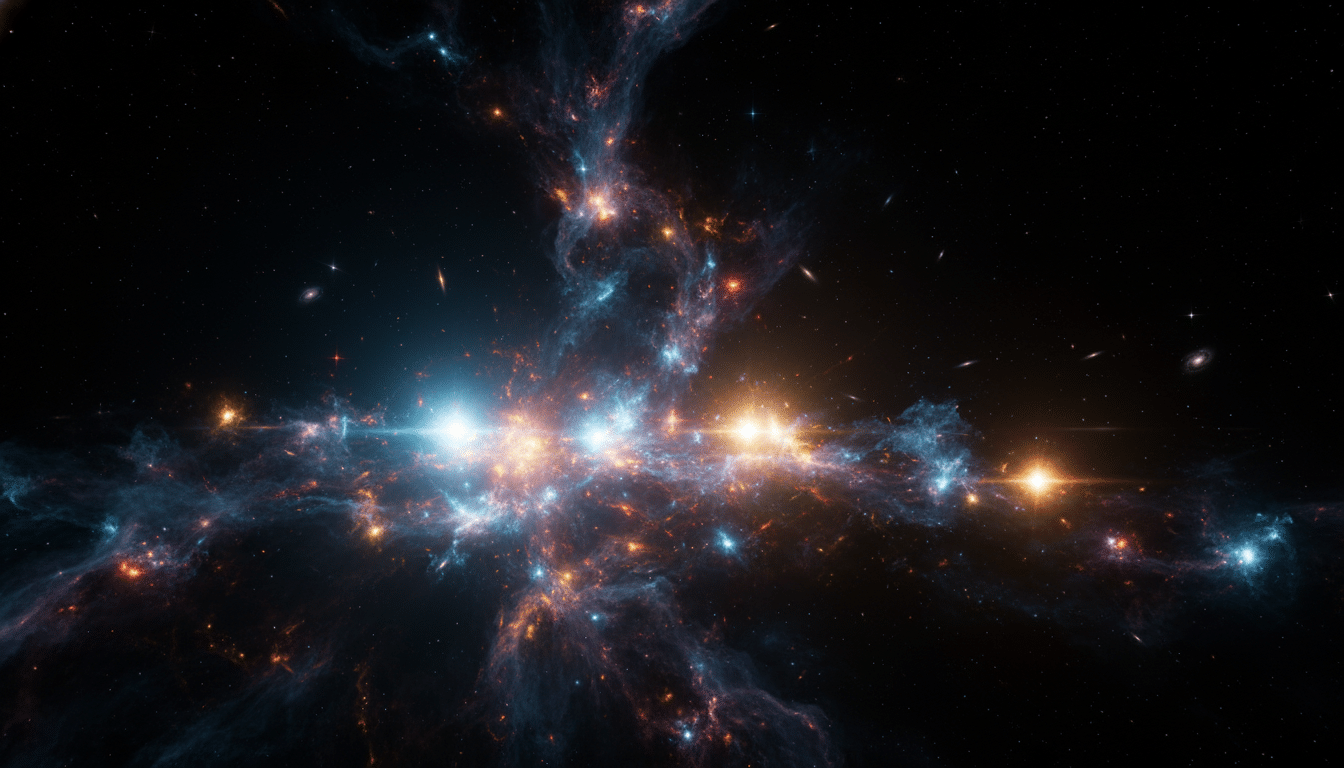
Imagine temperatures reaching trillions of degrees. The universe’s birth was hotter than any star Today. Normal Matter couldn’t exist; instead, energy and particles mixed in extreme ways.
Densities were so high that Today’s physics doesn’t apply. The four fundamental forces might have been a single force. The primordial universe was a place unlike anything we can imagine.
In these extreme conditions, time was different. Researchers at places like the Harvard & Smithsonian Center for Astrophysics study this. They explore the smallest scales to understand the cosmic event.
The universe changed dramatically in a very short time. These changes were faster than the blink of an eye. The universe’s character shifted dramatically in those moments.
Setting the Stage for Everything That Exists
Those initial extreme conditions were not random. They set the stage for everything that exists Today. Every galaxy, star, and living being comes from this moment of the universe’s creation.
The universe’s hot, dense start set its current rules. The balance of particles and forces was determined at that time. Understanding this helps us see why the universe is as it is Today.
This cosmic event laid the foundation for our universe’s structure. Tiny fluctuations in density grew into galaxies. Today’s universe, from atoms to superclusters, comes from those early moments.
3. The Big Bang Was an Expansion of Space, Not an Explosion
When we hear “Big Bang,” we often think of debris flying from a center. But this idea is far from correct. The name itself has led to a long-standing misconception. It’s time to rethink how we see the start of our universe.
The expansion of space is unlike any explosion we know. This difference changes how we understand the universe’s origins.
Why the Explosion Idea Doesn’t Work
Many imagine the Big Bang as a cosmic explosion, like a bomb in space. This view suggests material flying out from a single point. But this idea has a major flaw.
Explosions occur in space, with debris moving through it. A firework sends sparks in all directions through the air. A supernova blasts material into the cosmos.
The Big Bang was different. There was no space for it to explode into because space didn’t exist yet. It wasn’t an event that happened in a specific place—it happened everywhere at once.
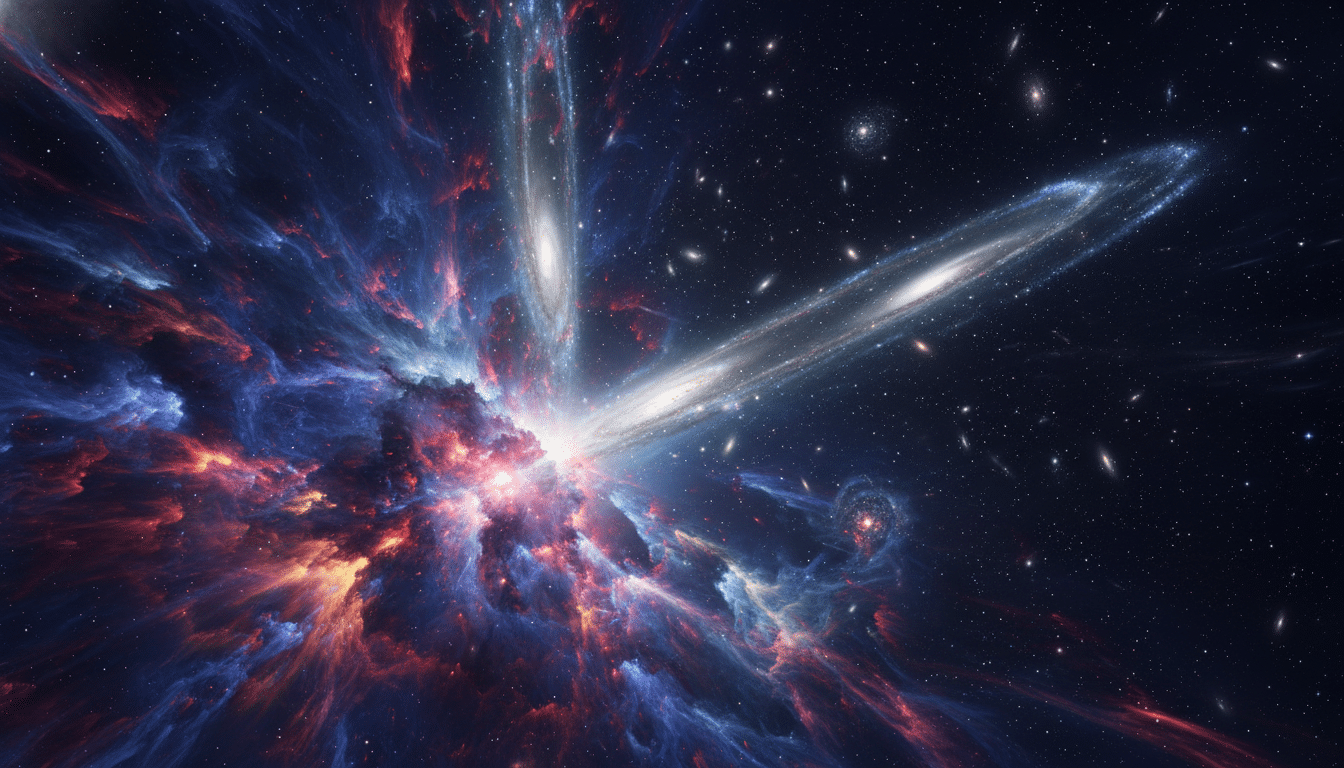
This misconception makes us think we could find the Big Bang’s center. If it were an explosion, we’d expect to see galaxies spreading out from a central point. But scientists have found no such center.
Space Stretched Like an Inflating Balloon
The correct view is that space-time expanded and stretched. Picture dots on a deflated balloon. As you inflate it, the dots move apart, not because they’re moving, but because the balloon is growing.
This analogy shows what happened during the Big Bang and continues Today. Galaxies aren’t moving through space like rockets. Instead, the expansion of space between them makes them move apart.
The universe’s fabric stretched in all directions at once. Every point moved away from every other as the universe grew. This is why astronomers see galaxies moving in all directions without a center.
Scientists call this the intrinsic expansion of the universe’s contents. The term “Big Bang” has been debated because it suggests a traditional explosion. Some suggest names such as “Everywhere Stretch” to describe it more accurately.
Understanding this difference helps explain many observations. If the Big Bang were a cosmic explosion, we’d see different conditions in space. But the universe is remarkably uniform in all directions, as expected from the expansion of space.
This idea challenges our intuition because we never see space change. We see objects move, but not the space between them. Yet, on cosmic scales, this expansion shapes everything.
4. The Universe Cooled, and Matter Began to Form
Imagine the universe as a giant cosmic oven cooling down after being heated to unimaginable temperatures—this cooling process made the creation of Matter possible. As the young cosmos expanded outward, it underwent dramatic changes. These changes laid the foundation for everything that exists Today.
The story of how energy transformed into the Matter we’re familiar with is one of the most captivating tales in astrophysics.
This transformation didn’t happen all at once. Instead, it unfolded in several distinct stages over hundreds of thousands of years. Each phase brought the universe one step closer to the complex structures we observe throughout space.
Energy Transformed Into Tiny Particles
In the earliest fractions of a second after the Big Bang, the universe was far too hot for stable particles to exist. Pure energy dominated everything. But as expansion continued, temperatures began to drop rapidly, creating conditions in which the first building blocks of Matter could form.
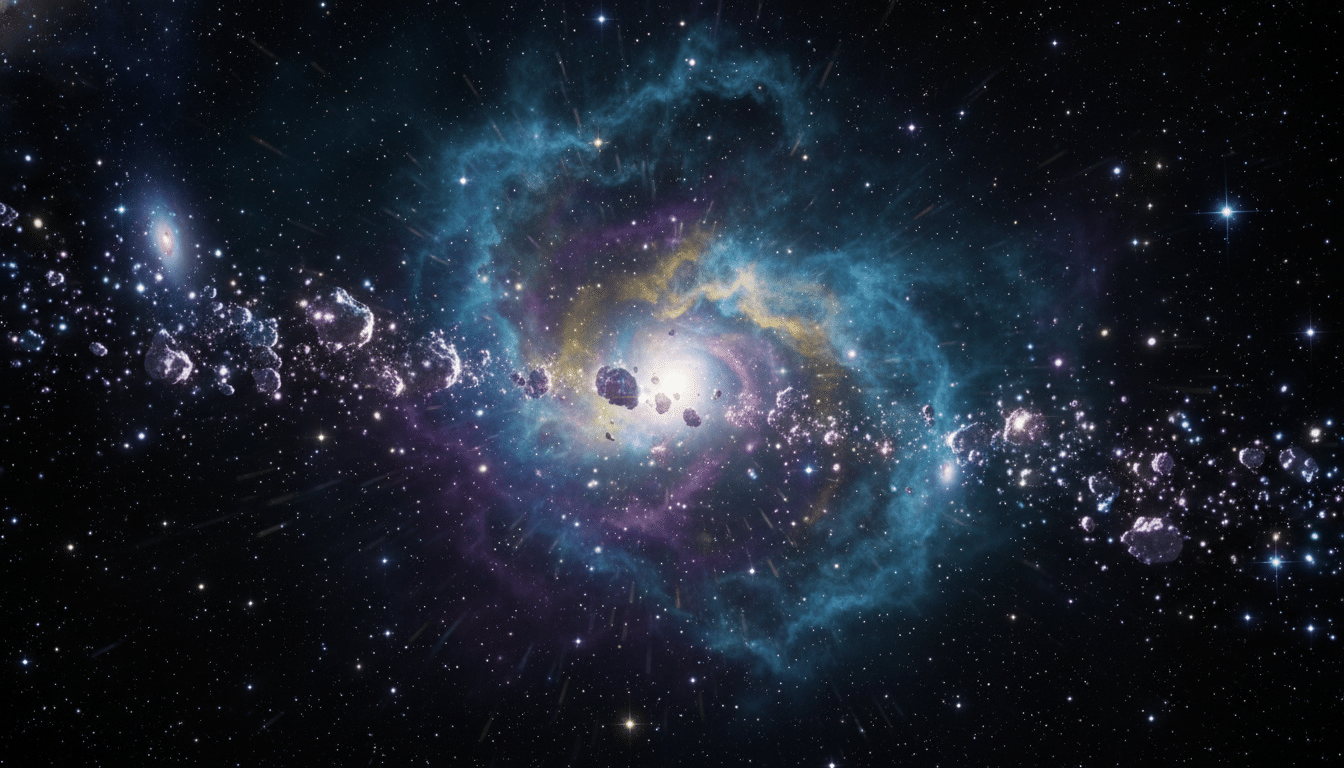
At approximately one millionth of a second after the beginning, something remarkable occurred. The universe had cooled enough for quarks and gluons—the most fundamental components of Matter—to bind together. This process of particle formation created the first protons and neutrons, collectively known as baryons.
Scientists understand these processes Today thanks to experiments at facilities like the Large Hadron Collider in Europe. By smashing particles together at tremendous speeds, researchers can recreate conditions similar to those in the infant universe. These experiments confirm the theoretical predictions about how subatomic particles behave under extreme temperatures.
The quarks and gluons didn’t randomly scatter throughout space. Instead, they combined according to specific rules dictated by fundamental forces. Three quarks joined to form each proton and neutron, establishing the atomic structure that would eventually make chemistry possible.
Particles Combined to Create Atoms
Once protons and neutrons existed, the next major milestone could begin. Just a few minutes into the universe’s expansion, temperatures had dropped to about a billion degrees— yet cool enough for a critical process called Big Bang nucleosynthesis to occur.
During this brief window, neutrons fused with protons to form the nuclei of the lightest elements. Deuterium (heavy hydrogen) appeared first, followed quickly by helium nuclei. This early nucleosynthesis created roughly three hydrogen nuclei for every helium nucleus, a ratio scientists observe throughout the universe Today.
These weren’t complete atoms yet. The universe remained too energetic for electrons to stick to the positively charged nuclei. Free electrons and atomic nuclei coexisted in a hot, dense plasma that prevented light from traveling very far.
The final stage of matter creation required much more patience. About 380,000 years passed before the universe cooled sufficiently for electrons to combine with nuclei. This period, known as the recombination era, marked a turning point in cosmic history.
When electrons joined with hydrogen and helium nuclei, the first neutral atoms formed. The universe became transparent for the first time, allowing light to travel freely through space. This same light, stretched by billions of years of expansion, reaches us Today as the cosmic microwave background radiation.
These primordial atoms—mostly hydrogen with some helium—became the raw material for everything that followed. Eventually, gravity pulled these atoms together into enormous clouds. Within these clouds, the first stars would ignite, beginning the process that would create all the heavier elements and complex structures throughout the cosmos, including the formation of the Moon and Earth.
The journey from pure energy to stable atoms represents one of the most profound transformations in astrophysics. Without this cooling process and the subsequent particle formation, the universe would remain a featureless sea of radiation. Instead, these early processes set the stage for the rich tapestry of cosmic structures we explore Today.
5. Building the Cosmos: Stars, Galaxies, and Planets
The story of cosmic structure starts with tiny differences in matter density. After atoms formed, the universe wasn’t perfectly uniform. Some areas had slightly more Matter, becoming the seeds for what we see in the sky.
Gravity became the main force shaping the cosmos. Areas with more Matter pulled in hydrogen and helium, growing denser. This set the stage for stars, galaxies, and planets.
How the First Stars Ignited
The first stars formed from massive hydrogen gas clouds. As these clouds collapsed, their cores became hot and dense. At about 10 million degrees, nuclear fusion ignited, marking the birth of the first stars.
Nuclear fusion ignited, ending the cosmic dark ages. Scientists at the Center for Astrophysics simulate how star formation began. Their work shows that dark Matter clumps first, attracting large hydrogen clouds.
These first stars were huge and bright. They burned fast, exploding as supernovae after a few million years.
The first stars were the universe’s cosmic furnaces, creating heavier elements for everything that followed.
Galaxies Assembled Across Space
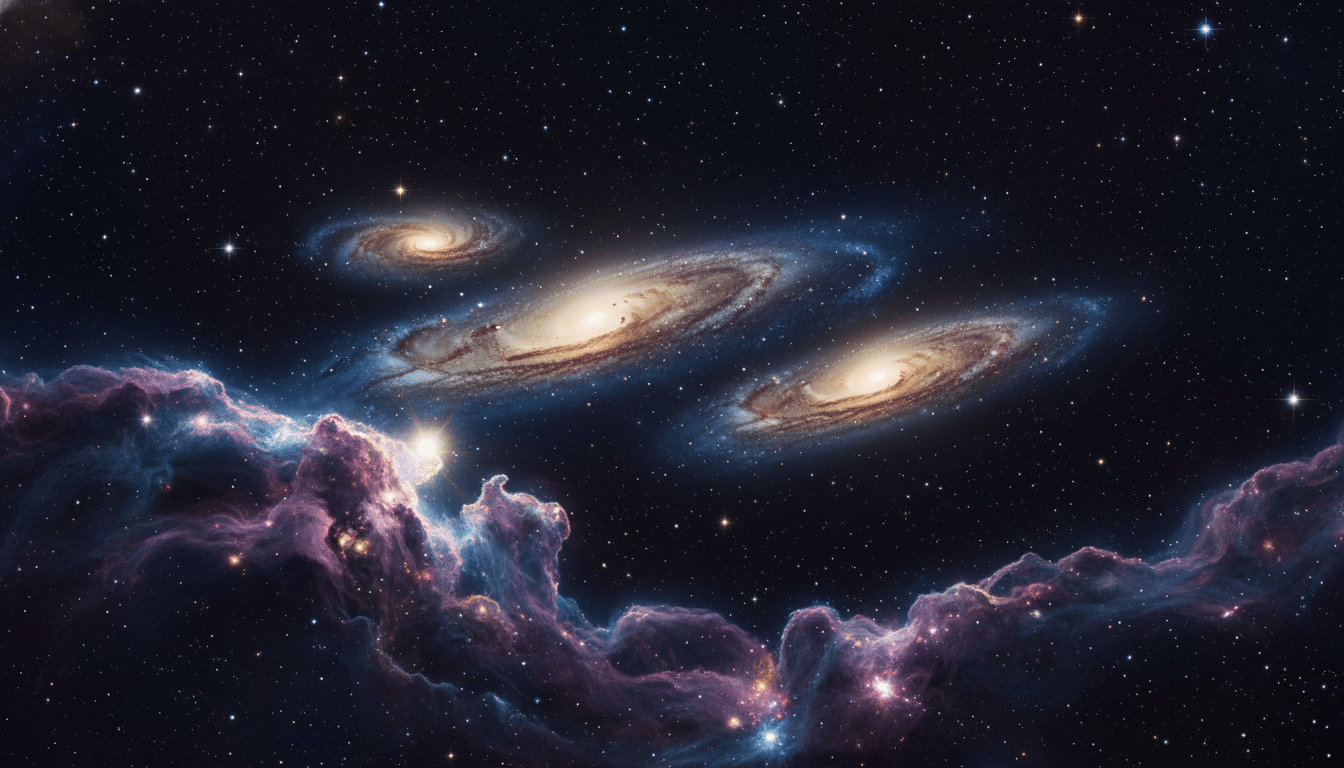
Stars formed from collapsing gas clouds, but galaxy formation was on a grander scale. Gravity pulled billions of stars into rotating systems. This transformed the universe into the structures we see Today.
Dark Matter was key in this process. It provided an invisible scaffolding for galaxies to form. Without it, galaxies wouldn’t have formed as quickly.
Different galaxies emerged based on their formation conditions. Some became spiral galaxies, while others became elliptical or irregular galaxies. Each galaxy had millions or billions of stars held together by gravity.
Planetary Systems Developed Over Time
Planetary systems formed later. When massive stars exploded, they scattered elements throughout space. These elements mixed with hydrogen and helium, creating enriched clouds.
New stars formed from this material, surrounded by disks of dust and gas. Particles collided, building asteroids, comets, and planets. Our solar system formed this way.
This process continues Today. Astronomers find new planetary systems forming around young stars. The same forces that shaped the first stars continue to shape the universe.
The universe transformed from simple atoms to stars, galaxies, and planets. Each generation of stars built upon the last, creating complex structures. These eventually led to solar systems capable of supporting life.
6. Evidence from Expanding Galaxies
Imagine every galaxy moving away from you. This amazing discovery helped prove the Big Bang. Scientists needed solid observational evidence to convince the world. They found this evidence by studying distant galaxies.
In the early 20th century, astronomers made a groundbreaking discovery. Their findings were not just interesting but revolutionary.
Watching Galaxies Race Away
Astronomers noticed something strange when they looked at light from distant galaxies. The light was shifted toward the red end of the spectrum. This is called galactic redshift and means these galaxies are moving away from Earth.
Think of an ambulance siren changing pitch as it speeds away. Light behaves the same way through the Doppler effect. When galaxies move away, their light waves stretch, making them appear red.
This discovery is amazing because galaxies aren’t just moving away from us in one direction. They’re moving away in all directions. This shows that space itself is stretching, taking galaxies with it.
The history of astronomy is a history of receding horizons.
The Astronomer Who Changed Everything
In 1929, Edwin Hubble made a discovery that changed everything. He used the 100-inch telescope at Mount Wilson Observatory. He measured distances to distant galaxies and their speeds.
Hubble found a clear relationship between distance and velocity. The farther away a galaxy was, the faster it was moving away from Earth. This became known as Hubble’s law and provided strong evidence for cosmic expansion.
This discovery was huge. If galaxies are moving apart Today, they must have been closer together yesterday. Going back in time, all galaxies come together at a single point about 13.8 billion years ago—the moment of the Big Bang.
Hubble’s work gave scientists their first measurable proof of the universe’s beginning. His findings turned the Big Bang from an idea into a scientific theory. Today, scientists keep measuring distances and velocities, confirming Hubble’s discovery.
This observational evidence is a key support for our understanding of cosmic origins. It shows that the universe is dynamic, evolving, and had a beginning.
7. Cosmic Microwave Background Radiation: Ancient Light
A faint signal fills every corner of space, supporting the Big Bang theory. This signal, known as the cosmic microwave background radiation, is the oldest light in the universe. It gives scientists a direct look into the early universe.
This discovery changed how we see the universe’s history. The radiation is like a snapshot from the universe’s early days. It shows the moment when light first traveled freely.
The Afterglow of Creation
The cosmic microwave background radiation is the afterglow of the universe’s initial expansion. When the universe was 380,000 years old, it cooled enough for atoms to form. Before this, the cosmos was too hot for light to travel far.
Once atoms formed, light could move through space without being absorbed. This ancient light has been traveling ever since, stretched by the universe’s expansion into microwave wavelengths we can detect Today.
Think of the CMB radiation like an echo in a giant canyon. Just as an echo carries the sound of the original shout, this radiation carries information from the universe’s fiery beginning. Scientists describe it as the oldest observable light in existence.
When astronomers observe this radiation, they’re seeing the universe as it appeared 380,000 years after its birth. It’s like having a baby picture of the entire cosmos.
An Accidental Discovery That Changed Science
In 1964, two scientists at Bell Labs made an unexpected discovery that would revolutionize cosmology. Arno Penzias and Robert Wilson were working with a sensitive radio antenna when they detected mysterious background noise coming from every direction in the sky.
They initially thought this signal was interference from their equipment. The scientists went to great lengths to eliminate possible sources, even famously cleaning pigeon droppings from the antenna. But the signal persisted.
What they had actually discovered was relic radiation from the Big Bang itself. This CMB radiation filled all of space uniformly, exactly as theoretical predictions suggested it should. Their groundbreaking work earned them the 1978 Nobel Prize in Physics.
Modern scientists now use sophisticated telescopes to measure tiny variations in this ancient light. Some of these instruments operate at the South Pole, where the cold, dry conditions allow for extremely precise measurements. The temperature and uniformity of the cosmic microwave background closely match predictions from Big Bang theory models.
These measurements reveal critical information about the early universe’s structure and composition. The CMB radiation shows us that conditions were remarkably uniform across the young cosmos, with only slight variations that eventually led to galaxy formation. This evidence has become one of the strongest confirmations that our universe began in a hot, dense state and has been expanding ever since.
8. Element Distribution Confirms Theoretical Predictions
Measuring what the universe is made of proves the Big Bang. Stars, gas clouds, and galaxies show a consistent pattern. They mostly contain hydrogen and helium, with only small amounts of heavier elements.
This pattern matches what the Big Bang Theory predicts. It shows the universe’s early moments.
The field of astrophysics has found that these elements reveal insights into the early universe. They reveal important information about its conditions.
The Dominance of Light Elements
The universe is mostly hydrogen (75%) and helium (25%) by mass. Carbon, oxygen, iron, and other elements make up less than 2%. Why are hydrogen and helium so common?
The answer is in the universe’s first minutes. As it expanded and cooled, temperatures fell from trillions to a billion degrees. This allowed nuclear fusion reactions to happen.
Big Bang nucleosynthesis describes this period. Protons and neutrons formed atomic nuclei. Most protons stayed as hydrogen nuclei because the universe cooled too fast.
The first three minutes of the universe set the chemical makeup of everything we see today.
This process was not random. The laws of physics determined the amounts of each element. Only the lightest elements could form before temperatures dropped too low.
Observations Confirm Predictions
Scientists study old stars and distant gas clouds to measure element abundance. These objects show the universe’s early chemical signature.
Comparing these measurements with Big Bang nucleosynthesis shows amazing agreement. The ratios of hydrogen to helium to lithium match predictions with precision. Different telescopes and techniques all agree.
This consistency strengthens the Big Bang model. Scientists have calculated the elemental abundances based on early-universe physics. Observations confirm these predictions.
The match goes beyond hydrogen and helium. Deuterium and lithium also appear in the predicted amounts. This multi-element confirmation supports the Big Bang Theory.
Astrophysics continues to refine these measurements. But the fundamental agreement remains strong. The universe’s chemical makeup tells a story that fits the Big Bang framework. It adds to the evidence supporting our cosmic origin story.
9. The Universe Continues to Expand Today
Our universe is growing, expanding faster than scientists thought. The cosmic expansion started 13.8 billion years ago and hasn’t slowed. It’s a key part of the scientific theory of our universe.
Astronomers see this expansion in action. They watch galaxies move away from each other. This doesn’t affect things held together by strong gravity, but it does affect the space between galaxy clusters.
Measuring the Current Expansion Rate
Scientists use advanced methods to measure the universe’s expansion. They find the Hubble constant, which shows how fast it’s expanding. This work builds on Edwin Hubble’s groundbreaking research.
One key method is the use of Type Ia supernovae. These stars explode with the same brightness, making them perfect for measuring. By measuring how far away and how fast they’re moving, scientists determine the Hubble constant.
Many methods confirm the universe’s expansion. Researchers use different ways to check their findings:
- Observing the redshift of light from distant galaxies
- Measuring brightness variations in certain types of stars
- Analyzing gravitational lensing effects
- Studying the cosmic microwave background radiation
These methods all agree: the universe is expanding. Scientists debate the exact rate, sparking interesting discussions about the causes of these differences.
The Surprising Acceleration Phenomenon
In the late 1990s, astronomers found something shocking. They expected the expansion to slow down, but it was actually speeding up. This was a big surprise.
This acceleration puzzled scientists. What could be pushing the universe to expand faster? The answer was dark energy.
Dark energy is everywhere, pushing space apart. It’s thought to make up about 73% of the universe’s energy. Despite its importance, scientists don’t know much about it.
The discovery of accelerating expansion won the 2011 Nobel Prize in Physics. It changed our view of the universe’s future. The universe will continue to expand, with galaxies moving apart due to dark energy.
Understanding the expansion rate helps scientists understand the universe’s history. By measuring Today’s expansion, they can work backward to learn about the Big Bang. They can also predict the universe’s future, showing its ultimate destiny.
10. Mysteries That the Big Bang Theory Cannot Yet Explain
The Big Bang Theory explains a lot about the universe’s history. But it can’t solve every mystery about the universe’s origin. This scientific theory has been great at showing how the cosmos evolved over 13.8 billion years. Yet, scientists admit there are many questions left unanswered.
These cosmological mysteries don’t make the theory less valuable. Instead, they show us exciting areas where research is ongoing. Understanding these limits helps us see what we know and what we don’t.
What Came Before the Beginning?
Many people wonder what existed before the Big Bang. This is a tough question to answer. Time itself started with the Big Bang, making “before” a tricky concept.
Trying to figure out what came before time is like asking what’s north of the North Pole. The usual meaning of “before” doesn’t apply. Without time, the word “before” loses its usual meaning.
Researchers explore new ideas to tackle this puzzle. Some suggest the universe goes through cycles of expansion and contraction. Others propose that it emerged from a quantum vacuum state. These ideas are speculative but show scientists’ efforts to push beyond current scientific theory.
What Triggered the Big Bang Event?
Even if time began with the Big Bang, we don’t know what caused it. Scientists are puzzled by this fundamental question about the origin of the universe.
Our current physics fails at the universe’s first moment due to extreme energies. Neither general relativity nor quantum mechanics can fully describe it. A unified theory of quantum gravity is needed to understand this period.
The earliest moment we can confidently describe is the Planck epoch, 10⁻⁴³ seconds after the Big Bang. Before that, the universe was too hot and dense. Understanding the initial expansion requires new physics that researchers are developing.
These questions connect to broader mysteries, like Fermi’s Paradox. They remind us of how much we have yet to discover.
The Enigma of Dark Matter
Dark Matter is a major mystery in modern cosmology. It makes up about 27% of the universe, yet we can’t see it. We know it exists because of its gravitational effects.
Galaxies rotate faster than expected based on visible Matter. Galaxy clusters also bend light more than their mass can explain. These signs point to a lot of invisible Matter.
Scientists have searched for dark matter particles for decades. Despite their efforts, these particles remain elusive. Various candidates, such as WIMPs, axions, and primordial black holes, have been proposed. Some even suggest modified gravity theories could explain the observations without invisible Matter.
The true nature of dark Matter is a major unsolved problem in physics. Finding it would change our understanding of the cosmos.
Dark Energy’s Role in Cosmic Acceleration
Dark energy is another deep mystery. It makes up about 73% of the universe and drives the accelerating expansion. This was discovered in the late 1990s.
Scientists expected the universe’s expansion to slow down due to gravity. Instead, it’s speeding up. Something must be pushing space apart with increasing strength.
Several explanations for dark energy have been proposed:
- Einstein’s cosmological constant, representing the energy of space itself
- Quintessence, a dynamic energy field that changes over time
- Modifications to gravity that alter how it works on cosmic scales
- Effects from extra dimensions beyond the three we experience
Scientists don’t really understand what dark energy is. Its properties don’t match anything else in physics. Some consider it the most profound mystery in cosmology Today.
These mysteries show that science is an ongoing journey of discovery. The Big Bang Theory has been great at explaining the universe’s history and structure. Yet, it also reveals how much more we have to learn about the cosmos and our place within it.
11. The Big Bang Theory Conclusion
The Big Bang Theory is a major achievement in astronomy. It happened 13.8 billion years ago and set everything in motion. The universe began as a hot, dense state and is expanding now.
Scientists have found strong evidence for this theory. Edwin Hubble saw galaxies moving away from each other. The cosmic microwave background radiation is like an echo from the early universe. The amounts of hydrogen and helium match what the theory says.
Space expanded, not exploded outward. This helps us understand how the universe grew from its start to what we see Today.
Many questions are left unanswered. Scientists are studying dark Matter and dark energy. The cause of the Big Bang is a mystery. Some researchers explore alternative ideas about the universe’s origins.
Every atom in us came from the Big Bang or ancient stars. Learning about the universe connects us to the cosmos. The Big Bang Theory shows how science can reveal nature’s secrets. It’s the result of centuries of work by many scientists.