How Long Will a Portable Power Station Run Your Home?
How Long Will a Portable Power Station Run Your Home? Discover how to calculate power station runtime for your home. Real examples show how long portable units actually last

How Long Will a Portable Power Station Run Your Home?
We may earn a commission when you purchase through links on this page, at no additional cost to you.
How Long Will a Portable Power Station Run Your Home? Real Examples: Outages are becoming more common in America. Old infrastructure, harsh weather, and grid overload mean families need reliable backup solutions. A portable battery system gives peace of mind when the power goes out.
See our Guide for the top choices Best Portable Power Stations for Home Backup (2026 Guide)
Unlike older generators, these units offer significant benefits. They are quiet, don’t need fuel, make no indoor pollution, and need little upkeep. You can use them indoors safely during storms or emergencies.
Understanding power station runtime starts with knowing your battery’s watt-hour capacity. This guide shows real-world examples with actual appliances. You’ll learn how to calculate operational uptime for your specific needs and discover factors that affect performance, including inverter losses and efficiency.
With the right information, choosing a backup system becomes straightforward. Your family deserves protection during outages, and knowing these facts helps you make a confident decision.
How Long Will a Portable Power Station Run Your Home? Key Takeaways
- Backup systems provide quiet, fuel-free emergency solutions for American households facing frequent outages.
- Battery capacity in watt-hours directly determines how long your devices will run.n
- Inverter losses typically reduce available energy by 10-15% during operation.
- Calculating your specific needs requires knowing appliance wattage and usage duration.
- Real-world examples help you understand practical expectations for your home.
- Proper planning maximizes your investment and keeps essential devices running longer.
Understanding Portable Power Station Runtime
To get the most out of your portable power station, you need to know how it stores and uses energy. Many people buy these backup systems without knowing how long they’ll last. Learning about their inner workings helps you choose the right one for you.
Runtime isn’t just about the battery size. It’s about how well the system stores, uses, and converts energy. The energy goes through stages before it reaches your devices. Each stage affects how long your power will last when you need it most.
What Is a Portable Power Station?
A portable power station is a large rechargeable battery in a small, portable package. It has many outlets for different devices. Unlike gas generators, it’s clean, quiet, and works indoors without harmful emissions.
These units have AC outlets like your home, USB ports for phones, and DC outlets for special equipment. They’re great for emergencies and camping trips.
They’re different from small power banks that charge phones. Portable power stations can power big appliances, medical devices, and tools. They’re quiet, need no maintenance, and give power right away.
Key Components Affecting Runtime
Knowing the parts inside helps predict how well your power station will perform. The battery cells are the core, using lithium-ion or LiFePO4 chemistry. LiFePO4 lasts longer but may not hold as much energy as lithium-ion batteries.
The battery management system (BMS) is the brain. It checks cell temperature, stops overcharging, balances power, and protects against short circuits. A good BMS makes batteries last longer and work safely, affecting how long you can use your power station.
The inverter changes DC battery power to AC household electricity. This part affects efficiency because it loses some energy as heat. Better inverters give cleaner power but might be less efficient.
Output ports and their circuitry finish the system. Each port type has its own efficiency. Direct DC outputs are usually more efficient than AC because they bypass the inverter.
“The inverter is often the bottleneck in portable power systems. A 90% efficient inverter means you’re losing 10% of your stored energy just in the conversion process.”
Energy Storage Capacity Explained
Energy storage is measured in watt-hours (Wh). It shows how much energy the battery can hold. A bigger capacity means longer use before needing to recharge. For example, a 500Wh station can power a 500-watt device for 1 hour or a 50-watt device for 10 hours.
The basic formula for runtime is: Runtime (hours) = Battery Capacity (Wh) ÷ Device Power (W). For instance, a 1000Wh station can run a 100-watt laptop for 10 hours. This formula helps estimate how long devices will run.
But, real-world use can differ from these calculations. Using AC outlets can reduce efficiency by 10-15%. So, a 1000Wh station might only give 850-900Wh of usable AC power. This loss is key when planning for emergencies.
Environmental factors also affect performance. Cold temperatures can cut lithium battery performance by 20% or more. Battery age also matters—after many charge cycles, capacity decreases. Users should consider these factors when planning for emergencies.
Here are some practical examples:
- A 500Wh station can charge a smartphone about 40 times
- A 1000Wh unit can run a small fridge for 10-15 hours
- A 2000Wh model can power a laptop, lights, and fans for a day
- A 3000Wh station can keep essential home systems running for 24 hours
These examples help compare models and set realistic expectations. Knowing capacity numbers helps you choose the right size for your needs. This way, you avoid overbuying or underbuying.
Factors Influencing Runtime Duration
Your power station’s performance isn’t just about capacity—many variables influence it. Two identical units can deliver drastically different results. This depends on what they’re powering and where they’re operating. Knowing these factors helps users predict actual runtime more accurately than manufacturer specifications alone.
Several critical elements work together to determine how long a portable power station will run. These include the devices being powered, battery technology, management systems, and the surrounding environment. Each plays a distinct role in optimal power plant performance.
How Device Power Draw Affects Runtime
Different appliances consume vastly different amounts of electricity. A smartphone charger might draw only 5-10 watts, while a microwave can demand 1000 watts or more. This variation makes it essential to understand individual device power consumption for accurate predictions.
Most appliances display their wattage ratings on labels or in user manuals. But actual consumption sometimes differs from these rated values. Refrigerators, for example, cycle on and off throughout the day, using power intermittently.
Devices with motors or heating elements typically consume the most energy. Coffee makers, hair dryers, space heaters, and power tools fall into this high-consumption category. Electronics like laptops, televisions, and LED lights use significantly less power and can run much longer on the same battery capacity.
Check price and availability on Amazon → Jackery Solar Generator 1000 V2 (View on Amazon)
Calculating total power consumption requires adding up the power consumption of all devices running simultaneously. If someone powers a 100-watt laptop, a 60-watt fan, and a 20-watt LED light at the same time, the total draw equals 180 watts. This combined load determines how quickly the battery depletes.
Battery Technology and Usable Energy
Portable power stations can’t deliver 100% of their rated capacity due to battery management protections. Most units provide 80-90% usable efficiency depending on battery chemistry, inverter quality, and operating conditions. This means a 1000Wh station might realistically deliver only 800-900Wh of actual power.
Battery management systems protect against over-discharge, which extends battery cycle life but reduces immediately available energy. Depth of discharge directly impacts how many times a battery can be recharged before capacity degradation becomes noticeable.
Different battery chemistries offer distinct advantages. Lithium-ion batteries provide high energy density in compact packages. LiFePO4 (lithium iron phosphate) batteries deliver longer lifespans and better thermal stability, though they’re typically heavier for the same capacity.
Battery degradation occurs gradually over time. Lithium-ion and LiFePO4 batteries lose capacity after repeated charging cycles. This natural process means that a unit that originally ran a refrigerator for 10 hours might only run for 8-9 hours after several years of use.
Temperature and Environmental Impact
Environmental conditions significantly affect power plant efficiency and overall performance. Temperature extremes pose the greatest challenges to consistent operation. Cold weather reduces chemical reactions inside batteries, cutting effective capacity.
Freezing temperatures can reduce runtime by 20% or more compared to optimal conditions. A power station that normally runs for 8 hours might only deliver 6-6.5 hours in cold weather. The battery chemistry determines exactly how much performance drops in the cold.
Extremely hot conditions create different problems. Excessive heat can cause batteries to overheat, triggering protective features that limit output or shut down the station entirely. These safety mechanisms prevent damage but interrupt power delivery when it’s needed most.
Optimal operating temperatures typically range from 50 to 86°F for most portable power stations. Staying within this range ensures optimal power plant performance and maximum battery efficiency. Users should store units in climate-controlled environments when possible.
Practical protection strategies help maintain performance during seasonal extremes. In winter, keeping the power station indoors until needed preserves battery warmth. During summer, positioning units in shaded areas with good airflow prevents overheating.
Humidity also plays a role, though less dramatically than temperature. Excessive moisture can damage electronics over time. Keeping units dry and away from condensation extends their operational lifespan and maintains consistent performance.
These variable factors explain why manufacturer estimates might differ from real-world experience. A power station tested at 70°F in a laboratory will perform differently from one used outdoors in 30°F weather while powering high-draw appliances. Understanding these influences helps users set realistic expectations and plan accordingly.
Realistic Examples of Power Station Runtime
Portable power stations can power everyday devices and essential appliances. Knowing how long they can run is key. This is clearer when we look at real-world examples with actual wattage numbers.
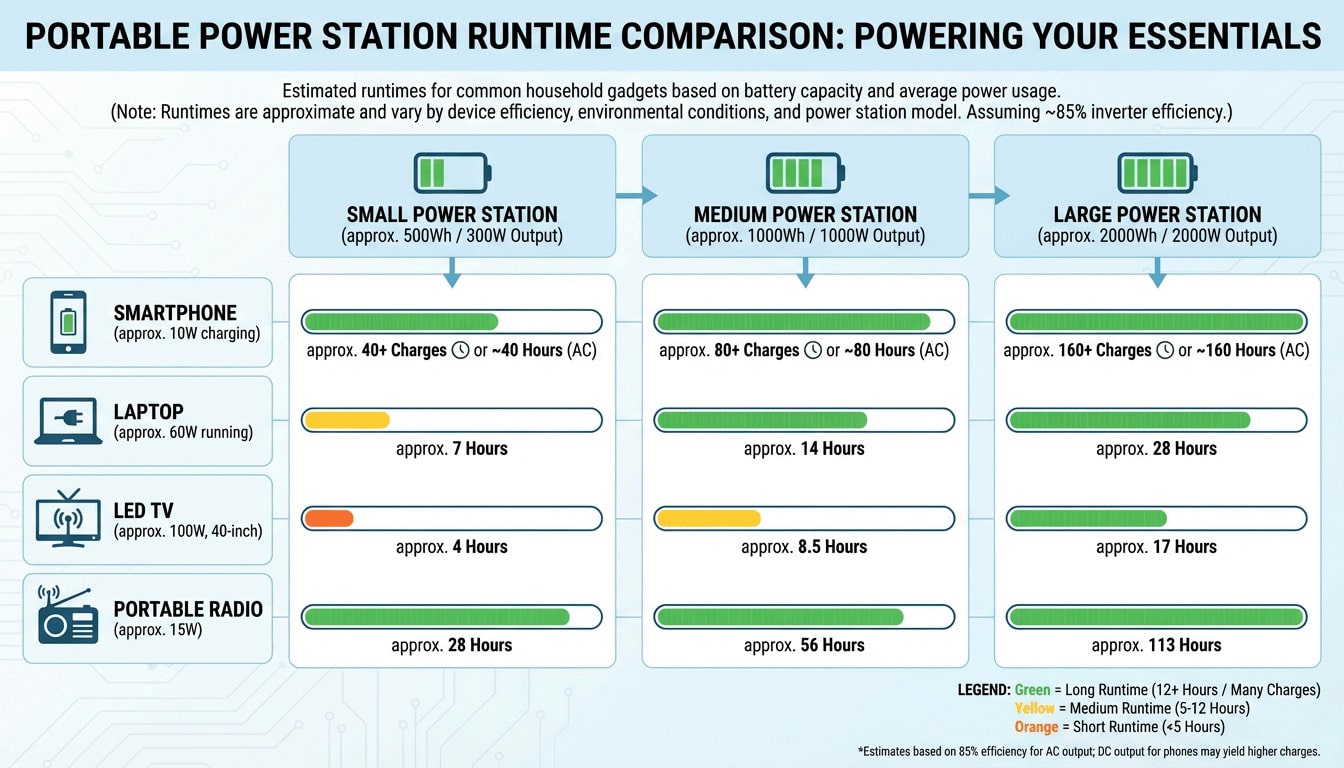
Let’s look at three common capacity ranges and their efficiency rates. A 606Wh station works at about 85% efficiency, giving 515Wh of usable power. Mid-range 1100Wh units offer around 935Wh of usable capacity. Larger 2000Wh stations have about 1700Wh of usable power after losses.
Running a Refrigerator
Refrigerators are critical during power outages to prevent food spoilage. They use between 150 and 200 watts on average, though this can change. The compressor turns on and off, affecting energy use.
A 150-watt small refrigerator is a good test for power stations. With a 2000Wh station, you can get about 11.3 hours of use. This is found by dividing the usable capacity by the appliance’s wattage (1700Wh ÷ 150W = 11.3 hours).
When planning for refrigerator backup, remember the startup surge. Most refrigerators need 2-3 times their running wattage for the first few seconds. For example, a 150-watt refrigerator might need 450 watts at startup, so the inverter must handle these spikes.
Here are ways to extend refrigerator runtime during outages:
- Keep the refrigerator door closed as much as possible to maintain internal temperature
- A well-stocked freezer retains cold temperatures longer than an empty one
- Place ice packs or frozen water bottles inside to reduce compressor cycling
- Set the temperature to the warmest safe setting (40°F for refrigerator, 0°F for freezer)
Powering Essential Electronics
Essential electronics are lifelines during power outages. They keep families connected and informed. These devices use less power than major appliances, allowing extended electricity generation duration from portable stations.
Here’s a breakdown of common essential electronics and their typical power requirements:
- WiFi routers: 5-20 watts, depending on model and features
- Phone chargers: 5-10 watts per device during active charging
- Laptops: 40-60 watts during normal use, less when only charging
- LED lighting: 5-10 watts per bulb for adequate illumination
- CPAP machines: 30-80 watts, depending on humidifier settings
A 606Wh station with 515Wh usable capacity is very versatile. It can power a 60-watt laptop for about 8.6 hours. For someone needing a CPAP machine overnight, a 100-watt unit runs for about 5.1 hours, covering most of a typical sleep period.
Mid-range 1100Wh stations are great for powering multiple devices at once. For example, a 120-watt TV, a 20-watt WiFi router, and 15 watts of LED lighting. This 155-watt load runs for about 6 hours on the 935Wh usable capacity.
The larger 2000Wh stations offer remarkable electricity generation duration for low-power combinations. Running a home Wi-Fi router and small lighting totaling just 35 watts provides an impressive 48.5 hours of continuous operation. This nearly two-day runtime makes these stations invaluable for extended outages.
Utilizing for Outdoor Events
Portable power stations are great for outdoor activities beyond emergency preparedness. Camping trips, tailgating parties, and outdoor gatherings all benefit from reliable portable electricity. These scenarios show the versatility that makes power stations attractive investments for active families.
Camping applications highlight the advantages of power station runtime in remote locations. A 1100Wh unit can power a 55-watt electric fan for about 17 hours, providing comfortable sleeping conditions throughout a long weekend. Portable speakers that draw 20-30 watts run for 30-45 hours, providing music for multiple days without recharging.
Tailgating events benefit from higher-capacity stations that handle cooking appliances. A 2000Wh station powers an 800-watt coffee maker for about 2.1 hours of continuous operation, enough to brew several pots throughout a game day. Small electric grills, portable blenders for frozen drinks, and warming trays all become possible with adequate capacity planning.
Outdoor party setups often combine multiple moderate-draw devices simultaneously. Consider this typical configuration:
- String lights (50 watts total) create ambiance
- Portable cooler (45 watts) keeping beverages cold
- Bluetooth speaker (15 watts) providing entertainment
- Phone charging station (30 watts) for multiple devices
This 140-watt combined load runs for about 6.7 hours on a 1100Wh station. The calculation is simple: divide usable capacity by total wattage to determine runtime. Planning device usage around these numbers ensures uninterrupted outdoor enjoyment.
Small coolers designed for camping typically cycle like refrigerators but consume less power overall. A 50-watt mini cooler connected to a 606Wh station runs for about 10.3 hours, perfect for day trips or afternoon events. Understanding these practical applications helps buyers select appropriate capacity for their specific recreational needs.
Comparing Different Portable Power Station Models
The portable power station market offers many options. Each is designed for different power needs and budgets. Knowing how brands compare helps homeowners choose the right backup power.
Real-world performance is key. While specs are important, how long a power station lasts and how reliable it is matter most. Modern tools give users real-time data on power and expected runtime.
ALLWEI Power Stations: Versatile Mid-Range Solutions
ALLWEI is known for three models that meet various power needs. The smallest, a 600W station with 606Wh capacity, is great for camping and short outages. It’s light and can power a laptop for 8-10 hours.
The 1200W model with 1100Wh capacity is perfect for many homes. It can run a fridge for 8-12 hours or charge many devices during long outages. It’s great for tailgating and weekend trips.
The largest, a 2000W station with 2000Wh capacity, handles big appliances like microwaves and power tools. It’s ideal for families needing backup power for important appliances during emergencies.
ALLWEI models have:
- LiFePO4 battery for long life (3000+ cycles)
- Many USB ports, AC outlets, and DC outputs
- Solar charging with MPPT controllers
- LED display for real-time power use
- Pass-through charging for using and recharging at the same time
Real-world runtime example: The 1200W model can power a 150W fridge for about 6-7 hours, considering compressor cycles and door openings.
EcoFlow DELTA Pro 3: Expandable Whole-Home Power
EcoFlow’s DELTA Pro 3 offers 4000W continuous power output at dual-voltage. It supports big appliances like electric water heaters and central air units that smaller stations can’t handle.
It’s expandable, allowing users to add more battery modules. This increases capacity from 3kWh to 25kWh. It’s great for growing your system as needs and budgets change.
The EcoFlow app has advanced tools for monitoring power use. Users can see which devices use the most power and adjust to save energy during outages.
DELTA Pro 3 highlights:
- Fast charging: 0-80% in 50 minutes via AC wall outlet
- Smart app for remote monitoring and control
- UPS mode with 10ms switchover time
- X-Boost for running high-wattage appliances
- Five-year warranty on battery and electronics
The dual voltage output makes it valuable for serious backup needs. It can be hardwired into a home’s electrical panel for automatic backup power.
EcoFlow DELTA PRO ULTRA X: Ultimate Whole-Home Solution
The DELTA PRO ULTRA X offers 12-36kW of continuous power with expandable capacity. It’s a whole-home energy solution that rivals traditional standby generators.
It has a split-phase 240V design for easy integration with home electrical systems. Professional installation with an automatic transfer switch ensures quick activation of backup power.
Modular expansion is key to its flexibility. Homeowners can configure it based on their needs and critical load requirements. A base setup might support essential circuits for 24-48 hours, while a full setup can power a whole home for days.
This model optimizes power plant performance with smart load management. It prioritizes critical circuits and can shed non-essential loads to extend runtime during long outages.
Premium features include:
- Stackable battery modules for customized capacity
- Smart home integration with major platforms
- Real-time grid monitoring and automatic switchover
- Solar input capability up to 5400W for off-grid operation
- Professional-grade construction with outdoor-rated components
The difference between surviving a power outage and thriving through one often comes down to having the right capacity and features matched to your actual needs.
Each brand serves different users well. ALLWEI models are great for portability and weekend adventures. The DELTA Pro 3 is a good middle ground. The DELTA PRO ULTRA X offers top-level backup for demanding homes. Choose based on budget, space, and power needs, not just size.
Calculating Your Home’s Power Needs
Figuring out how much power your essential appliances use is key to smart energy planning. Without the right numbers, you might buy a portable power station that’s not enough or too expensive. You need to know which devices are most important, how much power they need, and match that with what you actually need.
This method turns fuel consumption tracking into something you can use. Once you know your home’s energy use, you can choose the right backup power wisely.
Finding the Power Rating of Your Appliances
Every device has a specific power need that shows how much energy it uses. The first step is to find this information in a few ways.
Most appliances have a label or nameplate on the back or bottom that shows watts. Some older devices might only show amps. If that’s the case, multiply the amps by 120 volts to find watts.
A plug-in watt meter gives real data on how much power your devices use. It connects between the wall and your appliance, showing how much power it uses. This is great for devices that use different amounts of power, like refrigerators.
If you can’t find the label, you can look up the wattage online. Product manuals and online specs have the energy production metrics you need for planning.
The following table shows typical wattage ranges for common household items:
- LED light bulb: 5-10W
- Laptop computer: 50-100W
- LCD television (42-inch): 80-150W
- Desktop computer with monitor: 200-400W
- Refrigerator (modern Energy Star): 100-200W running, 600-800W surge
- Microwave oven: 600-1200W
- Coffee maker: 800-1400W
- Window air conditioner (8,000 BTU): 900-1200W
- Space heater: 1000-1500W
- Hair dryer: 1200-1800W
- Well pump: 800-1500W running, 2000-3500W surge
Surge wattage is important because many appliances need more power to start. Power stations need to handle these spikes to start devices.
Adding Up Your Total Energy Requirements
After finding out how much power each appliance uses, you need to plan your power needs. This means sorting devices into groups based on their importance during a power outage.
Essential items are things you need for health, safety, or food. Medical equipment, refrigerators, basic lighting, and communication devices are key. These are the basis of your energy plan.
Comfort and convenience items are next. Coffee makers, laptop chargers, phone charging stations, and small kitchen appliances are in this group. You can use these devices sometimes, not all the time.
Then there are non-essential items. These include entertainment systems, gaming consoles, clothes dryers, and decorative lighting. You can wait to use these when power is back on.
To find out how much power you need at once, add up the wattages of devices that use power together. For example, a 150W fridge, five 30W LED bulbs, a 75W laptop, and a 20W modem/router together use 275W.
To find out how much energy you use over time, multiply the wattage of devices by how long they use power. A 275W load for 8 hours uses 2,200 watt-hours (Wh) of energy.
Using Formulas to Determine Runtime
The basic formula helps estimate how long a power station will last. It’s simple: Runtime (hours) = Battery Capacity (Wh) ÷ Device Power (W).
For example, a 1,000Wh power station running a 200W fridge would last 5 hours (1,000 ÷ 200 = 5). But this formula doesn’t account for real-world losses.
A better formula includes an efficiency factor for energy lost during conversion. The real equation is: Runtime (hours) = Battery Capacity (Wh) × Efficiency (0.80-0.90) ÷ Device Power (W).
Using the same example with 85% efficiency: 1,000Wh × 0.85 ÷ 200W = 4.25 hours. This shows how important efficiency is for longer use.
To figure out how much power you need, work backward from how long you want to use it. If you need 330W for 6 hours, multiply: 330W × 6 hours = 1,980Wh. This is the minimum you need.
Adding 25-30% to this number is smart. This extra helps your battery last longer and gives a safety margin. Adding 30% to 1,980 Wh means you need about 2,500 Wh.
This method helps you plan your power needs:
- List all essential devices with their wattages
- Add up the total wattage for simultaneous operation
- Multiply by the desired runtime hours
- Add 30% overhead for efficiency and battery protection
- Compare the result to available power station capacities
For example, planning for a 12-hour outage with a fridge (150W), five LED bulbs (50W), two phone chargers (20W), and a laptop (75W) would mean: (295W × 12 hours) × 1.30 = 4,602Wh. You would need a power station with at least 5,000 Wh.
These steps turn vague numbers into clear choices. They help you pick the right portable power station for your needs during emergencies or off-grid times.
Best Practices for Extending Runtime
To get the most from a portable power station, it’s key to know how to use it efficiently and take good care of it. Small changes in how you use your unit can add hours of power when you need it most. If you’re still choosing a unit, check out our guide to the best portable power stations to find one that fits your needs. These tips help your power station work better and last longer.
Getting more hours from the same battery can be simple. Just follow some proven practices. These small changes can turn wasted energy into power when you really need it.
Energy Efficiency Tips
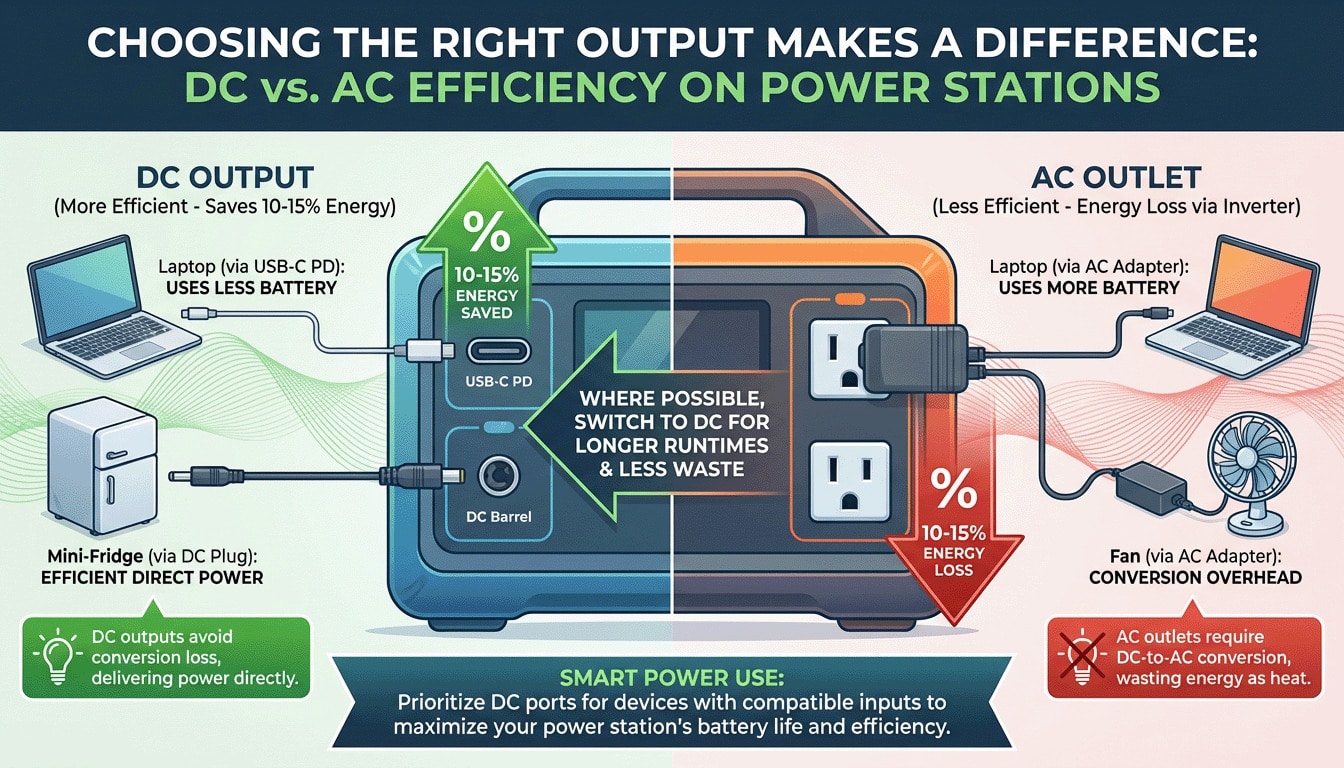
Choosing the right way to use your power station makes a big difference. DC outputs like USB ports and DC barrel plugs save 10-15% of energy compared to AC outlets. This means using a laptop charger from a USB-C PD port uses less battery than an AC adapter.
Even when devices seem off, they can quietly drain batteries. Phone chargers, power adapters, and devices in standby mode draw power continuously. Unplugging these can save a lot of power.
Stopping just 20 watts of vampire draw can save 200 Wh over 10 hours. This extra energy can power lights for hours or keep a phone charged for days.
Choosing the right appliances also saves energy. LED bulbs use 75% less power than old bulbs and light up just as well. Laptops use much less power than desktops for the same tasks.
Pre-cooling your fridge before a power outage helps your fridge last longer. A cold fridge can stay cool for 4-6 hours without power if the door is closed. Using insulated containers for often-used items also helps.
Smart Load Management
Using many high-power appliances at once drains batteries fast. A microwave, coffee maker, and space heater together might be too much for the inverter to handle. Managing your load smartly prevents quick battery drain and system shutdowns.
Plan your power use to get the most value. Charge phones, tablets, and laptops during the day. This saves battery for essential items like CPAP machines or refrigeration at night. Using timers and planning your power use turns it into a strategy.
Knowing how appliances work helps you use power better. Fridges don’t need constant power; they cycle on and off. Running other devices when the fridge is off reduces battery demand.
Some people use a priority list for power use. Give power to critical devices like medical tools and phones first. Then, use it for less important things like entertainment when you can.
Regular Maintenance Suggestions
Regular maintenance keeps your power station running well and lasting longer. Update your firmware to get the latest efficiency and safety features. Manufacturers often release updates that improve how your battery charges and delivers power.
How you store your power station affects its health and life. Keep it charged between 50% and 60% if you won’t use it for a while. This helps avoid stress on the battery cells.
Keeping your power station in a cool place is important. The best temperature range is 50-86°F. This prevents damage from heat or cold. Garages and sheds can get too hot or cold in summer and winter.
Clean your power station regularly to keep it running well. Dust from cooling vents can cause overheating. Check ports for corrosion or debris to ensure reliable connections.
Even when not in use, using and recharging your unit every 3-6 months keeps it healthy. This simple habit can extend your battery’s life by hundreds of charges.
Adding solar panels can keep your power station topped up. Even a small 200W panel can generate 800Wh a day in good weather. This reduces your need for grid power and lets you use power indefinitely for low-draw devices.
Watch for signs that your battery is getting old. A noticeable drop in capacity, longer charging times, or unexpected shutdowns mean it’s time for a new one. Fixing these issues early prevents failures when you really need your power station.
Keeping your battery charged between 20% and 80% during regular use helps it last longer. While it’s okay to drain it to near-empty sometimes, doing it all the time wears it out faster. This is true whether you use it daily or just for emergencies.
Understanding Inverter vs. Battery Capacity
Two key specs decide how well a portable power station works. Many people focus on battery size but ignore the inverter’s role. Together, they convert stored energy into power for your home, making smart choices easier.
The battery stores energy in DC form, while the inverter changes it to AC power. This AC power is what most appliances need. Both specs affect how long devices run and which appliances can be used.
How Inverters Affect Runtime
Inverters convert DC power to AC power, but the process isn’t perfect. Most portable power stations lose 10-15% of stored energy during this change. High-quality inverters work at 90-95% efficiency, but real-world performance can vary.
The type of inverter is key to runtime and device use. Pure sine wave inverters are safe for sensitive electronics and essential for motors and medical devices. Modified sine-wave inverters are cheaper but can damage some equipment and significantly reduce power plant efficiency.
Inverter efficiency is best at moderate loads, between 30% and 80% of their rated capacity. Using devices that draw very little power or maxing out the inverter reduces efficiency and wastes battery capacity.
A common confusion is inverter ratings. A 2000W inverter rating shows maximum AC output capability, not energy storage. This tells users which devices the station can power, but battery capacity determines how long those devices will run.
Types of Batteries Used
Two main battery types power modern portable stations: traditional lithium-ion (NCM or NMC) and lithium iron phosphate (LiFePO4). Each has its own benefits based on usage and priorities.
Traditional lithium-ion batteries offer high energy density in compact, lightweight packages. They’re best when portability is key. But they support only 500-1000 charge cycles before capacity drops significantly. They’re also more sensitive to temperature and need careful handling.
LiFePO4 batteries last longer with 3000-5000+ charge cycles under normal conditions. They allow 80-90% of their capacity to be safely used, unlike standard lithium-ion’s 80% depth of discharge. These batteries are more temperature-stable and safer, making them great for frequent use and long-term investment.
The tradeoff is energy density and size. LiFePO4 units are slightly larger and heavier than lithium-ion units with the same capacity. For occasional use, lithium-ion is fine. But for regular off-grid use or daily cycling, LiFePO4 offers better energy production metrics and lower long-term costs.
Balancing Inverter and Battery Output
Both specs are important when choosing a portable power station. You need enough inverter capacity for your highest-wattage device, including surge needs at startup. Also, enough battery capacity must support the total load for the desired time.
For example, a unit with a 3000W inverter but only a 1000Wh battery can power a 1500W space heater for less than an hour, considering efficiency losses. On the other hand, a 1000W inverter with a 3000Wh battery can’t power that heater, but can run multiple smaller devices for longer.
Matching specs to your needs prevents disappointment. For occasional power tool use, a high inverter capacity and a moderate battery size are enough. For a camper needing to run LED lights, phones, and laptops, a larger battery capacity with a modest inverter rating is better. Understanding this balance ensures the power station meets your needs, not just impressive specs.
The Importance of Runtime in Emergency Situations
When the lights go out, knowing how long your backup power will last is key. It’s not just a technical detail; it’s a lifeline for your family’s safety. Portable power stations offer a safe, quiet, and effective solution for emergencies, storms, or just peace of mind.
Power outages are becoming more common in the U.S. Having a reliable backup power source is now essential. Climate-related events have made power outages more frequent in every region. Preparing your family now means understanding how long your backup power will last during extended outages.
Preparedness for Natural Disasters
Different disasters require different backup power strategies. Hurricane season in the Gulf Coast can cause outages lasting 24 to 72 hours. California faces dual threats: wildfire evacuations and Public Safety Power Shutoffs that can last 48 hours or more.
Texas winter storms show how temperature extremes change power needs. Heating in cold weather drains batteries faster than in summer. Midwest severe weather brings sudden, violent storms with unpredictable restoration timelines.
Regional patterns help determine minimum capacity targets. Most outages last a few hours, but major weather events can last 12-72 hours or longer. A 4-6 hour window requires 1,000-2,000Wh capacity and covers ride-out-the-storm scenarios. This keeps your refrigerator cool, charges devices, provides lighting, and allows cooking one hot meal.
An 8-12 hour window (2,000-4,000Wh) covers overnight and into the next morning. A 24-hour backup (5,000-8,000Wh) sees you through most weather-related outages. Multi-day backup requires 10,000-15,000Wh with careful rationing and usually solar recharging capabilities.
“The emotional value of maintaining normalcy during crisis situations cannot be overstated—keeping communication channels open and critical devices running provides psychological stability when everything else feels chaotic.”
Operational uptime analysis for disaster scenarios must account for the worst-case duration in your specific region. Earthquake-prone areas face infrastructure damage that unpredictably extends restoration times. Wildfire evacuation zones need portable solutions that are easy to transport while providing days of autonomous operation.
Usage During Power Outages
Strategic timeline planning transforms panic into preparedness. The first four hours represent your immediate response phase. Communication takes priority—charging phones to contact family, checking emergency alerts, and assessing the situation. Basic lighting and food preservation begin immediately.
The 4-12 hour window shifts to settling in and overnight preparation. Food management becomes critical as refrigerators lose cooling efficiency. Strategic device charging prioritizes medical equipment and communication tools.
Lighting needs increase as darkness falls, but LED efficiency significantly extends power station runtime.
Beyond 12 hours, families enter the rationing and conservation phase. Opening refrigerators less frequently preserves food longer. Consolidating device charging into planned sessions maximizes efficiency.
Entertainment shifts to battery-powered options or books to preserve capacity for essential functions.
The 24-hour threshold marks a critical decision point. If restoration seems unlikely, aggressive conservation begins. Non-essential loads shut down completely.
Families seek recharge opportunities through solar panels, vehicle charging, or community resources. This extended phase requires disciplined power management and realistic expectation setting.
Temperature management presents special challenges. Summer heat forces difficult choices between cooling for comfort and charging devices. Winter cold demands heating solutions that often exceed the capabilities of portable stations, requiring alternative approaches such as proper insulation and layered clothing.
Essential Appliances to Prioritize
Not all devices deserve equal consideration during emergencies. A tier-based prioritization system helps families make smart decisions when capacity runs low. Understanding this hierarchy before a crisis strikes prevents difficult conversations during stressful moments.
Tier 1 represents truly critical, life-sustaining devices:
- Medical equipment, including CPAP machines, oxygen concentrators, and nebulizers
- Refrigeration for medications requiring cold storage, including insulin and certain prescriptions
- Communication devices for emergency contact and information access
- Lighting for safety and navigation during nighttime hours
Tier 2 covers essential comfort and safety needs:
- Food refrigeration to prevent spoilage and waste
- Basic heating or cooling in extreme weather conditions
- Water supply systems for homes dependent on well pumps
- Charging stations for backup batteries and power banks
Tier 3 includes comfort items that improve quality of life:
- Hot food preparation using electric kettles or small cooking appliances
- Entertainment devices for children and stress relief
- Convenience items like coffee makers or toasters
- Internet routers for non-emergency communication
Tier 4 encompasses non-essential devices that can wait:
- Large screen televisions and gaming systems
- Hair dryers and styling tools
- Decorative lighting and non-functional electronics
- Luxury appliances with minimal emergency value
Calculating minimum runtime needs starts with an honest assessment. Medical device users must account for continuous operation instead of intermittent use. CPAP machines running 8 hours nightly need dedicated capacity planning. Oxygen concentrators demand priority allocation with backup plans if the power station’s runtime falls short.
Regional outage patterns significantly inform capacity decisions. Gulf Coast residents experiencing frequent multi-day hurricane outages need different solutions than Midwest families facing occasional 4-8 hour storm disruptions. Historical data from local utility companies provides realistic planning baselines.
Making difficult prioritization decisions becomes easier with advanced planning. Families should conduct practice drills, running essential loads from their power station to verify actual runtime against theoretical calculations.
These exercises reveal unexpected power draws and highlight devices consuming more energy than anticipated.
The emotional component of emergency preparedness deserves recognition. Maintaining some normalcy—keeping phones charged for family connections, preserving a sense of control through strategic planning, protecting vulnerable family members—provides psychological benefits that extend beyond mere electrical capacity.
Smart power station runtime planning delivers both practical functionality and invaluable peace of mind when uncertainty surrounds everything else.
Upgrading Your Power Solutions
Many people find that upgrading their portable power system improves emergency preparedness. As families grow and energy needs change, a single unit might not be enough. Knowing when and how to expand helps homeowners make smart choices.
Deciding to upgrade means looking at current performance and future needs. Some might add a second unit, while others need a whole-home system. Solar integration can make a battery last forever during outages.
Recognizing When a Larger Model Makes Sense
Signs show when a power station is too small. Running out of power before outages end means it’s not big enough. Being unable to power essential medical equipment is a serious safety issue.
Adding family members or devices can significantly change power needs. Moving to areas with longer outages means needing more power. Going from camping to serious emergency preparedness means needing professional-grade capacity and reliability.
Thinking about the cost of upgrading versus buying more units is important. A second or third unit costs between $800 and $2,000. This way, you can add more power as you can afford it.
Modular systems grow with your needs. They let you add more batteries without replacing the whole unit. When you need more than 5,000Wh, a whole-home system is cost-effective.
Whole-home systems cost between $5,000 and $15,000. Portable units are cheaper and easier to set up. The cost of a whole-home system is worth it when you need a lot of power.
Transforming Capabilities with Solar Panels
Solar panels turn portable power stations into renewable energy systems. A few hundred watts of solar panels can add 1,000 to 2,000Wh on a sunny day. This makes power last for weeks.
Choosing the right solar panels is important. Folding panels are easy to store, while rigid panels are durable. Blanket-style panels are flexible for different uses.
Wattage depends on how much you want to charge and how you use it:
- 100W panels: Slow recharge for maintenance
- 200-400W panels: Good for daily recharge
- 600W+ arrays: Fast charging for high needs
Make sure the panels fit your system. Most modern stations use MC4 connectors or special adapters. Some systems let you charge devices while charging the station.
Charging times vary by season and location. Arizona gets lots of sun, while Seattle has less in winter. Sun hours affect how much energy you can make.
To size panels, multiply daily use by a safety factor. Then divide by the number of sun hours to find the minimum wattage. Add 25-30% for efficiency and weather.
Selecting Value-Adding Accessories
The right accessories enhance your power system. Runtime monitoring tools show how much power you’re using. They help you manage loads when it matters most.
Must-haves include extra charging cables and DC-to-DC adapters. Solar panel mounts increase energy capture. Protective cases keep your gear safe.
Expansion batteries increase capacity without replacing the unit. Transfer switches make home integration easy. Monitoring apps and displays keep an eye on your system.
Regular maintenance keeps your system running well. Tools and reminders help with upkeep. Regular care can extend your system’s life by years.
Nice-to-have accessories include special adapters and carrying solutions. Backup power for non-essential items is also nice. Smart buyers know the difference between must-haves and nice-to-haves.
For long setups, you might need multiple units or a home battery system. These setups offer redundancy and flexibility. They help you manage power needs better.
Final Thoughts on Optimizing Power Station Use
Knowing how long a power station lasts helps homeowners plan for emergencies. They can prepare for storms or feel secure during power outages. Portable power stations are a good choice because they are safe, quiet, and work well.
Key Takeaways for Success
The lifespan of a power station depends on three factors: battery size, the power devices used, and system efficiency. Systems usually lose some power, so you need to add extra. Choosing the right size for your needs means it will work when you need it most.
Making Informed Decisions
There’s no one-size-fits-all solution. The best choice depends on your situation, budget, and how much risk you’re willing to take. It’s smart to think about what you really need instead of buying too much or too little.
Today’s portable power stations are better than ever, being cleaner, quieter, and more flexible.
Share Your Experience
People who have used their power stations during real outages share important tips. What’s most important during emergencies? How did your power station’s runtime compare to what you expected?
Sharing your story helps others feel more confident and prepared. Keep this page bookmarked for future reference or when your needs change. If you’re preparing for outages, see our guide to the best portable power stations to choose the right setup for your home.