Understanding Dimensions: From Lines to Spacetime
Explore the fascinating world of dimensions from one-dimensional lines to four-dimensional spacetime. Learn what each dimension means and how they shape our reality.
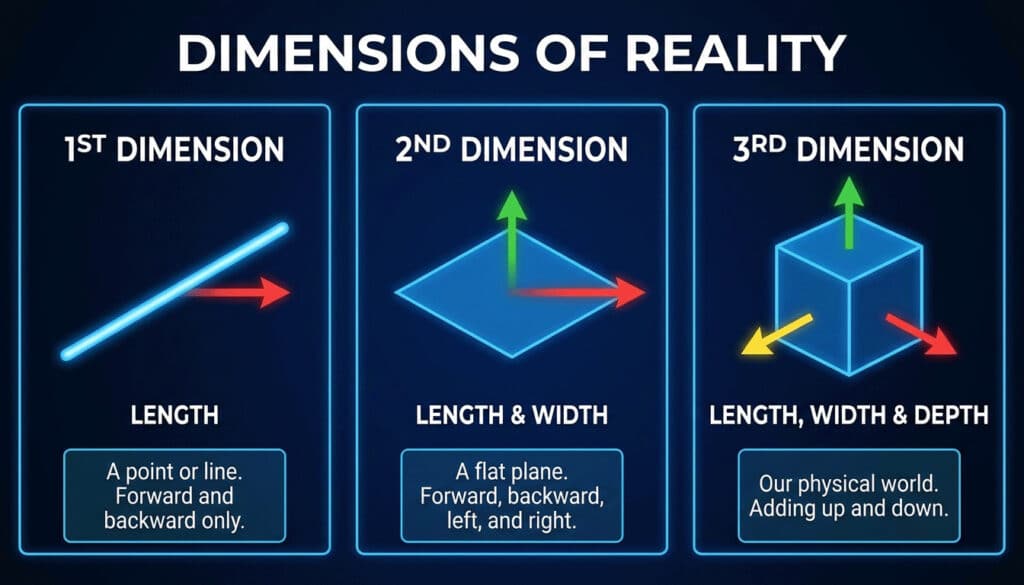
The concept of dimensions shapes how we understand space, time, and reality itself. Every object you see, every direction you move, exists within a framework of dimensions that define position, size, and form.
From the simplest one-dimensional line to the mysterious fourth dimension involving time, each dimension adds a new degree of freedom to our understanding of the universe. This scientific exploration will guide you through each dimension systematically.
What Are Dimensions in Mathematics and Physics
In mathematics and physics, a dimension represents an independent direction in which you can move or measure. Each dimension provides one degree of freedom for positioning an object in space.
Think of dimensions as coordinate axes. The number of dimensions determines how many coordinates you need to specify a unique position.
Scientists use dimensions to describe everything from simple geometric shapes to complex theories about the structure of our universe. The dimensional framework helps us understand spatial relationships and physical phenomena.
Spatial Dimensions
Spatial dimensions define the physical space in which objects exist. These include length, width, and height that we experience daily in our three-dimensional world.
- Length measures distance along one axis
- Width adds perpendicular measurement
- Height creates three-dimensional volume
- Each dimension is independent of the others

Key Concept: Each dimension in space is perpendicular to all others. This perpendicularity ensures that dimensions remain independent measures of position and direction.
The First Dimension: A World of Pure Length
The first dimension is the simplest form of spatial existence. It consists only of length, with no width or height whatsoever.
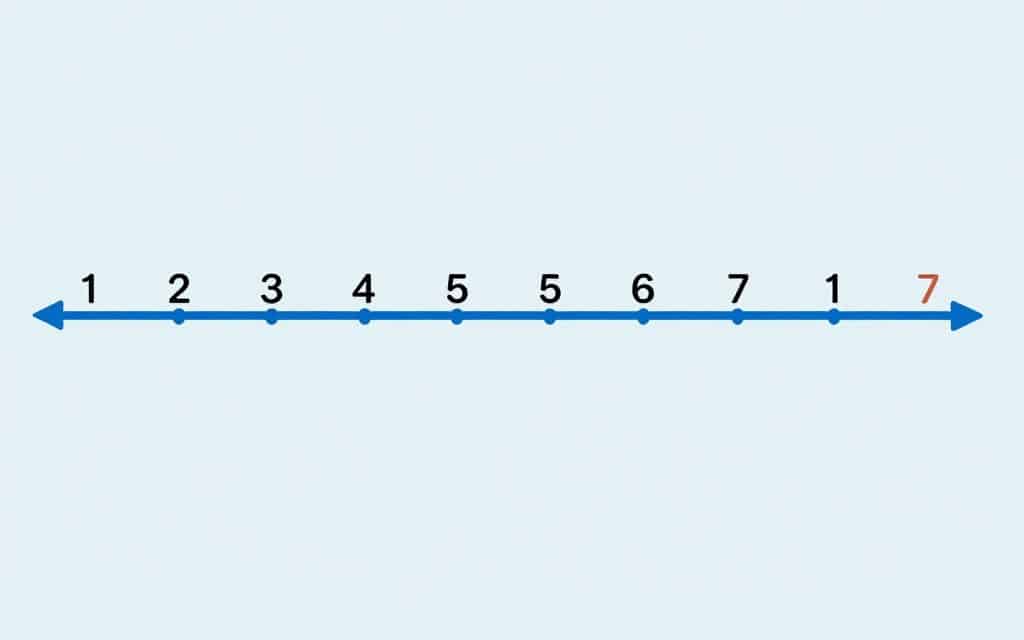
Imagine a perfectly straight line extending infinitely in two opposite directions. This line represents a one-dimensional space in which position requires only a single coordinate.
Characteristics of One Dimension
In one dimension, objects can only move forward or backward along a single axis. There is no way to move around an obstacle because no other direction exists.
- Only length exists as a measurable property
- Position requires just one coordinate number
- Movement is restricted to two opposite directions
- No area or volume can exist in this space
- Objects cannot pass each other on the line
Mathematical Representation
Mathematicians represent one-dimensional space using a single variable, typically x. Any point on this line has coordinates written as simply (x), where x is a real number.
The number line you learned in school is a perfect example of one dimension. Every number has a unique position on this line defined by a single value.
Real-World Examples
While pure one-dimensional objects don’t exist physically, we can observe one-dimensional behavior in certain situations.
- Temperature on a thermometer scale
- Time as a single forward direction
- Railway tracks as constrained paths
- Frequency spectrum in physics
Limitations of One Dimension
The first dimension imposes severe restrictions on what can exist within its space.
- No enclosed shapes or surfaces are possible
- Objects cannot rotate or turn around
- No concept of area or surface
- Impossible to bypass other objects

The Second Dimension: Adding Width Creates Surfaces
The second dimension adds width to length, creating a plane where shapes can form and area becomes meaningful. This dimensional leap transforms a line into a surface.
Two dimensions require two perpendicular directions. We typically call these directions the x-axis and y-axis, intersecting at right angles to form a coordinate plane.

Properties of Two Dimensions
In two-dimensional space, objects can move forward, backward, left, and right. This freedom allows navigation around obstacles and the creation of enclosed shapes.
- Two coordinates define any position.
- Area measurements become possible.
- Shapes can have perimeters and surfaces.
- Objects can move in four primary directions
- Rotation occurs in a single plane
- No concept of volume or thickness exists
Geometric Forms in Two Dimensions
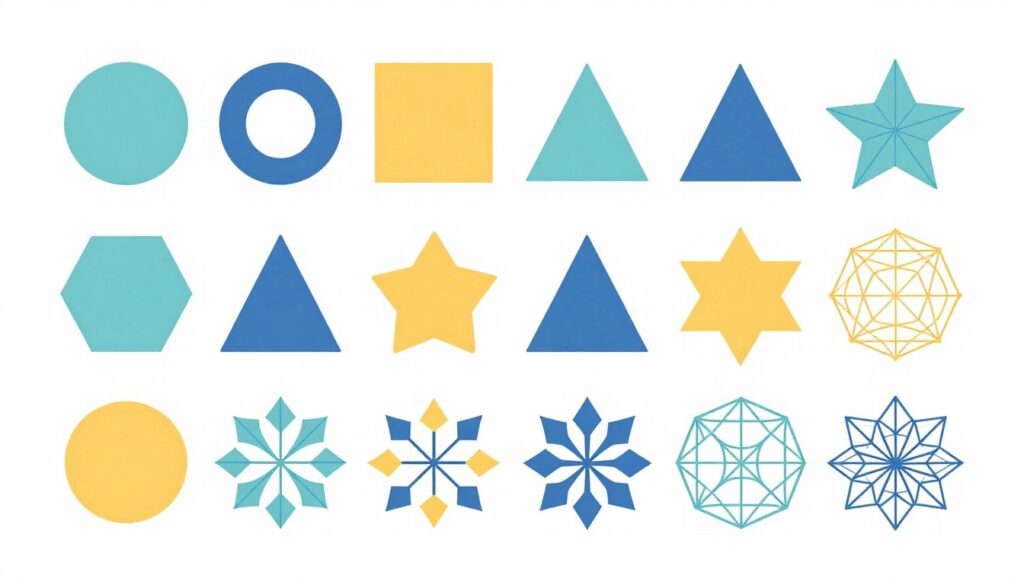
The second dimension allows the creation of numerous geometric shapes. Each shape occupies an area but has zero thickness or height.
Basic Shapes
Simple two-dimensional forms include circles, squares, triangles, and rectangles. Each has a defined area and perimeter.
- Circles with radius and diameter
- Polygons with straight edges
- Ellipses and curved forms
Complex Patterns
Two dimensions enable intricate designs and tessellations that fill space without gaps.
- Repeating tile patterns
- Fractal designs
- Artistic compositions
Mathematical Functions
Graphs of equations appear as curves and lines on the two-dimensional plane.
- Linear functions are straight lines
- Parabolas and hyperbolas
- Trigonometric waves
Two Dimensions in Daily Life
We encounter two-dimensional representations constantly, even though we live in three dimensions. Screens, paper, and surfaces display two-dimensional information.
Maps represent three-dimensional terrain on two-dimensional surfaces. Artists create the illusion of depth on flat canvases through perspective techniques.
Visual Representation: Everything you see on computer screens, photographs, and drawings exists in two dimensions. Our brains interpret visual cues to perceive depth, but the actual display surface is two-dimensional.
Explore Visual Dimension Guides
Download our comprehensive visual guide comparing one-dimensional, two-dimensional, and three-dimensional spaces with detailed diagrams and real-world examples.
The Third Dimension: Our Physical Reality
The third dimension adds height to length and width, creating the three-dimensional space we inhabit. This dimension allows objects to have volume and physical presence.
Three dimensions provide complete freedom of movement in physical space. We can move forward, backward, left, right, up, and down through our three-dimensional world.

Understanding Three-Dimensional Space
Our universe appears to operate in three spatial dimensions. Every object you touch occupies three-dimensional space with measurable length, width, and height.
Three coordinates are necessary to specify any position in this space. We typically label these axes as x, y, and z, all perpendicular to each other.
- Three independent directions of movement
- Objects possess volume and mass
- Rotation occurs around multiple axes
- Complex spatial relationships form
- Distance calculations use three coordinates
- Physical laws govern object interactions

Volume and Solid Geometry
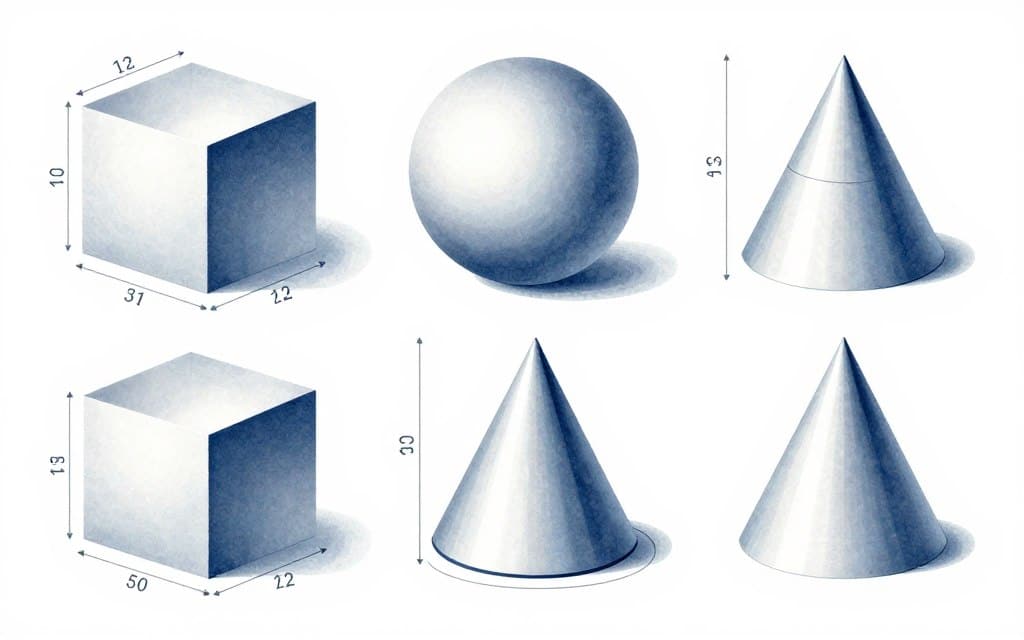
The third dimension introduces the concept of volume, which measures the amount of space an object occupies. Solid geometry studies three-dimensional shapes and their properties.
Regular Solids
Basic three-dimensional forms include cubes, spheres, cylinders, and pyramids. Each has a calculable volume and surface area.
- Cubes with equal edges
- Spheres with constant radius
- Cylinders with circular bases
- Pyramids with polygonal bases
Complex Structures
Three dimensions enable intricate architectural forms and natural structures with sophisticated spatial arrangements.
- Buildings and architectural designs
- Molecular structures in chemistry
- Biological organisms and organs
- Geological formations and crystals
Physics in Three Dimensions
Physical laws operate in three-dimensional space. Gravity, electromagnetism, and other fundamental forces act through three spatial dimensions.
Motion in three dimensions requires vector mathematics. Velocity, acceleration, and force all have components in three directions simultaneously.
| Physical Quantity | Dimensions Involved | Example Measurement | Real-World Application |
| Position | Three spatial coordinates | (x, y, z) in meters | GPS location tracking |
| Velocity | Three direction components | Vector with magnitude and direction | Aircraft navigation systems |
| Force | Three-dimensional vectors | Newtons in x, y, z directions | Structural engineering calculations |
| Volume | Product of three lengths | Cubic meters or liters | Container capacity measurement |
Perception of Three Dimensions
Humans perceive three-dimensional space through multiple sensory inputs. Our eyes provide stereoscopic vision that creates depth perception.
The brain processes visual information from two slightly different viewpoints to construct three-dimensional awareness. Touch and movement reinforce our understanding of spatial relationships.

Biological Adaptation: Human sensory systems evolved to efficiently navigate three-dimensional space. Our ability to judge distances, catch objects, and move through complex environments relies on sophisticated three-dimensional processing in the brain. Explore Fermi’s Paradox: Everything We Know – Network World News
Related Topics in Spatial Geometry
Expand your understanding of three-dimensional space with our articles on spatial geometry, vector mathematics, and coordinate systems.
The Fourth Dimension: Time and Beyond
The fourth dimension remains one of the most fascinating concepts in physics and mathematics. While we directly experience three spatial dimensions, the fourth dimension lies in the realms of theoretical physics and abstract mathematics.
In physics, time serves as the fourth dimension. Einstein’s theory of relativity unified space and time into a single four-dimensional continuum called spacetime.

Time as the Fourth Dimension
In relativistic physics, time forms the fourth dimension alongside the three spatial dimensions. Events in the universe require four coordinates to specify their position: three for space and one for time.
This spacetime framework revolutionized our understanding of the universe. Gravity itself results from the curvature of this four-dimensional spacetime fabric.
- Time flows in one primary direction: forward.
- Events require temporal coordinates for complete specification. The speed of light connects measurements of space and time.
- Massive objects curve the spacetime geometry.
- Time dilation occurs at high velocities.
- Gravitational fields affect time passage rates.
Spacetime Physics
Einstein’s special and general relativity treat time as intimately connected to space. The interval between events depends on both spatial separation and temporal difference.
Objects moving through space also move through time. The faster you travel through space, the slower you move through time relative to stationary observers.

Mathematical Fourth Spatial Dimension
Beyond time, mathematicians conceive of a fourth spatial dimension perpendicular to all three we experience. While we cannot visualize this dimension directly, mathematics describes it precisely.
A four-dimensional spatial object, called a tesseract or hypercube, extends beyond our three-dimensional perception. It relates to a cube as a cube relates to a square.
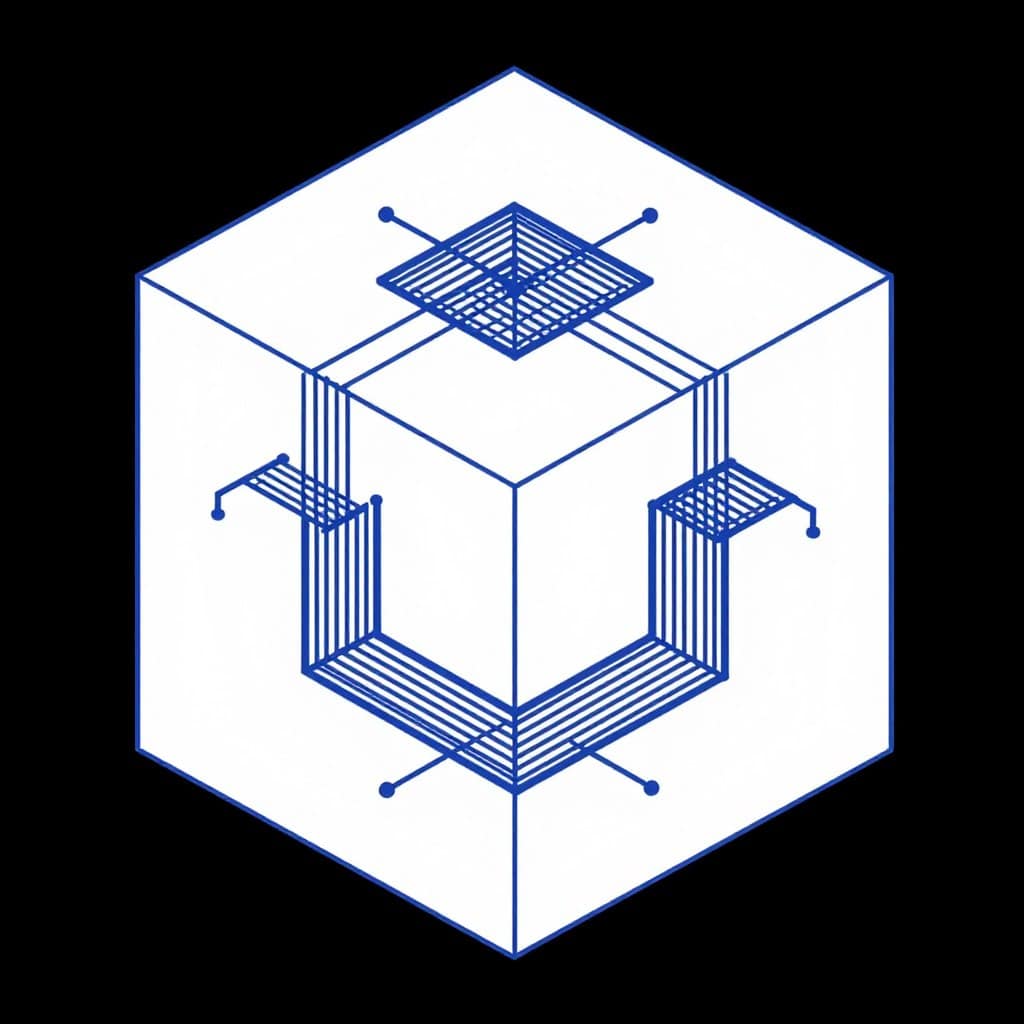
Visualizing Four Dimensions
Humans cannot directly perceive four spatial dimensions, but we can understand them through mathematical projections and analogies. Consider how a three-dimensional object casts a two-dimensional shadow.
Similarly, we can observe three-dimensional projections or “shadows” of four-dimensional objects. These projections help us study properties of higher-dimensional shapes.
Cross-Sections
Slicing through a four-dimensional object creates three-dimensional cross-sections, just as slicing a cube creates square cross-sections.
Rotations
Four-dimensional objects can rotate in ways impossible in three dimensions, revealing different three-dimensional aspects as they turn.
Unfolding
A hypercube unfolds into eight cubes, similar to how a cube unfolds into six squares on a flat surface.

Higher Dimensions in String Theory
Modern theoretical physics, particularly string theory, proposes the existence of additional spatial dimensions beyond the four we discuss. These theories suggest a total of 10 or 11 dimensions.
Extra dimensions might be “compactified” or curled up so small we cannot detect them. Only through high-energy particle physics experiments might we glimpse evidence of these hidden dimensions.
Theoretical Framework: String theory requires additional dimensions for mathematical consistency. These extra dimensions could explain fundamental forces and particle properties in ways that four dimensions alone cannot.
| Dimensional Theory | Number of Dimensions | Primary Application | Current Status |
| Classical Physics | 3 spatial + 1 time | Everyday phenomena and engineering | Well-established and verified |
| General Relativity | 4-dimensional spacetime | Gravity and cosmology | Extensively tested and confirmed |
| String Theory | 10 or 11 total dimensions | Unifying quantum mechanics and gravity | Theoretical framework under development |
| M-Theory | 11 dimensions | Unification of string theories | Active research area |
Practical Implications
Understanding higher dimensions influences modern technology and science. Computer graphics use four-dimensional mathematics to create animations. Engineers apply dimensional analysis across multiple variables.
Data scientists work with high-dimensional spaces when analyzing complex datasets. Each variable in a dataset can represent an additional dimension in mathematical space.
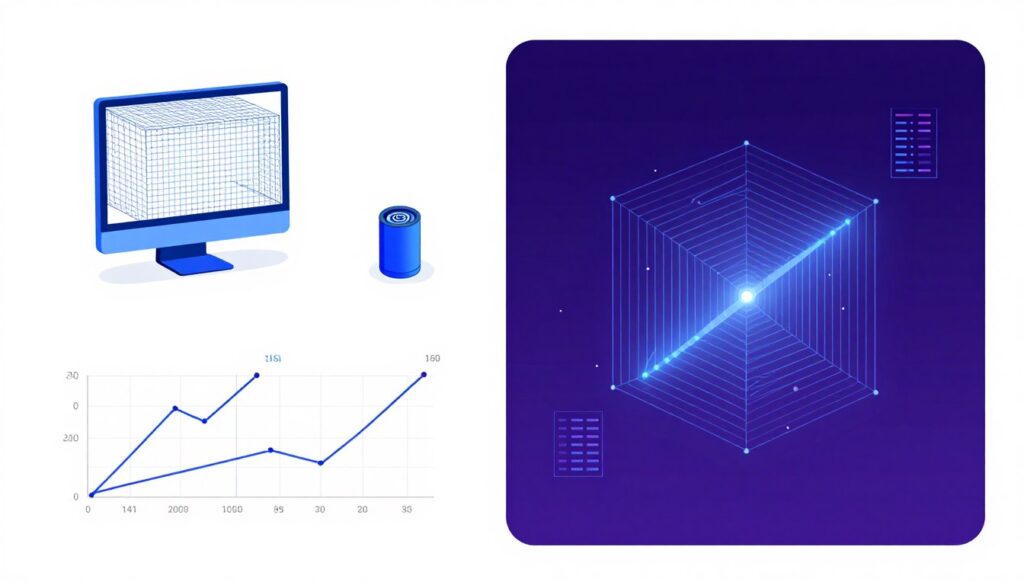
Comparing All Dimensions: A Comprehensive Overview
Understanding how dimensions build upon each other clarifies the nature of space itself. Each dimension adds a new degree of freedom and expands possibilities for form and movement.
| Dimension | Coordinates Needed | Freedom of Movement | Geometric Measure | Example Objects |
| First (1D) | One (x) | Forward or backward only | Length | Lines, number axes |
| Second (2D) | Two (x, y) | Forward, backward, left, right | Area | Squares, circles, flat shapes |
| Third (3D) | Three (x, y, z) | All spatial directions | Volume | Cubes, spheres, all physical objects |
| Fourth (4D) | Four (x, y, z, t or w) | Spatial plus temporal | Spacetime interval or hypervolume | Events in spacetime, tesseracts |

Dimensional Hierarchy
Each dimension contains all lower dimensions within it. A three-dimensional cube contains two-dimensional faces, one-dimensional edges, and zero-dimensional vertices.
This hierarchical structure appears throughout mathematics and nature. Understanding this progression helps us comprehend increasingly complex spatial concepts.
Lower Dimensions
- Simpler mathematical descriptions
- Easier to visualize completely
- Limited geometric possibilities
- Fewer degrees of freedom
- Restricted movement options
Higher Dimensions
- Complex mathematical structures
- Require abstract thinking
- Rich geometric diversity
- Greater freedom of movement
- More spatial relationships are possible
Real-World Applications of Dimensional Concepts
Dimensional thinking extends far beyond abstract mathematics. Scientists, engineers, and technologists apply dimensional concepts in practical ways daily.
Computer Graphics

Three-dimensional graphics engines use coordinate systems to render realistic images. Every pixel on your screen results from calculations in three-dimensional virtual space.
- Video game environments
- Animated films and special effects
- Architectural visualization
- Virtual reality experiences
Engineering Design

Engineers specify every component using precise dimensional measurements. CAD software models parts in three dimensions before physical manufacturing.
- Mechanical part specifications
- Structural building plans
- Circuit board layouts
- Product prototyping
Data Analysis

Data scientists work with datasets containing hundreds of dimensions. Each variable represents an additional dimension in mathematical analysis space.
- Machine learning algorithms
- Statistical pattern recognition
- Market trend analysis
- Scientific research data
Physics and Cosmology
Understanding dimensions proves essential for modern physics. From quantum mechanics to cosmology, dimensional frameworks shape our theories about reality.
Physicists use dimensional analysis to verify the validity of equations and derive relationships between physical quantities. This method ensures consistency across mathematical models.

Frequently Asked Questions About Dimensions
Can humans perceive the fourth dimension?
Humans cannot directly perceive a fourth spatial dimension. Our sensory organs and brain evolved to process three spatial dimensions. However, we perceive time as a fourth dimension through memory and anticipation. We can understand four-dimensional geometry mathematically and visualize projections, but direct perception remains impossible with current human biology.
Why do we live in three dimensions of space?
The reason our universe has three spatial dimensions remains an open question in physics. Some theories suggest that three dimensions provide optimal conditions for complex structures and life. Others propose that additional dimensions exist but remain compactified at scales too small to observe. Three dimensions allow stable orbits, complex chemistry, and the physical laws we observe.
What would life in two dimensions be like?
Life in a truly two-dimensional world would be dramatically different. Organisms could not have complex internal organs since there would be no “inside” separate from “outside” without cutting the organism into pieces. Digestion would be impossible as a complete digestive tract would split a two-dimensional being in half. Movement would be restricted to surface navigation only.
How do scientists study higher dimensions?
Scientists study higher dimensions through mathematics, computer simulations, and indirect observations. Mathematical equations precisely describe properties of higher-dimensional spaces. Particle physics experiments look for signs of extra dimensions through unusual particle behavior at high energies. Computer visualizations help researchers understand projections and cross-sections of higher-dimensional objects.
Is time really a dimension like space?
In Einstein’s theory of relativity, time functions as a dimension, similar to the spatial dimensions, but with important differences. Time has a preferred direction of flow, while space does not. The mathematics of spacetime treats time with an opposite sign compared to spatial coordinates. Despite these differences, space and time are intimately connected, and events require both spatial and temporal coordinates for complete description.
Understanding Our Dimensional Universe
The concept of dimensions provides a fundamental framework for understanding space, time, and reality. From the simple one-dimensional line to the complex four-dimensional spacetime, each dimension expands our comprehension of the universe.
We live in a three-dimensional spatial world where length, width, and height define every physical object. Time adds a fourth dimension, creating the spacetime continuum that Einstein revealed. Beyond these familiar dimensions, theoretical physics explores additional dimensions that might exist at scales beyond our current perception.
Understanding dimensions enables practical applications across science, engineering, and technology. Whether designing buildings, creating computer graphics, or analyzing complex data, dimensional thinking shapes how we solve problems and create new technologies.
The study of dimensions continues to evolve. As our mathematical tools improve and experimental techniques advance, we may discover new insights about the dimensional structure of our universe. Whether additional dimensions exist, how they influence physical laws, and what they mean for the ultimate nature of reality remain exciting frontiers of scientific exploration.
Source Links
- How Many Dimensions Does the Universe Really Have? | NOVA | PBS
- https://phys.org/news/2026-05-mathematicians-decades-mystery-hidden-high.html