Unraveling the Mystery of Dark Matter
Explore the enigmatic nature of Dark Matter, its role in shaping galaxies, and ongoing scientific efforts to detect this elusive cosmic substance.

Dark Matter is a mysterious part of our Universe that fascinates scientists and astronomers worldwide. It greatly affects the cosmos but is invisible and unlike the Matter we know.
Recently, scientists have made big strides in understanding dark Matter. They’ve used new research and advanced technologies. This article examines the latest findings and their implications for solving the secrets of dark Matter.
Key Notes
- Dark Matter is an invisible and mysterious part of our Universe, unlike ordinary Matter.
- Gravitational lensing and observations of gravitational effects on visible Matter provide key evidence for the existence of dark Matter.
- Particle physicists are searching for dark matter candidates, such as weakly interacting massive particles (WIMPs), beyond the Standard Model of particle physics.
- Dark Matter plays a crucial role in the formation and evolution of galaxies, acting as a gravitational scaffold.
- Dark Matter affects the cosmic expansion and the formation of large-scale structures in the Universe, interacting with dark energy.
What is Dark Matter?
Dark Matter is a mysterious substance that makes up a big part of the Universe. It’s invisible to us but pulls on visible objects with a strong gravity. This invisible force shapes galaxies and the Universe’s growth.
The Gravitational Influence of the Invisible
We can’t see dark Matter, but we know it’s there by how it affects visible Matter. Astronomers observe that galaxies and galaxy clusters move in ways that suggest more mass than can be directly observed.
Observational Evidence from Gravitational Lensing
Gravitational lensing is a key way to study dark Matter. It happens when dark Matter’s gravity bends light. Telescopes and imaging techniques help us see where dark Matter is. This shows us dark Matter’s effects on visible Matter that can’t be explained by known science.
Gravitational lensing lets us map dark Matter across the Universe. It shows how dark Matter shapes galaxies and galaxy clusters.
| Metric | Percentage |
|---|---|
| Dark Matter | 27% |
| Normal Matter | 5% |
| Dark energy | 68% |
The table shows the Universe’s makeup. Dark Matter, normal Matter, and dark energy make up most of it.
“Dark matter is the gravitational scaffold upon which our universe is built.”
This quote highlights dark Matter’s role in the Universe. It’s the unseen framework that holds up the visible Matter we see.
Particle Physics and Dark Matter Candidates
Particle physicists are searching for dark Matter beyond the Standard Model. Dark Matter makes up about 27% of the Universe. It’s thought to be composed of exotic particles that interact only weakly with regular Matter.
This has led to extensive research and experimentation. They aim to find these hidden particles and learn about their nature.
Exploring Beyond the Standard Model
Several theories, such as supersymmetry, suggest new particles as candidates for dark Matter. These particles, called weakly interacting massive particles (WIMPs), are top contenders. Labs like the Large Hadron Collider (LHC) are working hard to detect and study these particles.
Weakly Interacting Massive Particles (WIMPs)
WIMPs are predicted to interact with regular Matter through the weak nuclear force. This makes them very hard to find. They are expected to be much heavier than particles in the Standard Model, with masses from a few GeV to tens of TeV.
Experiments like the LHC aim to create and study these particles. The goal is to understand their properties and reveal the secrets of dark Matter.
| Dark Matter Candidates | Characteristics | Experimental Searches |
|---|---|---|
| Weakly Interacting Massive Particles (WIMPs) | Predicted to have masses ranging from a few GeV to tens of TeV, interacting through the weak nuclear force | Large Hadron Collider (LHC), underground particle detectors |
| Axions | Extremely light particles, proposed in the early 1970s, with a mass of a millionth of an electronvolt | Axion Dark Matter Experiment (ADMX), ABRACADABRA, HAYSTAC, CERN Axion Solar Telescope (CAST) |
The search for dark matter candidates, like WIMPs and axions, is key in particle physics and cosmology. These efforts aim to uncover the Universe’s secrets and understand the invisible Matter shaping our cosmos.

“Understanding dark matter is crucial to unraveling the mysteries of the universe’s origins and ultimate fate, as well as our own existence.”
Dark Matter’s Role in Galaxy Formation
Dark Matter is key to how galaxies form and grow. Observations and computer simulations show it acts like a gravitational framework. This framework helps Visible Matter grow and sound out.
By studying galaxy dynamics, scientists can infer the presence of dark Matter. This helps us understand its role in the structure and evolution of the Universe.
Dark Matter is a big part of our Universe, making up about 85 percent of all Matter. It’s more than five times the amount of ordinary Matter. This mysterious substance is crucial for understanding the Universe’s beginnings and growth. Research on dark Matter has led to many scientific and technological advancements
| Cosmic Epoch | Time After Big Bang | Key Observations |
|---|---|---|
| Cosmic Dark Ages | 380,000 years to 1 billion years | Cosmic microwave background radiation gives us a glimpse of the Universe. Dark matter halos hold galaxies and galaxy clusters together |
| Galaxy Formation | 470 million years to 13.4 billion years | Simulations based on the cold dark matter model fit well with observations. They show galaxies form in dark Matter’s high-density areas 10. |
The Rubin Observatory is a major research facility. It aims to map billions of galaxies in the Southern Hemisphere. This includes small galaxies that could reveal properties of dark Matter.
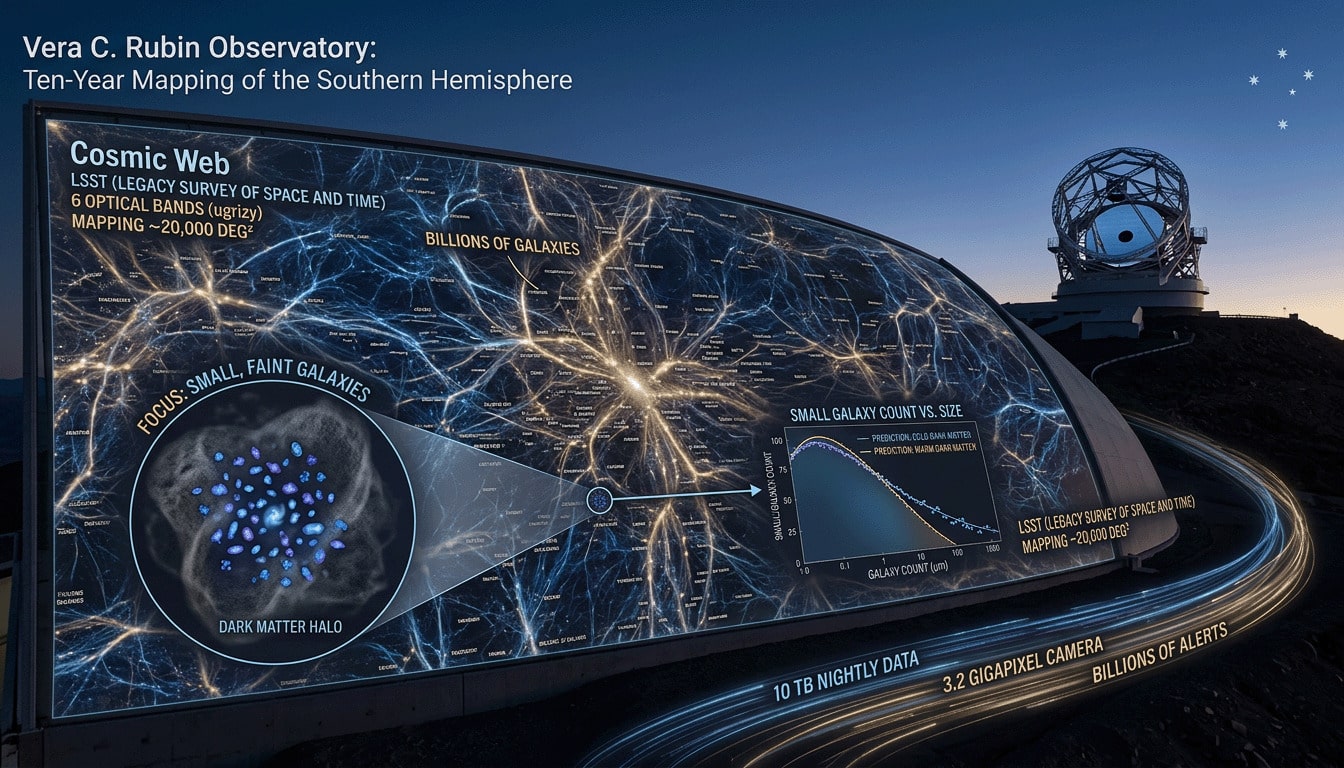
“Dark matter is a form of non-baryonic matter, crucial in shaping the structure formation of the universe.”
Researchers are still trying to figure out dark Matter. They use large, sensitive detectors underground to search for dark matter particles. They also look for cosmic rays and gamma rays to find indirect signs of dark Matter. These efforts are backed by the Department of Energy’s Office of Science High Energy Physics program.
Dark Matter and Cosmic Structures
Dark Matter is key to the formation and evolution of cosmic structures, such as galaxies and large-scale structures in the Universe. Studies show it acts as a gravitational scaffold. This helps visible Matter grow and spread out in space.
The Gravitational Scaffold of the Universe
Dark Matter makes up more than 85% of the Universe’s Matter, leading over visible Matter. Galaxy clusters, the biggest structures, have hundreds or thousands of galaxies. The Milky Way is about 100,000 light-years wide, and the Local Group, of which it’s part, is 10 million light-years wide.
The Local Supercluster, which includes the Local Group, is 110 million light-years wide. Cosmic voids, almost empty of galaxies, are 30 to 300 million light-years wide. The Cosmic Web’s filaments can stretch over several hundred million light-years.
Computer Simulations and Observations
Computer simulations and the mapping of the Cosmic Web have helped us understand dark Matter’s role 11. Since the 1980s, scientists have mapped the Cosmic Web in 3D using surveys like the Sloan Digital Sky Survey. The Cosmic Web is the biggest known pattern in our observable Universe, linking galaxy clusters together.
It started with early quantum fluctuations after the Big Bang, as seen in the Cosmic Microwave Background radiation.
Computer simulations and data have given us insights into the formation and evolution of cosmic structures. Galaxy and cluster distributions show a hierarchical pattern up to a certain scale, then become uniform. In the 1970s, visualizations showed galaxies forming chains and networks, with voids in between.
But large cosmic structures grow more slowly than Einstein’s Theory of General Relativity predicts. Dark energy’s effect on the growth of structure is stronger than expected. Exploring the properties of dark energy and dark Matter, or extending General Relativity, might help solve this mystery.
“Cosmic structures, including the Cosmic Web, arise from early quantum fluctuations in the universe shortly after the big bang, observed through the Cosmic Microwave Background radiation.”
| Key Insights | Implications |
|---|---|
| Dark Matter constitutes over 85% of the Matter in the Universe and acts as a gravitational scaffold for the formation and distribution of cosmic structures. | Understanding the role of dark Matter in shaping the large-scale structure of the Universe is crucial for unraveling the mysteries of galaxy formation and the evolution of the cosmos. |
| Computer simulations and observational mapping of the Cosmic Web have provided detailed insights into the hierarchical formation and distribution of cosmic structures. | Continued advancements in computational power and observational techniques will enable more accurate modeling and mapping of the Cosmic Web, shedding light on the fundamental nature of dark Matter and its influence on the Universe. |
| The observed rate of growth for large cosmic structures is slower than predicted by General Relativity, suggesting the need for further research into the properties of dark energy and dark Matter. | Investigating the anomaloth suppression of cosmological growth may lead to groundbreaking discoveries that could redefine our understanding of gravity and the evolution of the Universe. |
The Fate of the Universe and Dark Matter
The mysteries of dark Matter and dark energy are key to understanding our Universe’s future. Dark Matter makes up about 85% of the Universe’s material. It works with dark energy, which is 71.4% of the Universe today. Together, they shape how the Universe expands and forms large structures.
Dark Matter’s Interaction with Dark Energy
Scientists are studying how dark Matter’s gravity affects the expansion of the Universe. This study helps us determine whether the Universe will continue to expand or collapse. It’s a big mystery.
The Universe might be flat, with a balance of Matter and energy. But we only see 30% of this balance. Dark energy is thought to be the missing part, causing the Universe to expand faster.
| Component | Percentage of Universe |
|---|---|
| Dark Matter | 85% |
| Dark Energy | 71.4% |
| Baryonic Matter | 24% |
The Universe’s future depends on dark Matter and dark energy. If dark energy wins, the Universe will continue to expand. Stars and galaxies will move apart, and everything will fade away.
“The ultimate fate of the universe is still a matter of speculation, but the discovery of dark energy has profoundly changed our understanding of the universe’s evolution and its possible futures.”
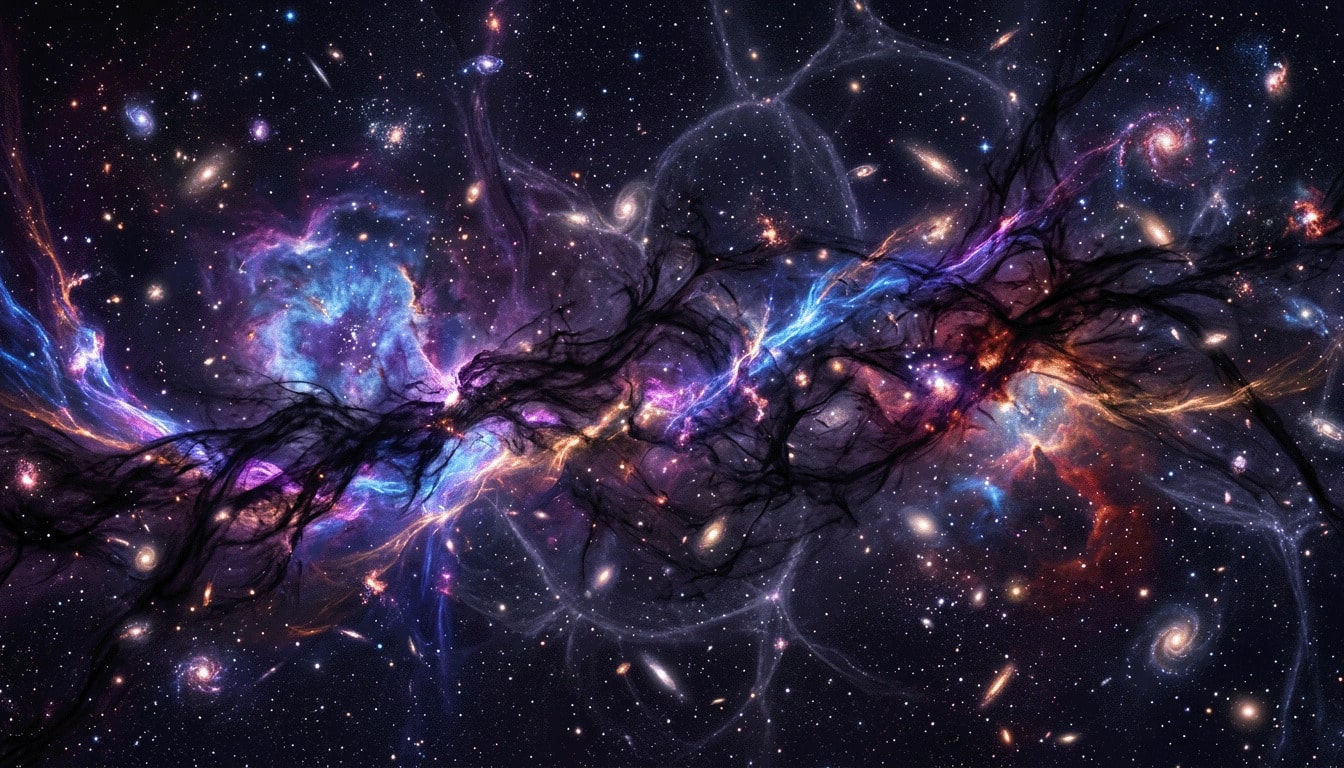
Researchers are learning more about dark Matter and dark energy. They hope to understand the future of our Universe better. More study and experiments are needed to solve these cosmic mysteries.
Experimental Searches for Dark Matter
Researchers are working hard to find dark Matter, a key part of our Universe. They are using many methods to detect these particles. One way is to build larger underground detectors in labs worldwide.
The LUX-ZEPLIN (LZ) team, with 38 institutions like the University of Michigan, is studying 280 days of data. They are looking for Weakly Interacting Massive Particles (WIMPs), a top dark matter candidate. They found no WIMPs above 9 GeV/c2, which is a big step forward.
At the same time, big particle accelerators like the Large Hadron Collider (LHC) in Geneva are trying to make dark matter particles. Also, observatories in far-off places are looking for signs of dark Matter in our galaxy.
Narrowing Down the Possibilities
Experiments like LZ help rule out some dark matter models. This leaves fewer places for these particles to be. The team aims to gather 1,000 days of data by 2028.
These searches, with hundreds of scientists worldwide, are key to understanding dark Matter. They help us learn how it shapes our Universe.

| Key Findings | Data |
|---|---|
| No evidence of WIMPs above 9 GeV/c2 | |
| LZ plans to collect 1,000 days of data by 2028 | |
| LZ is a collaboration of 250 scientists from 38 institutions. | |
| LZ uses 10 tonnes of liquid xenon for detection. |
As we keep searching for dark Matter, these efforts are expanding our knowledge. They are leading to discoveries that could change how we see our Universe.
The Axion: Another Dark Matter Candidate
Aside from Weakly Interacting Massive Particles (WIMPs), another intriguing candidate for dark Matter is the axion. Axions are believed to interact with magnetic fields and have been the focus of dedicated research for decades, much like their WIMP counterparts.
Despite extensive efforts, the search for axions has so far eluded detection, leaving the scientific community perplexed by their elusive nature as a potential dark matter component.
Axions are hypothesized to be incredibly light, with masses on the order of a millionth of a billionth of a proton’s mass. Unlike WIMPs, which behave more like individual particles, axions are thought to exhibit a wave-like behavior, with hundreds of billions of particles per cubic centimeter necessary to account for the same mass as dark Matter.
Experimental setups employing powerful magnets, such as the GrAHal experiment in Grenoble and the MadMax experiment, continue to search for axion signatures.
The recently launched Dark Matter Lab is also dedicated to exploring various detection methods for dark matter components, including axions. Additionally, researchers such as Francesca Calore at LAPTh are investigating axion-like particles indirectly using high-energy astrophysical data.
Despite these ongoing efforts, the hunt for axions as a dark matter candidate has yet to yield conclusive results. The scientific community remains intrigued by the potential of axions, as their detection could pave the way for a breakthrough in theoretical physics and offer new insights into the formation of galaxies and other cosmic phenomena.
| Axion Dark Matter Properties | Value |
|---|---|
| Estimated Mass | On the order of a millionth of a billionth of a proton’s mass |
| Estimated Density | Hundreds of billions of particles per cubic centimeter |
| Percentage of Total Dark Matter | Potentially ~0.1% |
| Experimental Detection Status | Ongoing, but no conclusive results yet |
“If axions are confirmed to be real, it would mark a breakthrough in theoretical physics and signal new physics beyond the Standard Model.”
The pursuit of axions as a dark matter candidate continues to captivate the scientific community, as their potential discovery could unlock new chapters in our understanding of the cosmos and the fundamental nature of reality.
Dark Matter and Gravitational Interactions
The search for dark matter particles such as WIMPs and axions has not yet found any solid evidence. Some theories suggest that dark Matter might interact with the Universe only through gravity. This idea of “gravitationally coupled dark matter” means these particles could be invisible to all but gravity.
If this is true, it would be a big challenge for scientists trying to understand dark Matter. Finding out what dark Matter is would become almost impossible. We would have to accept its presence without really knowing it.
This would force scientists to change how they do research. They would need to be more humble and open to new ideas.
Gravitational Interactions and Cosmic Implications
Gravitational waves, first found in 2015, could help us study dark Matter’s effects. Some theories suggest that ultra-light scalar-field matter could have produced gravitational waves early in the Universe’s life. These particles interact with normal Matter only through gravity.
Studying how dark Matter bends space through weak gravitational lensing is also important (25). This method shows how dark Matter affects distant galaxies. Future missions like Euclid and the Nancy Grace Roman Space Telescope will explore these phenomena further.
The idea of dark Matter interacting only through gravity is a tough concept for scientists. They must stay open and keep exploring new ways to understand it. This is the only way to uncover dark Matter’s true nature and its role in our Universe.
| Gravitational Waves | Dark Matter Detection Efforts |
|---|---|
| Detected for the first time in 2015 | The LUX-ZEPLIN (LZ) experiment involved an international team of 250 scientists and engineers from over 35 institutions. |
| Ultra-light scalar field matter can generate detectable gravitational waves shortly after the Big Bang. | Dark Matter is estimated to constitute about 85 percent of the total mass of the Universe. |
| These simple forms of Matter interact with regular Matter only through the feeble force of gravity. | The initial run of the LZ experiment encompassed 60 “live days” of testing over a three-and-a-half-month period. |
| Detection of gravitational waves from these simple forms of Matter may shed light on the mysterious composition of dark Matter. | LZ is designed to collect approximately 20 times more data in the future to study dark Matter further. |
“Embracing scientific humility and continuously exploring new avenues of research will be essential in navigating the complexities of this profound cosmic mystery.”
The search for dark Matter is ongoing, and scientists must stay open to new ideas. This guide on Alzheimer’s disease shows the value of humility and learning in science.
The Allure and Humility of Dark Matter
The mystery of dark Matter shows how much we still don’t know about the Universe. Despite all our efforts, the Universe still keeps its secrets. This shows the importance of being humble in science. We might keep guessing and trying new things, but the Universe follows its own rules, not ours.
The search for dark Matter is like a big drama in science. Simple answers often turn into complex ones. Scientists think dark Matter exists because astrophysics and particle physics show. But, there are still many things we don’t know about dark Matter, keeping scientists curious and humble.
The mystery of dark Matter is what makes it so fascinating. Learning and trying new things are key to this journey. By diving into this mystery, we can learn more about the Universe and its forces.
“The universe is not only queerer than we suppose, but queerer than we can suppose.” – J.B.S. Haldane
As we explore dark Matter, we must be open to new ideas. The journey of science is humbling, with each discovery leading to more questions. By staying curious and humble, we can keep pushing our understanding of the Universe.
| Characteristic | Dark Matter | Ordinary Matter |
|---|---|---|
| Composition | Unknown, possibly consisting of undiscovered subatomic particles | Familiar elements and compounds found on Earth |
| Interaction | Interacts gravitationally but not electromagnetically | Interacts through all four fundamental forces (gravity, electromagnetism, strong nuclear, weak nuclear) |
| Abundance | Approximately 85% of the total mass-energy content of the Universe | Approximately 15% of the total mass-energy content of the Universe |
| Detection | Elusive, requiring advanced experimental techniques and technology | Easily detected and studied through electromagnetic radiation |
The search for dark Matter is a thrilling journey in science. It shows the intellectual drama and scientific humility in our quest to understand the Universe. As we continue to explore, we must embrace both the simple and complex mysteries.
Continuous Learning and Adaptive Approaches
The search for knowledge never stops. It requires new ideas and never-ending questions. Just like dark Matter pushes us to think differently, learning in science needs flexible and critical methods. Brilliant.org is a great example. It makes learning fun and easy, covering everything from basic problems to quantum mechanics.
New ways of learning and thinking are changing science. Methods such as adaptive memory replay and prompt tuning help models learn new things without forgetting old ones. These methods are great for educational platforms, too. They make learning personal and can help more students succeed at a lower cost.
Exploring the Universe requires us to keep learning and adapting. By using adaptive thinking and new educational platforms, we can create a world where everyone keeps learning. This way, we can face the world’s challenges with confidence and curiosity.
“The most exciting phrase to hear in science, the one that heralds new discoveries, is not ‘Eureka!’ but ‘That’s funny…'”
– Isaac Asimov, renowned science fiction author and biochemist
As we uncover the secrets of dark Matter, we must keep learning and thinking adaptively. With the help of educational platforms and new learning methods, we can explore new areas of knowledge. This will inspire the next generation of scientists.
Conclusion
The search for dark Matter is a big part of science. It’s a journey filled with challenges and curiosity. We know only 4% of mass-energy is normal Matter, and dark Matter makes up 22%-32%. But, we still don’t know what dark Matter is.
As we explore the Universe, we find our current models don’t fully explain it. A new theory challenges our old views on dark Matter. It could change how we see the Universe’s forces.
Despite the challenges, scientists keep pushing forward. Advances in physics and astronomy might help us solve these mysteries. This journey shows our endless quest to understand the world around us.
True progress in science isn’t about having all the answers. It’s about always trying to learn more. Dark Matter might be hard to find, but our search will deepen our understanding of the Universe.
FAQ
What is dark Matter?
How do scientists study dark Matter?
What is the role of dark Matter in galaxy formation?
How does dark Matter relate to the fate of the Universe?
What are the current experimental efforts to detect dark Matter?
Why is the nature of dark Matter so elusive?
What is the significance of the dark matter enigma?
Source Links
- Dark Matter – https://home.cern/science/physics/dark-matter
- Dark Matter – https://en.wikipedia.org/wiki/Dark_matter
- How dark Matter became a particle – CERN Courier – https://cerncourier.com/a/how-dark-matter-became-a-particle/
- PDF – https://pdg.lbl.gov/2023/reviews/rpp2022-rev-dark-matter.pdf
- The other dark matter candidate – https://www.symmetrymagazine.org/article/the-other-dark-matter-candidate?language_content_entity=und
- DOE Explains…Dark Matter – https://www.energy.gov/science/doe-explainsdark-matter
- Role of dark Matter in structure formation | Cosmology Class Notes | Fiveable – https://library.fiveable.me/cosmology/unit-7/role-dark-matter-structure-formation/study-guide/gbjhwzy2YXAHdAgZ
- Simulations show dark Matter’s role in galaxy formation – https://chronicle.uchicago.edu/060713/darkmatter.shtml
- Dark Matter – Jaan Einasto – https://ned.ipac.caltech.edu/level5/Sept09/Einasto/Einasto5.html
- The Universe caught suppressing cosmic structure growth – https://news.umich.edu/the-universe-caught-suppressing-cosmic-structure-growth/
- The Dark Universe – https://chandra.harvard.edu/darkuniverse/
- Topical: Dark Energy, Dark Matter and Fate of the Universe – https://smd-cms.nasa.gov/wp-content/uploads/2023/05/45_f574b6e6d08f1677749e70942283043a_LiyanagePathmaA.pdf
- Why physicists now question the fate of the Universe – https://bigthink.com/starts-with-a-bang/physicists-question-fate-universe/
- LZ experiment sets new record in search for dark Matter – https://news.umich.edu/lz-experiment-sets-new-record-in-search-for-dark-matter/
- LZ Experiment Sets New Record in Search for Dark Matter – https://newscenter.lbl.gov/2024/08/26/lz-experiment-sets-new-record-in-search-for-dark-matter/
- International experiment sees new results in search for dark matter | Penn State University – https://www.psu.edu/news/eberly-college-science/story/international-experiment-sees-new-results-search-dark-matter
- Dark Matter: time for axion – https://news.cnrs.fr/articles/dark-matter-time-for-axion
- The compelling case for axions as our dark Matter – https://bigthink.com/starts-with-a-bang/axions-dark-matter-493004/
- Is Dark Matter Made of Axions? – https://www.scientificamerican.com/article/is-dark-matter-made-of-axions/
- Institute for Gravitation and the Cosmos – https://igc.psu.edu/topics/dark_matter/
- Gravitational waves hint at dark Matter and Big Bang mysteries – https://insideucr.ucr.edu/stories/2024/06/13/gravitational-waves-hint-dark-matter-and-big-bang-mysteries
- NASA Scientists Help Probe Dark Energy by Testing Gravity – http://www.jpl.nasa.gov/news/nasa-scientists-help-probe-dark-energy-by-testing-gravity/
- Waning Dark Energy May Evade ‘Swampland’ of Impossible Universes | Quanta Magazine – https://www.quantamagazine.org/waning-dark-energy-may-evade-swampland-of-impossible-universes-20240819/
- Dark Matter (2011) by Gregory Sholette & the Emergence of Humanity’s Evolving Spirit | CG FEWSTON – https://cgfewston.me/2014/12/09/dark-matter-2011-by-gregory-sholette-the-emergence-of-humanitys-evolving-spirit/
- The Dark Allure of Idealism – https://www.philosophytalk.org/blog/dark-allure-idealism
- Adaptive Memory Replay for Continual Learning – https://arxiv.org/html/2404.12526v1
- What Is Adaptive Learning and How Does It Work to Promote Equity In Higher Education? – Every Learner Everywhere – https://www.everylearnereverywhere.org/blog/what-is-adaptive-learning-and-how-does-it-work-to-promote-equity-in-higher-education/
- 07. Discussion and Conclusions – https://arachnoid.com/dark_energy/conclusions.html
- What is Dark Matter and Dark Energy, and What is Their Difference? – https://medium.com/@koza.kurumlu/what-is-dark-matter-and-dark-energy-and-their-difference-a6654c4b753f
- Dark Matter Doesn’t Exist | Pavel Kroupa – https://iai.tv/articles/dark-matter-doesnt-exist-auid-2180