Republican Primary Vote for Indiana Results and Updates
Stay updated on the Republican primary vote for Indiana, including results, candidate profiles, and essential election news for voters.

The Republican primary vote in Indiana is showing fast results that go beyond election night. This live update track covers key races, late counts, and what the Indiana primary vote results mean for the party’s future.
The main story from the May 5 indiana republican primary election is clear: Republican voters ousted at least five GOP state senators. This happened after a tense fight over congressional redistricting. The defeats changed the Senate’s power map and showed who has power in the party. See more politics: Virginia State Senate Corruption Probe.
In Indiana election news, the effects extend beyond Indianapolis. The results warn Republican leaders across the country. They show that opposing Donald Trump can lead to quick consequences in a primary, even for long-time incumbents.
As more Indiana primary vote results come in, the stakes get higher. They are about checks and balances and the next map fights. For those following the Republican primary in Indiana, these results may also accelerate the national effort to redraw congressional districts before the midterm elections. In Texas midterms, polls show Democrats leading in the Senate Race.
Republican Primary Vote: Key Notes
- The Republican primary vote in Indiana is reshaping the state GOP’s internal power balance.
- At least five GOP state senators lost after a redistricting standoff.
- The indiana republican primary election results carry national lessons about party discipline.
- Donald Trump’s influence remains a major factor in Republican primary dynamics.
- The Indiana primary vote results could weaken political guardrails meant to curb presidential overreach.
- Indiana election news may foreshadow a broader push to gerrymander congressional maps ahead of midterms.
Indiana primary vote results and updates: targeted GOP state senators unseated after redistricting standoff
The Indiana primary election shook things up beyond the Statehouse. For many, it was about who gets to make the rules, not just who to vote for. Results from the Indiana Key primary elections.
In the Indiana Republican Party, local races felt national. They were about maps, representation, and party loyalty.
What happened on May 5 in the Indiana Republican primary election
On May 5, voters in Indiana’s Republican primary threw out at least five GOP state senators. They had refused to follow Donald Trump’s lead on redistricting. One race was too close to call.
Only one Republican incumbent targeted by Trump made it through. This shows how much his influence mattered. The results changed the field for November and shifted the caucus balance.
Candidates running against incumbents kept their messages simple. They either supported Trump’s redistricting demands or faced a well-funded challenge. This made legislative contests must-watch events.
Why these Indiana Republican Party races drew national attention
These races were not just about budgets or roads. They were seen as a battle over loyalty to Trump versus following the Constitution. This drew in donors, strategists, and media from across the country.
For GOP members of Congress and other Republican lawmakers, the lesson was clear. Defying Trump was seen as the path to defeat within the Indiana Republican Party.
The Indiana primary election tested how fast party incentives change when a president targets lawmakers. Even small districts can send a strong signal in this environment.
Key context: guardrails, checks and balances, and Trump’s influence
The conflict started on Dec. 11, 2025, in Indianapolis. The Indiana Senate, dominated by conservative Republicans, rejected Trump’s demand to redraw maps. Supporters saw it as a stand for process, while critics called it disloyalty.
Trump quickly responded with anger and a promise to punish those who opposed him. By May 5, 2026, his influence was clear in the Indiana primary vote results.
The debate was about more than just the election. It was about the need for guardrails to control Trump’s impulses. Checks and balances only work if everyone respects them.
When targeted senators lost, it was not just about them. It raised questions about future Indiana primary candidates. Will they risk dissent when faced with high-pressure situations?
Republican primary vote for Indiana: candidates, election news, and the redistricting ripple effect
The Republican primary vote in Indiana was part of a bigger fight. It was not just about who won. It was about the arguments, alliances, and what it means for future power struggles.
As election news in Indiana continues, the focus is on the messages, leverage, and map lines shaping the competition.
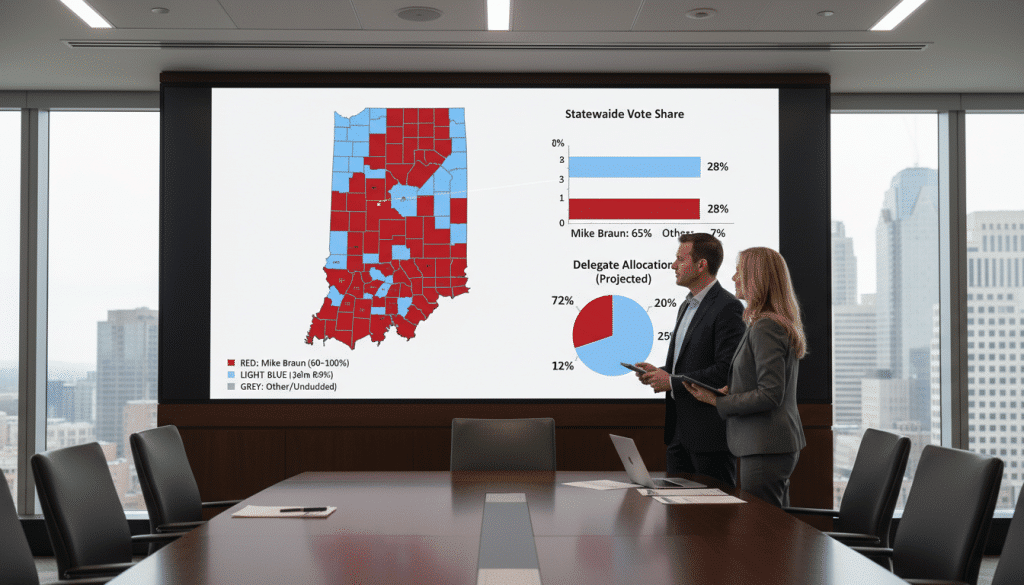
Indiana election news behind the Indiana primary candidates’ messaging
This cycle, redistricting became a big theme in campaign talk. Some incumbents were targeted for putting constitutional limits on Donald Trump’s map redo push. Challengers focused on party loyalty and pro-Trump cues.
This dynamic made the primary a tool for enforcing party lines. It showed which coalitions are rewarded in Republican races. It also showed which choices can lead to backlash from within the party.
How the Indiana primary election connects to congressional map fights nationwide
Indiana’s dispute is part of a national fight over congressional boundaries. This is ahead of the midterm elections, when Republicans have a thin lead in the U.S. House. The constitutional rule is clear: redistricting happens every 10 years after the census, not on demand.
Despite this, GOP lawmakers in Florida, Missouri, North Carolina, Ohio, and Texas have redrawn districts. This could help Republicans flip 13 Democratic-held seats in November. Other Republican-led states, like South Carolina and Tennessee, are also considering map changes.
Democrats have made moves, too. California and Virginia adopted gerrymandered maps that could help Democrats pick up nine seats. Plus, one seat in Utah due to court-ordered redistricting.
What the results suggest about gerrymandering incentives after the Indiana primary election
The May 5 outcomes put more pressure on both parties to push district lines beyond what is fair. When lawmakers who resist map-rigging can be removed by their own party’s voters, it weakens checks. This makes aggressive redistricting safer for politicians.
This approach hurts ordinary Americans. It can also erode trust in elections. Even if institutions last longer than any single presidency or election year.
How to vote in the Indiana primary: Indiana voting process basics for readers following updates
Readers following the results often want to know how to vote in the Indiana primary. They should confirm eligibility and check where to vote. Precinct locations and hours can vary.
The voting process also includes reviewing the ballot before voting. Many voters look up the races in advance. This way, they can focus on the contests and candidates that matter most to them.
- Confirm eligibility and any applicable registration rules.
- Find the correct polling place and verify voting hours.
- Check acceptable ID requirements, if needed.
- Review the Indiana primary ballot so the choices are clear before Election Day.
Republican Primary Vote: Conclusion
The Indiana primary vote results sent a clear message to the party. At least five GOP state senators lost after opposing Donald Trump’s redistricting push. Another race was too close to call, and only one incumbent managed to hold on.
This fight over maps became the main issue in the Republican primary vote. The outcome has big implications beyond Indianapolis. It showed how fast a GOP primary can punish those who disagree with Trump.
For Republicans in Congress and statehouses, the message is clear: loyalty is more important than internal checks. The Indiana primary vote turned a policy debate into a test of survival.
The impact of this election also fuels a wider redistricting battle. If map power can be enforced through primaries, both parties will push harder for an advantage. This is already happening in states like Florida, Missouri, and Texas.
The Indiana primary election added fuel to a national cycle that rarely cools down. It highlights the importance of checks and balances. The Indiana primary vote results showed how quickly these safeguards can erode when party control is prioritized.
What happened in Indiana will echo in future redistricting fights. It’s a reminder of the importance of defending our system of checks and balances.